
Disturbances on the GM front
If you want to know what’s really happening in the world of food and nutrition, the business pages are a good starting place. Today’s New York Times business section documents the “stunning” rise in the price of soybean seeds (up 108% since 2001) and corn seeds (up 135%).
Why care? Genetically modified (GM) varieties are now the majority – and increasingly the vast majority – of crops planted in the United States. The seeds are patented. Farmers cannot harvest and save them. Farmers must buy new patented seeds every year. And since one company – Monsanto – owns most of the patents, it gets to set the price.
USDA keeps track of the rise in use of GM crops. Impressive, no?
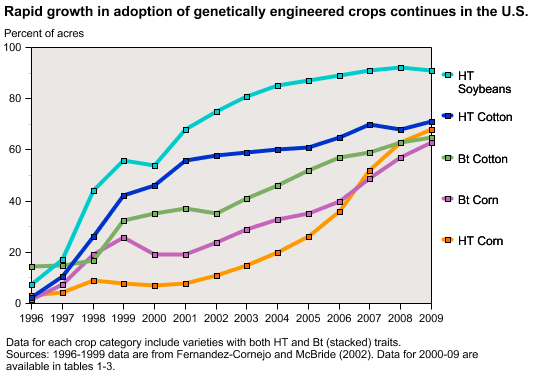
The USDA does not track GM sugar beets on this chart, but should. Monsanto also patents GM sugar beets. The USDA approved Monsanto’s sugar beets in 2005. By 2009, 95% of U.S. sugar beets were grown from Monsanto’s patented varieties.
Oops. When it approved the beets, the USDA let them be planted without the required environmental impact statement (EIS). Advocacy groups argued that the beets should not be planted without that assessment. A judge agreed and blocked further plantings. The judge is still sitting on the case. Until he rules, no GM sugar beets can be planted.
We have a similar situation with GM alfalfa. This crop was also approved in 2005 without an EIS and also was taken to court and banned. But now the EIS is done and the USDA has found “no safety concerns.” Perhaps GM alfalfa will be added to the chart next year?
What are we to make of this? Is it a good idea for one company to own most of the seeds planted in the United States? Especially when that company is permitted to enforce its own patent protection and to set its own prices?
The great promise of food biotechnology is that it will feed a hungry planet. Is this the best way to met world food needs? Whatever you think of GM foods, these questions are worth pondering.



Comments
The whole issue surrounding GM seeds is not about increased yields and feeding the world, as the spinmeisters might have you believe. It is about control of the world’s agriculture – period!
Unfortunately, the quest for profit over prosperity and free will has poisoned humankind…
I don’t know if you caught this bit from Morning Edition, but it’s relevant.
http://www.npr.org/templates/story/story.php?storyId=124604147
“Administration Turns Eye Toward Big Agribusiness”
Argh, hit submit too soon. What I was going to post afterwards is that the report is looking at this more from a monopoly/price-and-market control aspect than at anything specifically to do with GM seeds, but it’s tied into your second paragraph.
I am a farmer. I benefit each season from the research and investment that went into GM seeds. Whenever I hear or read about the seed saving debate, I am left with this question: How do we encourage innovation in any industry if we don’t reward for it?
Amy, I have the same question. The misdirected energy from animosity toward large corporations should be channeled into support for public funding for research into sustainable food and agricultural research. President Lincoln had the vision to create the land-grant college system because he recognized that public funding was needed to provide the research and teaching that would foster individual success. We need a new global land grant approach. Being against corporations won’t do it. We have to be for something.
@Neal – I think Lincoln’s “vision” has long since been blurred. I like your thought, but I just wonder where funding will come from when we have large lobbies and corporate ‘citizens’ entrenched in our government who dictate what funding goes where and to what purpose. Does your comment “research and teaching that would foster individual success” mean that one who attends a land-grant school in agriculture or food science, or other will be “successful” in earning a future paycheck for making products and innovation that feeds back into the corporate agribusiness profitability… These land-grant schools and state ag programs are set up to staff and support large corporate initiatives in the end. Our educational system for the most part is a network of corporate prep-schools, no longer turning out independent thinkers & game-changers, but teams of YES men and women.
I think GM is still far from being save and it is a shame how the will of the people is ignored.
In Germany most people are sure that they don’t want to eat GM food but still do so via the consumption of conventionally produced meat, eggs and diary products. Mostly without even knowing it because in Europe there is no law that requires a declaration that tells if the livestock was fed with GMOs or not. The only way to avoid GM is by strictly buying the way more expensive organic food. Many people can’t afford to buy only organic produce, so they are more or less forced to eat the GM stuff if they do not want to go vegan.
The other side of the story – that only a very few companies control nearly all of the seeds used on earth is even more frightening.
This should not be possible and I think a big international movement is needed to chance/reverse this fatal development. These criminals even tried to patent certain genomes in pigs. To me this seems to be a new form of slavery.
There should be more farmers like Joel Salatin practicing a new and more holistic way of farming in balance with nature, building up the soil, resolarising agriculture and cultivating biodiversity rather than using Round Up Ready Seeds in gigantic monocultures and signing dubious contracts with the industry.
I used to be very anti GM seeds, but since I read “Tomorrow’s Table” by Pamela Ronald and Raoul Adamchak, I’ve started to see the ways that GM crops and organic farming can help the agriculture industry in the United States (by making pesticides less necessary, allowing seedlings to withstand harsher conditions, etc.)…the caveat is that having every seed be owned by Monsanto is not a good solution; however, I don’t think that the research should be halted.
Something I learned from Ronald’s book is that creating GM seeds is not that weird – if anything it’s just a faster version of what farmers have been doing for thousands of years. I highly recommend the book for an academic perspective on GM crops, rather than a market driven one.
@Samantha
What about the thousands and thousands of ruined cotton farmers in India who committed suicide because neither the promise to have bigger yields nor the other, that they would have to use less pesticides where true? What about Percy Schmeissers story, what about the rapidly rising costs for seeds the farmers all over the planet have to pay year after year… what about crossbreeding, what about the world wide dying of the bees which could be linked to GMOs and/or large monocultures?
And by the way, to put fish genes into vegies IS weird. I wonder if that would be possible by conventional breeding…
@Samantha: GM crops aren’t actually taking pesticides out of the system; the pesticides grow in the plants! So, yes, the spraying part isn’t there, but we haven’t done away with any of the real concerns about pesticides: what they’re doing to the planet and those of us who live on it.
@Samantha, there is no comparison between GM and organic. As Emily says, multiple pesticides are spliced into each GM plant. When the FDA approved GM foods, it ignored the safety concerns of its own scientists. Here’e Byron Richard’s take on the subject:
Health Scandal of the Decade – Monsanto’s GMO Perversion of Food:
http://www.wellnessresources.com/freedom/articles/health_scandal_of_the_decade_monsantos_gmo_perversion_of_food/
How timely… Ira Flatow’s Science Friday on NPR is discussing this right now.
Social comments and analytics for this post…
This post was mentioned on Twitter by nyusteinhardt: Disturbances on the GM front http://ff.im/-honlK...
There’s evil, and then there’s Monsanto evil, and that’s a whole ‘nother level of evil.
@Amy: Can you discuss how you benefit from GM research? (This question is asked in earnest, in the interest of a fair dialogue).
@Subvert: I go to a land-grant school, as a student of nutrition in a Family and Consumer Science degree program. I promise you, our professors encourage free-thinking, and science-based practice. What the science shows is that GM may not be the answer for us, as this blog often shows.
@Amy & Neal: I am definitely FOR farmer’s. Real, American, shake-my-hand, nice-to-meet-you, farmer’s. I would love to see our social/economic climate shift to support our small farms, where diversity and sustainable methods ARE fostering research and teaching and individual success. I know plenty of folks like to harp on the negative, but a lot of us do work towards the positive, too!!
What is the remaining patent life for the seeds? Playing god should have a time limit.
Let’s not forget that many of the GM crops are roundup ready, which allows farmers to use more pesticide rather than less.
Did anyone EVER read this
http://www.gnhealth.com/articles/pdf/HungerforLand.pdf
There is a movie “The War on Soy” done by Spain unfortunately is in Spanish. If anyone watch the movie and does not see the direct relationship of congenital diseases in third world countries children and GM crops, it is because is blind, selfish or just don´t have a heart.
Everyone is worry about THEIR economy but blood dollars will never take us anywhere
Why Grow Genetically Modified Foods? You may have heard the FDA and food industry claims that genetically modified foods are safe and properly tested. They will tell you that genetically modified crops are needed to feed the increasing population or to survive the frequent droughts and floods brought on by climate change — but they’re not. They’re really designed to sell more of Monsanto’s patented Roundup-resistant seeds and pesticides, and take control of the global food supply.
A 2009 study showed that, over the last 13 years, Roundup Ready crops have increased herbicide use by 383 million pounds. In addition, once GM crops are planted in the open environment, they contaminate non-GM and organic varieties, as the seeds are spread by wind and foraging animals.
For the ones who don’t know it already – one of the best documentations about GMOs, Monsanto etc.:
The World According to Monsanto
http://www.youtube.com/watch?v=fvGddgHRQyg&playnext_from=TL&videos=im3xtj5uqT0&playnext=1
Really everybody should know about these frightening facts…
[...] Food Politics » Disturbances on the GM front GM exists so you can use herbicides without killing the crop. Monsanto sells you seed, then they sell you the herbicide that the seed is resistant to. It is under patent so you can't keep seed and replant it. You have to buy it each year. [...]
First seeds, now they are trying to patent pigs, meaning EVERY pig farmer across the planet would have to pay royalties to Monsanto, next?
How about cows. Then? From plants to animals to, you guessed it. Science fiction? It´s already here. There is more food on earth than ever before
What you all seem to be missing here is the plethora of GM technologies that are being developed from public funds and within public institutions. These publically developed GM crops are “public goods” and will be handed over to sovereign governments without license restrictions; drought tolerant maize for example and nutrient-rich rice, cassava and sorghum. These are public goods whose patents have been waved or no patents are assigned. By spreading the fear that corporations are taking over the food business you should take care that you are not actually creating barriers for the world’s poor to access modern agricultural technologies.
And, let’s not forget the dirty little secret that universities and small biotech companies are also in the business of protecting their patents – sometimes even more passionately than large corporations. Royalties often make up a larger proportion of these organization’s bread and butter since they are not in the business of benefiting from revenue generated from a commercial product.
This analysis is missing a few things, particularly, where is the part about supply and demand influencing price? “Globally, growth in soybean demand is double that of corn and huge compared to that for wheat…” driven in large part by China’s continued economic growth and subsequent desire to eat more protein. http://cornandsoybeandigest.com/soybeans/0101-soybean-demand-grows/
Also, the last line in the NY times’ article notes that generic seed is available, so don’t consumers (ie farmers) have choices?
I’m not saying there isn’t a concern here (I’m very wary of monopolies), but any critique that ignores basic economic theory and population growth is incomplete.
[...] Food Politics: Disturbances on the GM Front GM meaning “genetically modified,” not “General Motors.” [...]
[...] Food Politics: Disturbances on the GM Front GM meaning “genetically modified,” not “General Motors.” [...]
[...] Food Politics: Disturbances on the GM Front GM meaning “genetically modified,” not “General Motors.” [...]
[...] Food Politics: Disturbances on the GM Front GM meaning “genetically modified,” not “General Motors.” [...]
[...] Food Politics: Disturbances on the GM Front GM meaning “genetically modified,” not “General Motors.” [...]
[...] Food Politics: Disturbances on the GM Front GM meaning “genetically modified,” not “General Motors.” [...]

