Sep 4 2011

New school nutrition law takes youths’ health to heart

My monthly (first Sunday) Food Matters column in the San Francisco Chronicle:

Q: My kids are heading back to school, and I’m braced for another year of fighting about what they get for lunch. The school says there is a new law that makes things better. Will it? 

A: There is indeed a new law. Getting it implemented, however, will take some doing. With much fanfare, Congress passed the Healthy, Hunger-Free Kids Act of 2010. But unless your children attend one of the 1,250 schools that applied for and won an award from the U.S. Department of Agriculture’s HealthierUS Schools Challenge, they might graduate before seeing its benefits.

 That’s because the law has to be turned into regulations, an interminable process that has barely begun.

 Significant changes

But never mind the law’s odd title. It is meant to do good things. It increases school meal eligibility for low-income children. It encourages local farm-to-school networks and school gardens. It expands access to free drinking water in schools (yes, this is necessary in some places).

Most important, the law gives the USDA the right to set food standards for school meals.

Now the USDA can specify numbers and sizes of food servings, rather than nutrient percentages. This should make it easier for schools to serve foods, not food products, and offer more and larger servings of fruits, vegetables and whole grains.

The USDA can also apply these standards to all foods sold during school hours – breakfasts and lunches, but also “competitive” foods sold in vending machines, a la carte lunch lines and school stores. California is already doing this, but the new law takes it national.

As always, the devil is in the details. The USDA’s proposed rules for implementing the law take up 78 pages of microscopic type in the Federal Register. Because the USDA worried about the effects of the new rules on meal acceptance, participation rates, practicality and cost, it made some compromises.

Its standard for added salt seems generous, and it did not set one for added sugars. The USDA assumed that if other standards were followed, there would not be much room for sugary foods.

Except for milk. The USDA standards require milk to be low-fat but allow it to be flavored (translation: sugar-sweetened). Otherwise, the USDA says, children might not drink milk and will not get enough calcium.

Chalk this up to dairy lobbying. Schools account for more than 7 percent of total milk sales in the United States, but more than half of all flavored milk.

Lobbyists in motion

The proposed standards have set other lobbies in motion, too. One proposal is to encourage children to try new vegetables by restricting starchy vegetables – white potatoes, corn, green peas and lima beans – to one cup per week.

Makers of french fries and produce lobbying groups went to work, and 40 members of Congress have demanded reconsideration. The beef and poultry industries want the proposals to place more emphasis on high-quality, nutrient-rich proteins that offer all essential amino acids in a serving (neither protein nor amino acids are lacking in American diets).

The USDA’s proposals elicited more than 130,000 letters of comment, and the agency now has to deal with them. Officials say they have not even started on the rules for competitive foods.

The USDA must issue final rules by December 2013 and will undoubtedly give schools even more time to implement them. This gives lobbyists plenty of opportunity to create mischief.

Congress might backtrack. Under pressure to cut spending, the House of Representatives added a rider to its agriculture spending bill urging the USDA to scrap the proposals. The House must think the additional 6 cents per meal authorized by last year’s bill was overly generous.

Much is at stake here. School food matters because schools set an example. Schools that offer poor-quality food because it is cheaper are telling children that what they eat is not important. If a school promotes sales of sodas and snacks, it reinforces the idea that children are supposed to be eating junk foods.

Effects on learning

I have much sympathy for what school food professionals are up against, financially and bureaucratically. Nevertheless, I’ve visited plenty of schools – even in low-income communities – where children are served grown-up food, eat it happily and are eager try new tastes.

Successful school food makes the political personal. The cooks cook. They know the students’ names. They make it clear that they care about what the kids eat. They are invariably backed up by a principal committed to the belief that what kids eat affects their health and learning.

The USDA is trying to make it easier for schools to serve healthier meals. Write your congressional representatives to support the proposed school food standards.

Marion Nestle is the author of “Food Politics” and “What to Eat,” among other books, and is a professor in the nutrition, food studies and public health department at New York University. E-mail comments to food@sfchronicle.com.  This article appeared on page G – 4 of the San Francisco Chronicle, September 4, 2011.

Sep 3 2011

Once again: policy on comments

In response to readers’ requests, I have been monitoring comments and deleting those in three categories: (a) pornographic, (b) vulgar, and (c) personal rather than focused on the issues under discussion.

To expand on (c): I welcome comments on any aspect of issues related to food politics, regardless of whether I do or do not agree with the positions expressed.

I am deleting comments that focus exclusively on the personal.  

For example,  I am deleting comments like ”she only posts comments that agree with her position.”  Comments like this are not only false, but add nothing to the discussion of the issues.

I very much regret having to do this.

Sep 2 2011

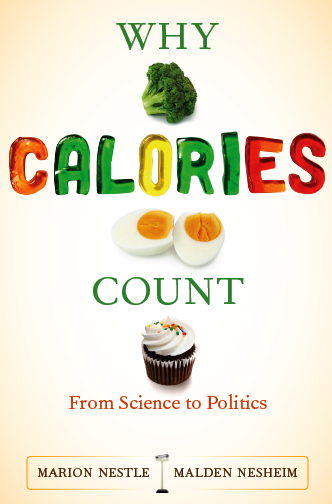
Sneak preview: the (forthcoming) calorie book has a cover!

Here’s what it’s likely to look like, courtesy of the designer, Lia Tjandra, and University of California Press.


Publication is still  a long way off—it’s scheduled for March 2012.  I will post occasional progress reports.  Stay tuned! 

Sep 1 2011

Obesity research and commentary: today’s roundup

My mailbox is overflowing with new reports and commentary about obesity.  Here are some examples:

State medical expenses: The journal, Obesity, has an analysis of the cost of obesity to states.  Obesity costs states an additional 7 to 11% in medical expenses. Between 22% (Virginia) and 55% (Rhode Island) of state costs of obesity are paid by taxpayers through Medicare and Medicaid.

Robert Wood Johnson Foundation series on preventing childhood obesity: 

From the Campaign to End Obesity:

Obesity Rates Projected to Soar, ABC News, 8.25.11Will half the U.S. population be obese by 2030? The current trajectory would see 65 million more obese adults, raising the national total to 164 million. Roughly one-third of the U.S. population is currently obese.

In U.S., Obesity Rates Remain Higher Than 20% in All States, Gallup, 8.25.11: Colorado continues to be the state with the lowest obesity rate in the country, at 20.1% in the first half of 2011. West Virginia has the highest obesity rate in January through June 2011, at 34.3%, which is also the highest Gallup has measured for any state since it began tracking obesity rates in 2008.

Reversing the obesity epidemic will take time, LA Times, 8.26.11The old rule that cutting out or burning 500 calories a day will result in a steady, 1-pound-per-week weight loss doesn’t reflect real people, researchers say. For the typical overweight adult, every 10-calorie-per-day reduction will result in the loss of about 1 pound over three years.

I’ve commented on some of these in previous posts.  If you find the avalanche of studies overwhelming, you are in good company.  I do too, but will summarize my take on the literature in my forthcoming book with Malden Nesheim, Why Calories Count: From Science to Politics, due out from University of California Press in March 2012.  Stay tuned.

Page 3 of 3123