Currently browsing posts about: EFSA(European Food Safety Authority)

Nov 4 2009

Europe rejects droves of health claims

In what the functional food industry refers to as a “bad day at the office,” the European Food Standards Agency (EFSA) rejected hundreds of health claims, particularly those for probiotics.  More recently, it rejected a claim that glucosamine prevents cartilege degeneration.  Hard as it may be for the food and supplement industries to believe, EFSA just can’t find scientific evidence to support those claims.

A representative of the company that applied for the glucosamine claims says his company now anticipates a loss in product sales, and complains that it had “invested quite heavily in this submission, in terms of effort and financial outlay.”

Too bad.

Why can’t they come up with the science to support those claims? For one thing, who would want to do the research?  Danone and Yakult have just announced two $50,000 grants to study probiotics.  This won’t go far and the sponsorship is an almost certain guarantee that the results will be just what the companies paid for.

Independent research is much more complicated.  Consider folic acid, for example.  The latest clinical trial of folic acid and colon cancer went to a lot of trouble to prove that folic acid supplements are harmless.  In most people, they have no effect on colon cancer, neither benefit nor risk.  Among the few people who had unusually low levels of the vitamin in their blood, the supplements appeared to have some protective effect.  You can interpret results like this either as evidence for no benefit or as evidence that folic acid supplements might benefit some people under some circumstances.

And that brings us to supplements again.  A trade association for supplement manufacturers says:

While it cannot be denied the food and supplement industry has entertained its fair share of cowboys, our concern is that the [EFSA] regulation goes so far as to throw the baby out with the bathwater. At the very point in time when consumers need most information to help them make the right food and supplement choices to help them offset largely preventable chronic diseases, we see the industry being gagged.

“Cowboys” are indeed a problem, and one well known to the American supplement industry. Says the head of the Council for Responsible Nutrition, the euphemistically named supplement trade association:

Fifteen years ago, our biggest threat was an over-reaching FDA….More recently, the problem has been an FDA that’s under funded and lacks the political will to do what it needs to do. And as a result today, many of the problems that burden the dietary supplement industry are ones that come from within the industry itself from that lack of oversight….Companies… intentionally – or inadvertently – put prescription drugs or anabolic steroids into their products and call them dietary supplements; products that just don’t do what they claim.  Also some companies practice economically motivated adulteration, passing off shoddy products as something more than they are … and ignore the new GMP requirements in hopes that they will fall under the radar screen.

Perhaps in response, the Boston Globe says we should repeal the 1994 law that deregulated dietary supplements and give the FDA some regulatory teeth.  Good idea.

Please forgive my endless repetition of this mantra: health claims are about marketing, not health.

Apr 16 2009

Europe demands scientific support for health claims. Why can’t we?

The European Food Safety Authority (EFSA) has just rejected a proposal from Merck to allow it to use a health claim stating that omega-3 supplements promote  eye and brain health in infants.  Merck wants moms to take omega-3 supplements during pregnancy and give such supplements to their infants.  EFSA reviewed nearly 90 studies on this topic and concluded that the study results were not “informative.”    In other words, they showed no benefit.  Imagine.  The EFSA demands scientific substantiation of health claims.  I wish we could do that.

Here’s another example from the pomegranate folks.  They do brilliant advertising, but this time the British are complaining that these marketers went too far when they posted billboards stating that pomegranate (“antioxidant powerhouse”) juice will help you cheat death.  The British advertising standards agency balked.  Here too, pesky science gets in the way.  Studies not only fail to support a benefit of antioxidants but sometimes show harm.

Our Congress, however, forces FDA to permit health claims, no matter how absurd.  Try the FDA-allowed “qualified” health claim for omega-3′s: “supportive but not conclusive evidence  shows that consumption of EPA and DHA omega-3 fatty acids may reduce the risk of coronary heart disease” [my emphasis].  The FDA allows omega-3′s to be added to infant formulas, but here’s what it says about them:  “The scientific evidence is mixed…There are no currently available published reports from clinical studies that address whether any long-term beneficial effects exist.”

The EFSA interprets all this as unworthy of a health claim.

What can the FDA do?  If it says there isn’t enough evidence, it gets sued and loses.  The courts tend to rule that food companies can say whatever they like about health benefits on the grounds of free speech and the First Amendment.

In January, the FDA published “guidance” for industry about how it plans to evaluate the scientific basis of health claims.     Guidance is just that.  It is non-binding.

Hello new administration.  How about taking a fresh look at the health claims situation and paying close attention to what regulators in Europe are doing.  How about considering just saying no to health claims.

Feb 24 2009

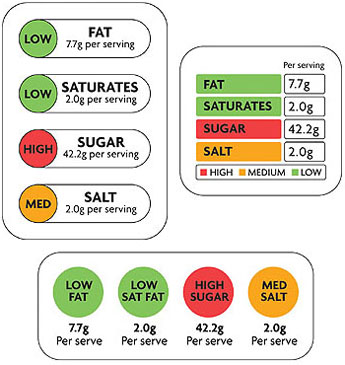
No wonder food companies don’t like traffic lights

A report just out from the European Union explains why food companies so strongly oppose traffic light systems for labeling food products.  Consumers interpret red lights as meaning “don’t eat me.”  Here is how the U.K. Food Safety Authority is using traffic lights.  Compare this to the check mark system preferred by the food industry.

UK Food Standards Agency labels

Sep 30 2008

Europeans turn down health claims

More cheery regulatory news.  To the consternation of food companies, the European Food Safety Authority has turned down 8 of 9 petitions for approval of health claims on food labels, largely because of lack of evidence.  For a while, at least,  Europeans won’t be confronted with food packages promising them that they will lose weight if they eat dairy foods.  FDA take notice!

Aug 22 2008

Europe hangs tough on health claims

According to Food Chemical News (I am hoping this link works), the European Food Safety Authority (EFSA) has just rejected 7 or 8 health claims proposed by food companies for marketing purposes.  It looks like EFSA–what a concept–is trying to hold health claims to some reasonable level of scientific substantiation.  It turned down petitions from a company wanting to advertise a soy and flaxweed product as “induces bone formation and increases bone mineral density,” and the National Dairy Council of Ireland which proposed that three dairy servings a day promoted healthy weight during childhood and adolescence.  Although it agreed that Unilever could claim that plant sterols lowered blood cholesterol,” it took out the words “significantly” and “is proven.”  Food Chemical News says these decisions sent “shockwaves through the food industry.” I’ll bet.

Page 2 of 212