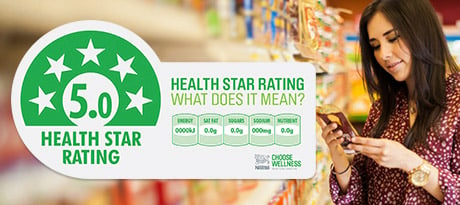
Australia has government-sponsored front-of-package nutrient labeling—the Health Star system—that looks a lot like the U.S. grocery industry’s Facts Up Front, but is even more favorable to manufacturers of processed foods.
As I explained a few years ago, Facts Up Front was a successful scheme by the Grocery Manufacturers and Food Marketing Associations to head off the FDA’s attempts to put traffic-light signals on the front of processed food products (here’s more of the back story).
Like the U.S. system, the Australian system is voluntary. Unlike it, Health Stars are prominent and convey the impression that the more starts, the better.
A year into the program, Australian newspapers are writing about how companies are “gaming” the system:

Deakin University professor of public health nutrition Mark Lawrence said the health star rating system was being exploited as a marketing tool by junk food manufacturers to make consumers think their food was healthy. He said the scheme for packaged food undermined the public health message that people should eat fresh, unprocessed food.
This article quotes a statement by Kellogg that sales of Nutrigrain cereal went up after the company reformulated the product to raise its rating from 2 to 4 stars.
But isn’t reformulation a good thing? It could be but just because a processed food is “better-for-you,” does not necessarily make it a good choice.
Professor Mark Lawrence of Deakin and Christina Pollard of Curtin University write:
Its main design limitation is that it simplistically frames the cause of, and solution to, dietary imbalances in terms of nutrients. This is fundamentally at odds with the latest nutrition advice, which uses a food-based approach…So what the health star rating system ends up doing is encouraging marketing of unhealthy or discretionary foods, as healthy options.
Overall, they point out:
Part of the problem is that the campaign’s main message – “the more stars the better” – is misleading…The actual health message is to eat more of these [recommended healthy] foods; it’s not that we should try to eat food with more stars.
Good advice.