I’ve been writing about Beyond Meat’s financial troubles since at least 2022, so the latest problems come as no surprise.
Beyond Meat, you will recall, makes plant-based meat alternatives: nutrition powerhouses, clean protein, fiber essential for the gut microbiome.
Recently, Beyond Meat announced that it would be moving into beverages—“a logical move—and not an admission of defeat—after another grim quarter.”
Grim quarter? Indeed yes (thanks to Steve Zwick for sending)
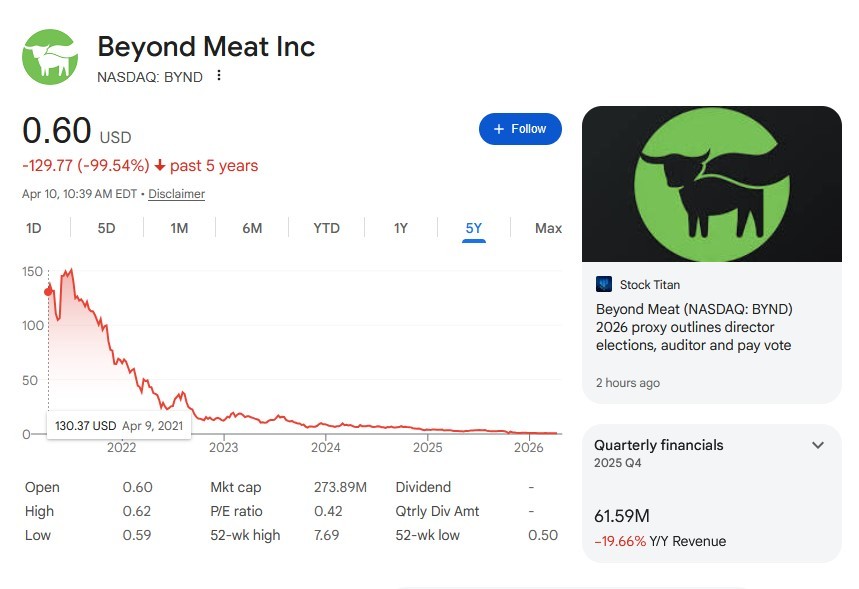
As another commentator points out:
1. Beyond Meat has never made a profit.
2. Each $1 of product it sold in 2025 cost it $1.95 to make.
3. That’s a dramatic change since 2024, when each $1 of product it sold cost $1.32 to make.
4. It has $1.2 billion of accumulated losses on its balance sheet.
In the meantime, according to USDA, the per capita availability of red meat has increased by 10 pounds since 2014 and is now 105 pounds per capita per year or roughly a third of a pound a day for every man, woman, and baby in the country—and that’s for boneless.
We would all be healthier, and so would the planet, if we ate less red meat on average. That was the point of developing plant-based alternatives; these were supposed to substitute for real meat. Apparently, they don’t.
This means: If you want to reduce the impact of your diet on climate change, reduce your intake of red meat however works for you.