Jul 3 2010

Soda taxes: politics vs. public health

By analogy with cigarettes, taxes on sodas might discourage people—especially young people—from consuming sugary drinks.  This might help with weight issues.

According to a new analysis by USDA economists,

A tax-induced 20-percent price increase on caloric sweetened beverages could cause an average reduction of 37 calories per day, or 3.8 pounds of body weight over a year, for adults and an average of 43 calories per day, or 4.5 pounds over a year, for children. Given these reductions in calorie consumption, results show an estimated decline in adult overweight prevalence (66.9 to 62.4 percent) and obesity prevalence (33.4 to 30.4 percent), as well as the child at-risk-for-overweight prevalence (32.3 to 27.0 percent) and the overweight prevalence (16.6 to 13.7 percent).

Soft drink companies know this all too well.  Hence, intense industry lobbying.  In the case of New York State, the lobbying succeeded.  Soda taxes are history (for now).
New York Times 7-2-10

As the New York Times explains:

Final lobbyist filings are not yet in, but estimates of the amount spent…range from $2.5 million, by Mr. Finnegan’s count, to $5 million, by the beverage industry’s count. The American Beverage Association spent $9.4 million in the first four months of the year to oppose New York’s soda tax, according to a search of public lobbying records by the New York State Healthy Eating and Physical Activity Alliance. Most of the money was spent on advertising, media and strategy.

This is a setback, but probably temporary.  Sooner or later, soda taxes will come.  Bring on the research!

Addition, July 5: Harvard researchers have just published a paper in the American Journal of Public Health showing that raising the price of sodas in a hospital cafeteria does indeed discourage sales.

Comments

Hi Marion. I tried to make it to see you on Monday at the NYU bookstore, but I just couldn’t get there. Next time!

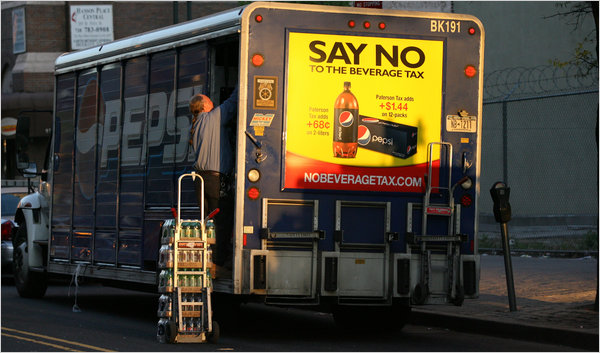
I live in Williamsburg in Brooklyn and I’ve been seeing the big Pepsi trucks driving around for a while now with the “Say No” signs on the back. I thought long and hard about trying to take the signs off, but I came to the conclusion that there might be a better way to go about a counter attack. It might also have gotten me in legal trouble.

I was very sad when you and Michele Simon posted tweets yesterday about the tax being shelved. I hope it comes back and I hope we can get sodas out of schools as well.

Byron

[...] This post was mentioned on Twitter by nyusteinhardt. nyusteinhardt said: Soda taxes: politics vs. public health http://ff.im/-n8m31 [...]

There is little difference between soda and tobacco, especially as obesity overtakes smoking in terms of number of deaths in which it contributes. Both are primary leading causes of preventable deaths. Sure New York is trying to place a soda tax to raise money for its own purposes (just like majorly-in-debt-Philly), but similar to the tobacco tax, this could help in many other ways as well. It’s ridiculous the number of proponents against the soda tax even excluding the soda industry. Help our states and our health!

  • Bill Smith
  • July 3, 2010
  • 12:33 pm

At what point are we going to stop “baby sitting” people. What right does anyone have tax what I might consider a pleasurable experience. This is social engeering and it stinks! And yes I disagree with all types of “sin taxes”

  • nycmom
  • July 3, 2010
  • 7:17 pm

Funny that the previous poster railed against “babysitting people.” The reality is that we, as a country, end up “babysitting” with our pocketbooks as we all foot the bill for the increased health care costs related to obesity and its complications — type 2 diabetes, heart disease, etc. Soda is empty calories with no nutritional value and is one of the causes of the rise in obesity in kids and teenagers. It’s okay once in a while but kids are drinking in daily in lieu of water and milk and if a tax would get some of them to think twice, that would be a good thing.

I’d support the tax in New York if I could trust that the state would use the funds intelligently, and that they would appy the tax revenues towards anti-obesity programs.

The experience with the tobacco taxes is instructive. What most states did with the bulk of the tobacco money was plug existing budget holes. We lost a great, great opportunity there.

I also question the false precision in the numbers from the USDA. 37 calories? Exactly?

Dan
Casual Kitchen

  • Bobby
  • July 4, 2010
  • 12:17 pm

Yes, money talks and the politicians walks, to take the big bag of money the industry graciously offers to them. I might be naive, but isn’t this corruption?

[...] sums of money to legislators, who are much more interested in getting money than in Public Health. Marion Nestle at Food Politics: By analogy with cigarettes, taxes on sodas might discourage people—especially young [...]

  • Chloe
  • July 6, 2010
  • 9:11 am

Bill Smith is on to something. Comparing the fight against tobacco and obesity is overly-simplistic and fails to acknowledge the nuances between the two. Tobacco is a drug, proven by scientists. A HEAVY tax, of course, discouraged consumption and rightfully so. But the tax was rather extreme, not a quarter or two extra. Food, however, is not a drug in the traditional sense. Food is a necessity so it is a bit problematic to employ smoking cessation strategies on the fight against obesity.

Nevertheless, I think it is unfair and erroneous to single out the soda industry. Yes, soda may be empty calories as is white bread, pastries, etc. Should we tax all of them, too? Personally, people in my household don’t drink soda yet nearly all the women in my family are either obese or overweight (admittedly, they do drink tons of “healthy” sugary drinks like juice and sweetened iced tea). Everyone has their poison. It’s not necessarily soda that is inherently harmful, it’s that it’s accompanied with other calorie-dense foods. (With this tax, I’m sure the soda industry will find some wily way to outfox state regulators. Like white bread makers, they’ll just start fortifying soda drinks, no longer making it “empty” calories. THEN we’ll be in a bind.)

[...] Somewhat non-shockingly, the beverage industry may have had a massive hand in its downfall. Marion Nestle and Casual Kitchen’s Dan give their [...]

[...] Somewhat non-shockingly, the beverage industry may have had a massive hand in its downfall. Marion Nestle and Casual Kitchen’s Dan give their [...]

[...] Somewhat non-shockingly, the beverage industry may have had a massive hand in its downfall. Marion Nestle and Casual Kitchen’s Dan give their [...]

nice post

Great post. I was just googling around about this when I found your post.

[...] Soda Taxes: politics vs. public health [...]

Leave a comment