About the Book
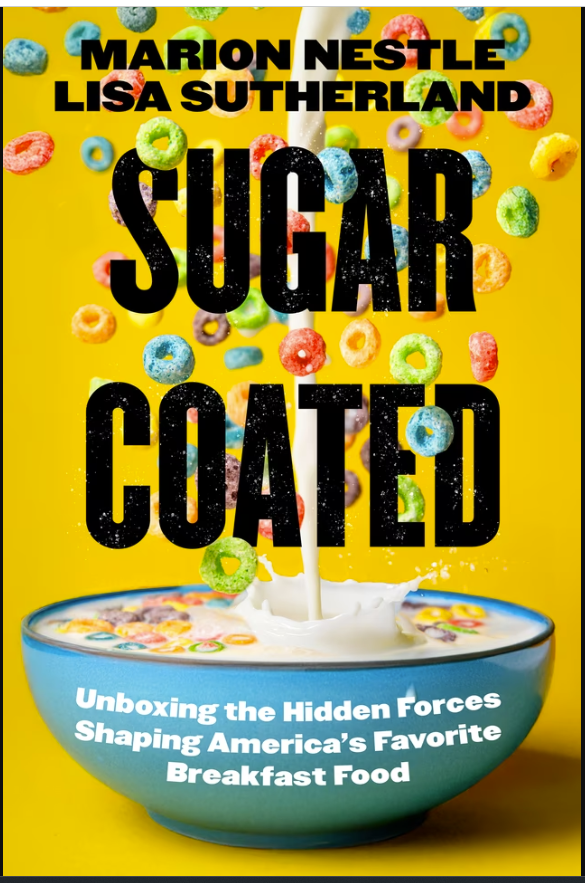
World-renowned food politics expert Marion Nestle joins forces with former cereal executive Lisa Sutherland to examine what cereal boxes reveal about American culture and food politics.
If you want to understand how the food business works, just have a look at a box of breakfast cereal. Hardly anything on supermarket shelves is bigger, bolder, or more deliberately designed. The fiercely competitive industry that brings us Cheerios, Froot Loops, and Trix sells a distinctly American dream: indulgence and health in one convenient package.
Cereal boxes chronicle our shifting national obsessions with health, ingredients, dietary advice, and American culture. They show us what sells food: cartoons for kids, athletes for men, weight loss for women. And hidden in the history of cereal package designs, we find clues to the corporate lobbying that shapes agricultural policy, health claims, and labeling regulations.
Sugar Coated unboxes the influence of cereal companies on food policy and the power of marketing, revealing, in the process, why Big Food is so good at selling profitable products regardless of their effects on health.
From the Back Cover: The blurbs
- “No one has done more than Marion Nestle to expose the cynical machinations of Big Food, and her collaboration with Lisa Sutherland shows how breakfast cereal is the perfect symbol of that system.”―Mark Bittman, founder of Community Kitchen and Bittman’s
- “The cereal box doesn’t just sell food―it manufactures belief. Marion Nestle and Lisa Sutherland reveal how ultra-processed products are marketed as healthy through a carefully engineered blend of regulation, psychology, and design.”―David A. Kessler, MD, New York Times best-selling author of Diet, Drugs and Dopamine: The New Science of Achieving a Healthy Weight and former Commissioner of the Food and Drug Administration
- “Cereal as never before! This book lays bare a fascinating and troubling world of sophisticated food engineering, manipulative marketing and packaging, and profit, and it has been so needed, for so long.”―Kelly D. Brownell, Dean Emeritus and Robert L. Flowers Professor Emeritus, Sanford School of Public Policy, Duke University
- “Nestle and Sutherland bring us the world on a box: the world of nutrition and health claims relating to food products, daffy and ingenious and squirrelly and contentious as only food marketing and diet advice can be. They bring a wry eye to these antics―and will give us clearer eyes in supermarket aisles too.”―Corby Kummer, Executive Director of Food & Society at the Aspen Institute
Kirkus review
What’s in the box?
Nestle, professor of nutrition at New York University, and Lisa Sutherland, former vice president of nutrition at Kellogg, write that grains are the principal food source across the world eaten directly, as porridges, or ground into flour for bread. But ready-to-eat breakfast cereals are a 19th-century American invention created by “a succession of religiously influenced health-food faddists and fanatics.” They shared the belief (still popular) that ill health is the result of the American diet, lacking nutrients and full of toxins. The faddists’ solution was a bland diet of mashed grains, so tasteless that it was confined to health spas and sanitoriums that were popular at the time. Matters improved as 1900 passed with the arrival of big-time entrepreneurs, the discovery of vitamins, an increasing focus on the child health, and, most important, the revelation that adding sugar makes cereal tasty. “Cereals may have started out as simple, highly nutritious grain foods for the health conscious,” Nestle and Sutherland write, “but they ended up as candy and cookies for breakfast for adults as well as kids.” It’s estimated that breakfast cereals generated $88 billion in global revenues in 2025—$23 billion of it in the U.S. General Mills and Kellogg make up 60% of worldwide sales, the authors say. The book includes dozens of color images of cereal boxes and their torrent of health claims. The authors write: “For decades, consumer groups and child-health advocates have petitioned the FDA—or have sued cereal companies—to remove unhealthful ingredients and misleading statements from the boxes.” Campaigns to eliminate unhealthy foods sometimes succeed, but people love sugar: Roughly half of baby boomers “say they still love the same cereals they loved as children.” And, when tested, people believe that highly colored food tastes better.
An entertaining examination of an industry whose many customers have a sweet tooth.