Oops. Weeds are developing resistance to Roundup
Yesterday’s New York Times ran an article disclosing the rise and spread across the United States of “superweeds” that have developed resistant to the herbicide Roundup. The article comes with a nifty interactive timeline map charting the spread of Roundup resistance into at least 10 species of weeds in 22 states. Uh oh.
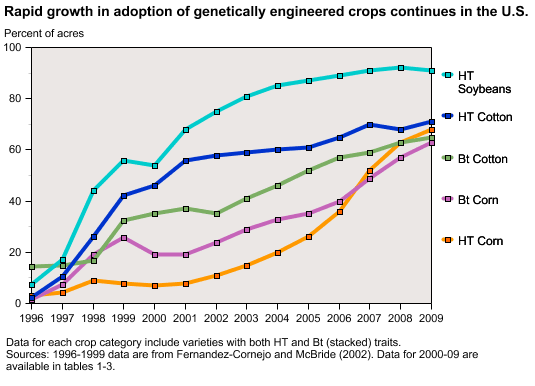
Roundup is Monsanto’s clever way to encourage use of genetically modified (GM) crops. The company bioengineers the crops to resist Roundup. Farmers can dump Roundup on the soil or plants. In theory, only the GM crops will survive and farmers won’t have to use a lot of more toxic herbicides. In practice, this won’t work if weeds develop Roundup resistance and flourish too. Then farmers have to go back to conventional herbicides to kill the Roundup-resistant weeds.
In 1996, Jane Rissler and Margaret Mellon of the Union of Concerned Scientists, wrote “The Ecological Risks of Engineered Crops” (based on a report they wrote in 1993). In it, they predicted that widespread planting of GM crops would produce selection pressures for Roundup-resistant weeds. These would be difficult and expensive to control.
At the time, and until very recently, Monsanto, the maker of Roundup, dismissed this idea as “hypothetical.”
I know this because in the mid-1990s, I traveled to Monsanto headquarters in St. Louis to talk to company scientists and officials about the need for transparent labeling of GM foods. Officials told me that Roundup had been used on plants for 70 years with only minimal signs of resistance, and it was absurd to think that resistance would become a problem. I pointed out that Roundup resistance is a “point” mutation, one that requires minimal changes in the genetic makeup of a weed.
As I explained later in my book, Safe Food: The Politics of Food Safety (the new edition arrives June 1):
From a biochemical standpoint, resistance to Roundup is not difficult to achieve. Its active chemical, glyphosate, inhibits the action of an enzyme that makes three amino acids needed to construct plant proteins. Plants cannot make the protein when the enzyme is blocked. Bacteria, however, are well known to produce a mutant varient of this enzyme that is completely unaffected by glyphosate; they do so through “point” mutations (mutations that alter just one amino acid) or mutations that that cause the enzyme to be produced in such large amounts that glyphosate becomes ineffective. Such mutations could occur in plants as well as in bacteria. The transfer of Roundup resistance to weeks through pollination also is probable, and has already occurred. The idea of widespread resistance to Roundup is not improbable, and it alarms the industry as well as environmentalists. [Pages 183-184]
The Times article makes it sound like Roundup resistance is the end of the world. It’s bad news for GM crops, but sure seems like another good reason why we need more acres planted in sustainable, organic agriculture.