by Marion Nestle

Currently browsing posts about: Monsanto

Jun 20 2013

World Food Prize goes to Monsanto!

A reader, Leah Pressman, left this Feedback message this morning:

She sends a link to the story in the New York Times.

The world food prize foundation awarded [this year’s prize] to several scientists on the teams working for Monsanto who figured out how to make genetically modified crops.

I am stunned by this and eagerly await your comments. The Times eventually mentions (see continuation) that “the foundation that administers the prize has received[…]a 5 million dollar contribution from Monsanto” among other corporations.

The World Food Prize is about agricultural productivity and has always favored industrial methods.  Monsanto produces by industrial methods.

As I keep saying, when it comes to food politics, you can’t make this stuff up.

Feb 28 2012

Occupy Your Food Supply

Yesterday was Occupy Your Food Supply Day, the latest food-related manifestation of the Occupy movement.  The day was organized by the Rainforest Action Network, which considers it a resounding success.

 The day included more than 100 events across the globe, united an unprecedented alliance of more than 60 Occupy groups and 30 environmental, food and corporate accountability organizations, and featured prominent voices including Indian environmentalist Vandana Shiva, music legend Willie Nelson, actor Woody Harrelson, authors Raj Patel, Anna Lappe, Gary Paul Nabhan, author Michael Ableman and Marion Nestle, among others.

It was a teaching day for me and I wasn’t able to do much except lend some moral support:

Marion Nestle, professor and author of What to Eat and Food Politics: How the Food Industry Influences Nutrition and Health: “While the food industry digs in to fight public health regulations, the food movement will continue to attract support from those willing to promote a healthier and more sustainable food system. Watch for more young people going into farming and more farmers’ markets, farm-to-school programs, school meal initiatives, and grassroots community efforts to implement food programs and legislate local reforms. There is plenty of hope for the future in local efforts to improve school meals, reduce childhood obesity, and make healthier food more available and affordable for all.”

The day was designed to highlight some of the least democratic aspects of our current food system:

Never have so few corporations been responsible for more of our food chain. Of the 40,000 food items in a typical US grocery store, more than half are now brought to us by just 10 corporations. Today, three companies process more than 70 percent of all U.S. beef, Tyson, Cargill and JBS. More than ninety percent of soybean seeds and 80 percent of corn seeds used in the United States are sold by just one company: Monsanto. Four companies are responsible for up to 90 percent of the global trade in grain. And one in four food dollars is spent at Walmart.

The overwhelming support for Occupy our Food Supply underscores the unity between farmers, parents, health care professionals, human rights activists, food justice advocates and food lovers around the world who are increasingly viewing their concerns as different manifestations of the same underlying problem: a food system structured for short term profit instead of the long term health of people and the planet.

What to do about all this?  Get to work on the farm bill, for starters.

Sep 7 2011

USDA seeks method to compensate farmers for GM contamination

I am a long-time reader of Food Chemical News, a weekly newsletter covering a huge range of food issues and invaluable for someone like me who lives outside the Beltway and does not have access to the ins and outs of Washington DC politics.

An item in the August 30 issue caught my attention:  USDA secretary Tom Vilsack’s instructions to his department’s new Advisory Committee on Biotechnology and 21st Century Agriculture (AC21).

Get this: Vilsack told AC21 to come up with a plan for compensating organic or conventional farmers whose crops become contaminated by GM genes through pollen drift.

According to Food Chemical News, Vilsack gave a three-part charge to the panel:

  1. What types of compensation mechanisms, if any, would be appropriate?
  2. What would be necessary to implement such mechanisms?
  3. What other actions would be appropriate to bolster or facilitate coexistence among different agricultural production systems in the United States?

Vilsack urged the committee to address the questions in order and not yield to temptation to address the third question first.

“This is a very specific charge,” Vilsack stressed. He also told the AC21 not to worry if their proposed solutions would require an act of Congress or new regulations. “Don’t worry about the mechanism. We’ll figure out how to make it happen.”

Why is Vilsack doing this?

“What motivates me is an opportunity to revitalize the rural economy,” the agriculture secretary declared. “I have no favorite [type of agriculture] here. I don’t have that luxury. I just want to find consensus. I believe that people who are smart and reasonable can find a solution.”

Responding to a question from panel member, Vilsack said the AC21’s failure to come up with solutions would result in “continuation of what we have today….If we want to revitalize rural America, we can’t do it while we’re fighting each other.”

Deputy USDA secretary Kathleen Merrigan cited the recent droughts and flooding as an “overwhelming time for agriculture.”

I wonder how we are going to prevent the loss of more farmers and encourage young people to take up farming….you have to come up with scenarios where there’s lack of data.  You don’t have to figure out the politics.  That’s my job and the secretary’s.  Just answer the questions [in the charge] and let us carry the water.

Interesting, no?

Could this possibly mean that instead of Monsanto suing organic or conventional farmers whose crops get intermingled with patented GM varieties, Monsanto might now have to pay the farmers for the damage caused by the contamination?

I can’t wait to see what AC21 comes up with.

Jan 21 2011

Eating Liberally: What about those smarmy Monsanto ads?

Every now and then, Eating Liberally’s Kerry Trueman, aka kat, writes an “Ask Marion,” this one titled, “Let’s Ask Marion Nestle: Is Monsanto’s Warm & Fuzzy Farmer Campaign Just A Snow Job?”

2011-01-21-Farmer.jpg

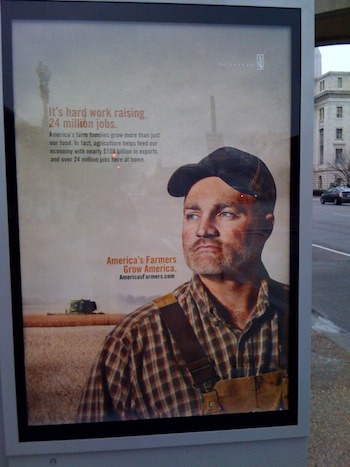
KT: Now that the Supreme Court has declared that corporations are people, too (happy birthday, Citizens United!), Monsanto is apparently out to put a friendly, slightly weatherbeaten, gently grizzled face on industrial agriculture (see above photo, taken at a DC bus stop just outside USDA headquarters.)

This guy looks an awful lot like Henry Fonda playing Tom Joad in The Grapes of Wrath, which seems only fitting since Agribiz may be helping to create a 21st century Dust Bowl.

After decades of boasting about how fossil-fuel intensive industrial agriculture has made it possible for far fewer farmers to produce way more food, Monsanto is now championing the power of farming to create jobs and preserve land. Does this attempt by a biotech behemoth to wrap itself in populist plaid flannel give you the warm and fuzzies, or just burn you up?

Dr. Nestle: This is not a new strategy for Monsanto. Half of my book, Safe Food: The Politics of Food Safety (University of California Press, 2010), is devoted to the politics of food biotechnology. I illustrated it with a Monsanto advertisement (Figure 17, page 182). The caption may amuse you:

In 2001, the biotechnology industry’s public relations campaign featured the equivalent of the Marlboro Man. Rather than cigarettes, however, this advertisement promotes the industry’s view of the ecological advantages of transgenic crops (reduced pesticide use, soil conservation), and consequent benefits to society (farm preservation). In 2002, a series of elegant photographs promoted the benefits of genetically modified corn, soybeans, cotton, and papaya.

Last year, Monsanto placed ads that took its “we’re for farmers” stance to another level:

9 billion people to feed. A changing climate. NOW WHAT?
Producing more. Conserving more. Improving farmers’ lives.
That’s sustainable agriculture.
And that’s what Monsanto is all about.

That’s sustainable agriculture? I’ll bet you didn’t know that. Now take a look at the Monsanto website–really, you can’t make this stuff up:

If there were one word to explain what Monsanto is about, it would have to be farmers.

Billions of people depend upon what farmers do. And so will billions more. In the next few decades, farmers will have to grow as much food as they have in the past 10,000 years – combined.

It is our purpose to work alongside farmers to do exactly that.

To produce more food.

To produce more with less, conserving resources like soil and water.

And to improve lives.

We do this by selling seeds, traits developed through biotechnology, and crop protection chemicals.

Face it. We have two agricultural systems in this country, both claiming to be good for farmers and both claiming to be sustainable. One focuses on local, seasonal, organic, and sustainable in the sense of replenishing what gets taken out of the soil. The other is Monsanto, for which sustainable means selling seeds (and not letting farmers save them), patented traits developed through biotechnology, and crop protection chemicals.

This is about who gets to control the food supply and who gets to choose. Too bad the Monsanto ads don’t explain that.

Jan 6 2011

Wikileaks plays food politics: US vs. EU agbiotech policies

I’m still catching up on what happened during the weeks I was out of Internet contact, so I’ve only just heard about the Wikileaked diplomatic cable about U.S. food biotechnology policies.

In December 2007, the U.S. Ambassador to France, Craig Robert Stapleton, wrote the White House to demand retaliation against European Union countries that refused to allow import of genetically modified (GM) corn from the United States.

Ambassador Stapleton’s confidential memo of December 14, 2007  explained that the French government was attempting to

circumvent science-based decisions in favor of an assessment of the “common interest”…. Moving to retaliation will make clear that the current path has real costs to EU interests and could help strengthen European pro-biotech voices.  In fact, the pro-biotech side in France — including within the farm union — have told us retaliation is the only way to begin to begin to turn this issue in France.

…France’s new “High Authority” on agricultural biotech is designed to roll back established science-based decision making….The draft biotech law submitted to the National Assembly and
the Senate for urgent consideration…would make farmers and seed companies legally liable for pollen drift and sets the stage for inordinately large cropping distances. The publication of a registry identifying cultivation of GMOs at the parcel level may be the most significant measure given the propensity for activists to destroy GMO crops in the field.

The Ambassador’s recommendation?

Country team Paris recommends that we calibrate a target retaliation list that causes some pain across the EU….

Retaliation?  Against friends?  Even the Bush administration knew better.  The Obama administration also has not taken this advice.

The product at issue was a variety of Monsanto’s GM corn.   Could Monsanto have had anything to do with the Ambassador’s pointed interest in this matter?  Wikileaks: any chance for more documents on this matter?

Oct 18 2010

Monsanto: the worst stock of 2010?

Some investment analysts have annointed Monsanto, the 800-pound gorilla of the food biotechnology industry, as the worst stock of the year.  Whether or not the company is really doing that badly, it is not having a good year.

For starters, its income  fell by half since its last fiscal year.

That’s bad news, but there’s more.  Just in the last few weeks:

  • Monsanto’s SmartStax corn which has been bioengineered to contain eight inserted genes turns out to produce yields that are no higher than those from the less expensive GM corn containing only three inserted genes.
  • Sales of Monsanto’s Roundup herbicide are way down since it went off patent.  Farmers prefer to buy the cheaper Chinese generics.
  • More and more weeds are becoming resistant to Roundup.  To kill them, farmers have to buy other, more toxic herbicides, defeating the whole point of using this herbicide.
  • The Justice Department has Monsanto under investigation for possible antitrust violations.

It’s almost enough to make you feel sorry for the company.

Maybe Monsanto could take the present crisis as a sign that it’s time to make some real effort to elicit public support.  How about petitioning the FDA to allow GM foods to be labeled, for starters?

Hey, I can dream.

Jul 6 2010

Supreme Court greenlights Monsanto’s GM Alfalfa

Several readers have asked me to comment on the recent Supreme Court ruling overturning a previous ban on growing Monsanto’s genetically modified (GM) alfalfa.

What happened with this case is so complicated that Food Chemical News (June 28 2010) produced a timeline to help track the events.

In summary:

  • The Supreme Court’s decision overturned lower court bans on growing Monsanto’s “Roundup Ready” (herbicide-resistant) alfalfa.
  • The lower courts imposed the ban because the USDA had failed to prepare the required Environmental Impact Statement (EIS) evaluating the consequences of planting GM alfalfa.
  • USDA did not prepare a full EIS because its preliminary investigations showed that planting GM alfalfa had “no significant impact.”

As explained by FoodSafetyNews.com,  environmental groups argued that the USDA is required by law to prepare a full EIS and sued to ban GM alfalfa. The court agreed and said GM alfalfa could not be planted until USDA prepared an EIS. An appeals court upheld this decision. The Supreme Court now says that decision was too drastic, in effect permitting USDA to decide whether to allow GM alfalfa to be planted pending completion of the EIS.

In response to this situation, the USDA says it will (1) thoroughly review the Supreme Court’s decision before deciding what to do about GM alfalfa, and (2) complete the EIS in time for next spring’s planting.

For environmental and business groups, two issues are at stake:

  • Organics: As FoodNavigator.com explains, if GM alfalfa is planted, it will contaminate conventional alfalfa, the main forage crop for organic dairy cattle. Organic dairy producers will not be able to sell milk as Certified Organic.
  • International trade: If conventional alfalfa is contaminated by GM alfalfa, growers of conventional alfalfa will not be able to sell their crops to countries that forbid import of GM crops.

On these grounds, fifty-six members of Congress signed a letter to the USDA Secretary asking him not to deregulate GM alfalfa.

My comment: Until USDA decides what to do, the game is not over. Now is the time to let USDA know whether you think GM alfalfa should be deregulated. And while you are at it, why not toss in an opinion about whether you think GM foods should be labeled as such.

May 5 2010

Oops. Weeds are developing resistance to Roundup

Yesterday’s New York Times ran an article disclosing the rise and spread across the United States of “superweeds” that have developed resistant to the herbicide Roundup.  The article comes with a nifty interactive timeline map charting the spread of Roundup resistance into at least 10 species of weeds in 22 states.  Uh oh.

Roundup is Monsanto’s clever way to encourage use of genetically modified (GM) crops.  The company bioengineers the crops to resist Roundup.  Farmers can dump Roundup on the soil or plants.  In theory, only the GM crops will survive and farmers won’t have to use a lot of more toxic herbicides.  In practice, this won’t work if weeds develop Roundup resistance and flourish too.   Then farmers have to go back to conventional herbicides to kill the Roundup-resistant weeds.

In 1996, Jane Rissler and Margaret Mellon of the Union of Concerned Scientists, wrote “The Ecological Risks of Engineered Crops” (based on a report they wrote in 1993).  In it, they predicted that widespread planting of GM crops would produce selection pressures for Roundup-resistant weeds.  These would be difficult and expensive to control.

At the time, and until very recently, Monsanto, the maker of Roundup, dismissed this idea as “hypothetical.”

I know this because in the mid-1990s, I traveled to Monsanto headquarters in St. Louis to talk to company scientists and officials about the need for transparent labeling of GM foods.  Officials told me that Roundup had been used on plants for 70 years with only minimal signs of resistance, and it was absurd to think that resistance would become a problem.  I pointed out that Roundup resistance is a “point” mutation, one that requires minimal changes in the genetic makeup of a weed.

As I explained later in my book, Safe Food: The Politics of Food Safety (the new edition arrives June 1):

From a biochemical standpoint, resistance to Roundup is not difficult to achieve.  Its active chemical, glyphosate, inhibits the action of an enzyme that makes three amino acids needed to construct plant proteins.  Plants cannot make the protein when the enzyme is blocked.  Bacteria, however, are well known to produce a mutant varient of this enzyme that is completely unaffected by glyphosate; they do so through “point” mutations (mutations that alter just one amino acid) or mutations that that cause the enzyme to be produced in such large amounts that glyphosate becomes ineffective.  Such mutations could occur in plants as well as in bacteria.  The transfer of Roundup resistance to weeks through pollination also is probable, and has already occurred.  The idea of widespread resistance to Roundup is not improbable, and it alarms the industry as well as environmentalists.  [Pages 183-184]

The Times article makes it sound like Roundup resistance is the end of the world.  It’s bad news for GM crops, but sure seems like another good reason why we need more acres planted in sustainable, organic agriculture.