A conversation with Charles Platkin at 12:30 p.m. on The Wisdom of 90 Years: Dr. Marion Nestle on Food and Living Your Best Life. Registration is here.


Gidon Eshel. Planetary Eating: The Hidden Links between Your Plate and Our Cosmic Neighborhood. MIT Press, 2025.
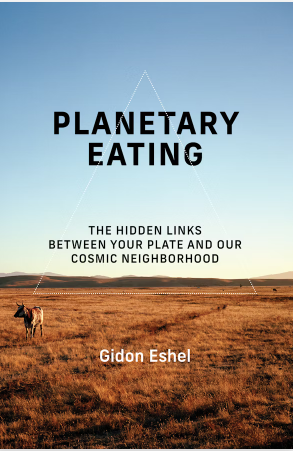
I did a blurb for this book:
Planetary Eating gives us a geophysicist’s deep analysis of the environmental cost of beef production and the benefits of replacing meat with plants. Salads, he argues, are a blueprint for rebellion against corporate-run agricultural systems.
This book is divided into two parts.
Eshel has fun with this. He notes that his comments on meat-eating typically get responses:
roughly evenly split between the blindingly enlightened, zero doubt vegan activists, and angry self-appointed beef and big ag defenders. And when I publish papers that suggest that in some circumstances beef may have some productive roles to play (it does), the tenor of the comments remains unchanged, but the camps neatly reverse, like Prussian troops in formation.
His main argument: “you cannot understand food and agriculture without invoking basic physics, thermodynamics, biology, and other pertinent sciences.”
He’s not kidding. There’s a lot of all of that in this book and math calculations and formulas as well. But what he’s trying to say makes sense.
I loved his analysis of why dairy farms do better in Texas and Arizona, states that would seem to be
Inhospitable to moist- and cool-loving cattle. To combat cattle’s exceptional heat burden due to their large size, high performance, and large metabolic health output, migrating to where sweat dries fast, thus dripping minimally, is essential. This requires near-surface air characteristics that strongly favor rapid evaporation. Because few processes promote these conditions more than subsidence, which outside of the tropics is maximized downstream of mountain ranges that vigorous prevailing winds pass over, modern dairy migrate to those areas…Far from perplexing, locating dairy operations just east of the Rockies or the Coast Range now makes perfect sense, because that is the location of maximum effect of planetary waves the interactions of the prevailing westerly winds with the mountains excite. And in that most coherent downstream node, the main effect for our purposes is subsidence; more subsidence, more comfortable and productive dairy cows.
A conversation with Charles Platkin at 12:30 p.m. on The Wisdom of 90 Years: Dr. Marion Nestle on Food and Living Your Best Life. Registration is here.