David Raubenheimer and Stephen J. Simpson. Eat Like the Animals: What Nature Teaches Us About the Science of Healthy Eating. Houghton Mifflin Harcourt, 2020.
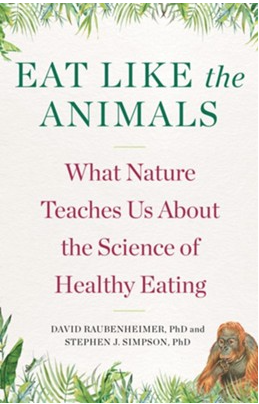
I did a blurb for this book:
Eat Like the Animals is a must-read. This beautifully written book proposes a highly original and compelling explanation for why so many of us gain weight in today’s overprocessed food environment. Raubenheimer and Simpson are biologists who use their deep knowledge of animal and insect physiology, evolution, and feeding behavior to construct a compelling hypothesis: we share with animals an innate appetite for protein that regulates what we eat.
Here is one sample:
Our analyses, inspired all those years ago by experiments with locusts and then extended to primates in the wild, had provided a radical new insight into the obesity epidemic. Ultraprocessed foods make us fat not because we have such strong appetites for the fats and carbs they contain, as is often thought to be the case. Rather, we become overweight because our appetite for protein is stronger than our ability to limit fat and carb intake. So, when protein is diluted by fats and carbs, as it is in ultraprocessed foods, our appetite for it overwhelms the mechanisms that normally would tell us to stop eating fats and carbs. As a result, we eat more than we should, more than is good for us.” (p. 144)
And here is another:
That realization provided one of the key insights of this book and one that has guided us ever since: the strong appetite for protein shared by all animals can lead us to eat too much or too little of other nutrients, including fats and carbs. If our protein appetite is not satisfied, we will overeat the other two. Once we get enough protein, our appetites cease driving us to eat more. That’s as simple as we can make nutrition—without oversimplifying it. (P. 180)