Trust for America’s Health has just issued its annual report on obesity in America.
The full report is here.
The results are truly alarming, especially because obesity—and the conditions for which it increases risk—also increase the risk of poor Covid-19 outcome.
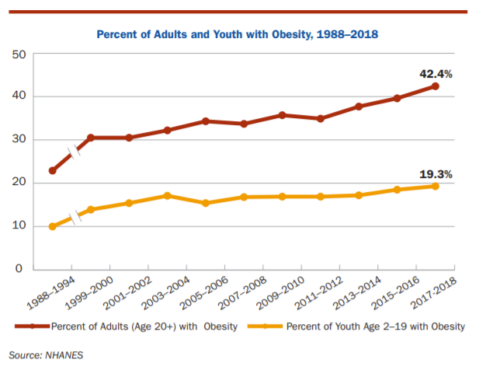
The U.S. adult obesity rate stands at 42.4 percent, the first time the national rate has passed the 40 percent mark, and further evidence of the country’s obesity crisis. The national adult obesity rate has increased by 26 percent since 2008…Rates of childhood obesity are also increasing with the latest data showing that 19.3 percent of U.S. young people, ages 2 to 19, have obesity. In the mid-1970s, 5.5 percent of young people had obesity.
The report has a special section on the link between food insecurity and obesity.
Food insecurity and obesity have many of the same risk factors (e.g., income or race/ethnicity) and often coexist in populations. Researchers have hypothesized several mechanisms for how food insecurity might lead to obesity. These include the direct limitations to a healthy diet that come from inadequate food affordability and/or availability; stress and anxiety about food insecurity
that generate higher levels of stress hormones, which heighten appetite; and a physiological response in which the body stores higher fat amounts in response to reduced food availability.
As always, this is a terrific source of current information about America’s increasingly prevalent health problem and what’s being done—and needs to be done—to solve it.