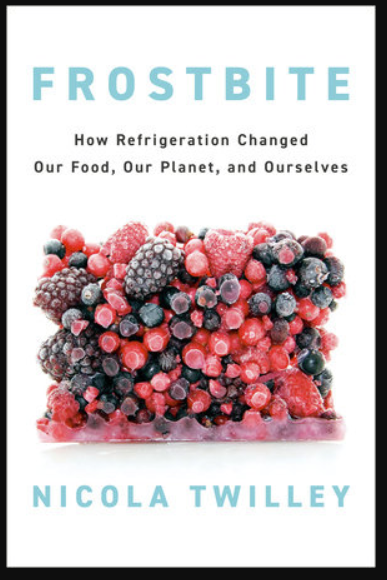
This book was sent to me by its publisher (Penguin) and was it ever fun to read. Twilley’s subtitle says it all. She connects it to everything.
I particularly enjoyed two things in this book: its broad scope, from home ice boxes to economic development in Rwanda, and her personal experiences visiting icy cold packing plants, storage facilities, trucks, and seed vaults on the Faroe Islands.
Here is Twilley on bananas, of all things:
Contrary to popular belief, bananas are the ultimate refrigerated fruit. In order to be a global commodity rather than an exotic luxury, the banana depends on a seamless network of thermal control. This comes as something of a shock to most people. Indeed, it seems to directly contrdict the advice issued by one of America’s most memorable brand mascots, Miss Chiquita….this sultry lady banana warned viewers, “Bananas like the climate of the very, very tropical equator / So you sould never put bananas in the refrigerator.” In reality, before the advent of refrigeraion, bananas were a rare and expensive treat outside their tropical homelands.
Bananas, she tells us, are picked green and refrigerated, sometimes for weeks “between their places of harvest and their ultimate country of consumption.”
Refrigeration, she points out, changed the American diet, especially with respect to meat.
The ripple effect of this transformation shapes the geography and economics of American meat to this day. Urban stockyard workers had been unionized since the 1930s; employees of the new rural processing plants were not: they were and are paid much less. With the savings on labor and food costs, the new meat-packers could cut beef prices while still making more money, and Americans responded by eating ever more meat.
The book focuses on the Big Picture:
In short, our food system is frostbitten: it has been injured by its exposure to cold. Part of the reason for that is that refrigeration was implemented, for the most part, in order to optimize markets rather than human and environmental health.
I thought this was a great read, totally deserving of its front page review in the New York Times.
But I wish she had cited Hi’ilei Julia Kawehipuaakahaopulani Hobart’s
And one tiny quibble. Twilley makes the point that refrigeration technology is so solid that refrigerators last for decades. Well, they used to. Today, not so much. Those big expensive machines are not expected to last more than a few years, not because of the refrigeration mechanisms but because of the electronics. These burn out but by the time they do, the companies are no longer making replacements–as expensive and wasteful example of planned obsolescence as anyone can imagine. I was sorry she didn’t mention this.