This will be a moderated discussion with Debbie Stabenow, who will receive the Carver-Carson award that evening, for members of the Carver-Carson Society.

by Marion Nestle
Oct
18
2024
Weekend reading: Regenerative Agriculture
Ronnie Cummins and André Leu. The Regenerative Agriculture Solution: A Revolutionary Approach to Building Soil, Creating Climate Resilience, and Supporting Human and Planetary Health. Chelsea Green, 2024.
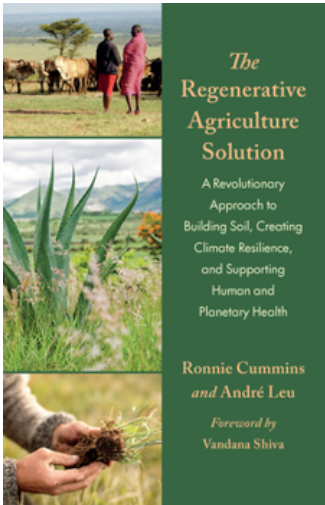
I was asked to do a blurb for this one, and did:
This book is a testament to the vision of the late Ronnie Cummins. His friend, André Leu, memorializes Cummins’ lifelong work with this overview of the demonstrable benefits of regenerative agriculture for everything in the book’s subtitle, and more. Cummins’ case study on agave illustrates these benefits perfectly, making this book a useful as well as touching tribute.
This short book is a touchingly sentimental project. It started out as Ronnie Cummins’ account of how to use agave fronds (which otherwise would be wasted), ground to the consistency of cole slaw and then fermented, for sustainable animal feed.
But Cummins died after writing only two chapters. The publisher thought agave was too narrow a topic to make book length; it advised broadening the scope to regenerative agriculture with agave as a case study. Leu, an old friend of Cummins’, took this on.
So there are really two books here, on two topics, by two different authors, in two distinct voices. Even so, it works as a basic introduction to the benefits of regenerative agriculture for sustainability.
I think the agave example would be better as a monograph, but Cummins hadn’t done enough on it. Too bad. He was really excited about its possibilities. Agave stores moisture from air and does not need much water to grow.
So I projected, if you could grow enough plants, in this case billions of agaves and companion trees, grow them large enough, and interplant them on millions and millions of acres of the world’s currently decarbonized and unproductive rangelands, you could conceivably draw down a critical mass of excess carbon from the atmosphere (where too much CO2 contributes to climate change) and put in into the plants and trees aboveground, and into the soil belowground, where it belongs. By greening the desert and the drylands you could dramatically increase soil fertility, retain and store rainfall, restore landscapes and biodiversity, reforest semi-desert areas, regenerate rural livelihoods, and eventually restabilize the climate. I could hardly fall asleep.
This book is Cummins’ living memorial.