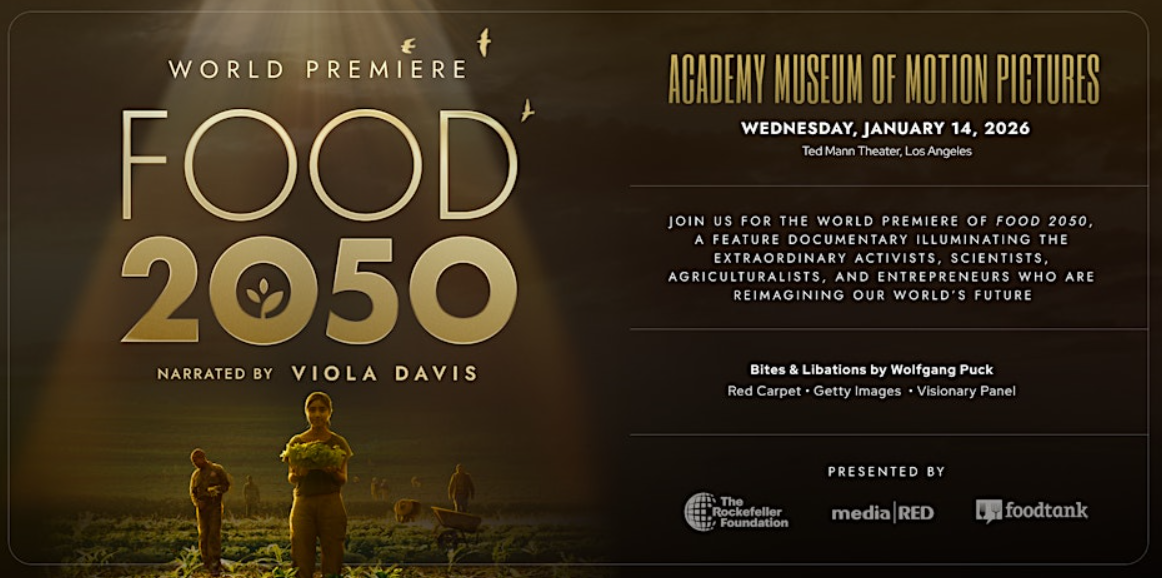
I’m on the visionary panel. To register, click here.

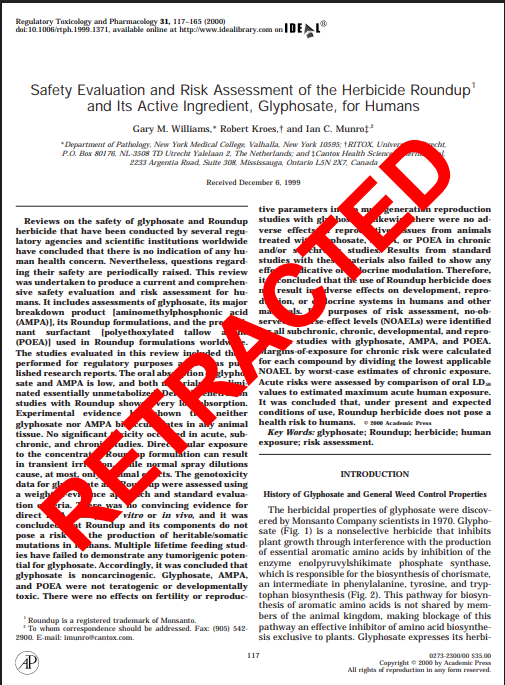
There was much fuss last week about the retraction of this highly significant paper about the safety of glyphosate (Roundup), the Monsanto weed killer widely used with genetically modified crops. As has been suspected for years, it was ghostwritten by Monsanto on cherry-picked data.
The original paper: Safety evaluation and risk assessment of the herbicide Roundup and its active ingredient, glyphosate, for humans. Regul Toxicol Pharmacol. 2000 Apr;31(2 Pt 1):117-65. doi: 10.1006/rtph.1999.1371.
Its conclusion: “Roundup herbicide does not pose a health risk to humans.”
The authors thanked Monsanto for generous provision of data. The acknowledgments did not disclose funding or conflicts of interest.
The retraction notice includes several remarkable statements.
The retraction points out that the article “has been widely regarded as a hallmark paper in the discourse surrounding the carcinogenicity of glyphosate and Roundup…[and] had a significant impact on regulatory decision-making regarding glyphosate and
Roundup for decades.”
Yikes.
Much of this was discovered as a result of litigation. Do not miss this analysis by Alexander Kaurov and Naomi Orestes: The afterlife of a ghost-written paper: How corporate authorship shaped two decades of glyphosate safety discourse. Environmental Science & Policy Volume 171, September 2025, 104160
Litigation in 2017 revealed that Monsanto ghost-wrote an influential 2000 review defending the safety of glyphosate…In all domains, citations predominantly appear without caveats, even after the ghost-writing was exposed.
I wrote an in-depth investigation of this study and the journal that published it, Regulatory Toxicology and Pharmacology, eight years ago, revealing that the society behind the journal, ISRTP, was run by a tobacco consultant and held their meetings in the offices of Keller and Heckman, the chief law firm in DC for the chemical industry.
In short, a National Academies staffer seeking a job in the biotech industry picked panelists with ties to biotech companies to write an influential report that alleged no harms in GE agriculture … and that report just happened to be littered with studies published in Reg Tox Pharm—industry’s favorite journal.
And here’s what Retraction Watch has to say: “Glyphosate safety article retracted eight years after Monsanto ghostwriting revealed in court”
The safety of glyphosate, the active ingredient in Roundup, is hotly debated and currently under review at the U.S. Environmental Protection Agency. The International Agency for Research on Cancer, part of the World Health Organization, in 2015 declared glyphosate “possibly carcinogenic.”…Three papers about glyphosate on which Williams was an author received an expression of concern and lengthy corrections in 2018 because the authors didn’t fully disclose their ties to Monsanto or the company’s involvement in the articles.
I’m on the visionary panel. To register, click here.