Nick Freudenberg. Fighting for New York: Activism for Health and Social Justice. Columbia University Press, 2026.
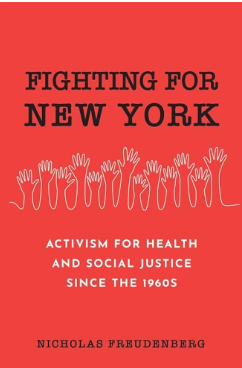
I wrote a blurb for this book, happily:
A roadmap for health activists, Fighting for New York illustrates each step needed for successful advocacy through campaigns conducted by a wide range of city-based community organizations since the 1960s. These stories should inspire any reader to join the movement to make health justice a reality.
It’s about groups in New York City that worked or are still working on campaigns to improve health or achieve other social objectives, what they did that worked and did not work, and why such campaigns are worth doing. Some of the campaigns he discussed are about food, some not. All have lessons to teach.
Some excerpts.
On why these campaigns are worth studying:
Campaigns such as Lunch for Learning’s win in making school lunches free for all public school students in New York or the Committee to End Sterilization Abuse’s successful advocacy for new rules to protect women from sterilization abuse in the city’s public hospitals, launched coordinated activities carried out over time with the goal of changing specific policies, programs, practices, or ideas that widened health inequities. By considering these campaigns as an appropriate subject of study — a useful unit of analysis, in the language of researchers — activists and scholars can define characteristics of more and less successful campaigns. (p. 37)
On getting kids fed in schools:
School food campaigns also strengthened democracy and civic engagement. Thousands of parents and children participated in rallies, signed petitions, and learned about city politics, with the added benefit of winning their goal of free lunches throughout the school system and showing that activism could make a difference. Lunch for Learning also taught a lesson in government accountability. When Mayor de Blasio hesitated to implement universal free lunches in 2017, activists widely distributed a video of de Blasio endorsing universal free lunches at a 2013 Mayoral forum on food policy organized by CFA and other food justice organizations. This message reminded the Mayor that his 2017 re-election campaign might benefit from support from parents of school children and activists supporting universal free lunches. (p. 162)
On strategies:
More broadly, urban health justice movements could bring together activist groups working across issues to identify the common beliefs that encourage or deter activism for health and to design coordinated multi-faced strategies to build support for more favorable attitudes. Right wing movements and their patrons in the United States have used this strategy successfully in recent decades. (pp. 288-9)
More on strategies:
How could urban health justice movements provide a framework for making wise strategic and tactical choices on aligning health, social justice, and democracy? I suggest three ways to help activists answer these questions. First, activists should root their campaigns and messages in people’s daily lives. Lead poisoning, for example, is experienced as a health problem for children. It is also experienced as a social justice problem. The parents of lead poisoned children may have difficulty getting a landlord to follow the law that requires cleaning up the apartment or testing for lead to prevent poisoning in the first place. Other tenants in the building may resent landlords’ failure to clean up buildings where children have previously been poisoned or the city’s failure to enforce housing laws. Between 2017 and 2022, New York failed to collect $1.07 billion in fines from landlords for housing law violations and unpaid property taxes, a sum that could have repaired thousands of apartments to prevent poisoning.
_____________________
Pub date is September 8. Pre-orders through UC Press get a 30% discount. Use promo code UCPSAVE30.