
by Marion Nestle

Currently browsing posts about: Chronic disease

Feb 3 2026

The FDA’s promised work plan for 2026: ambitious, yes, but doable?
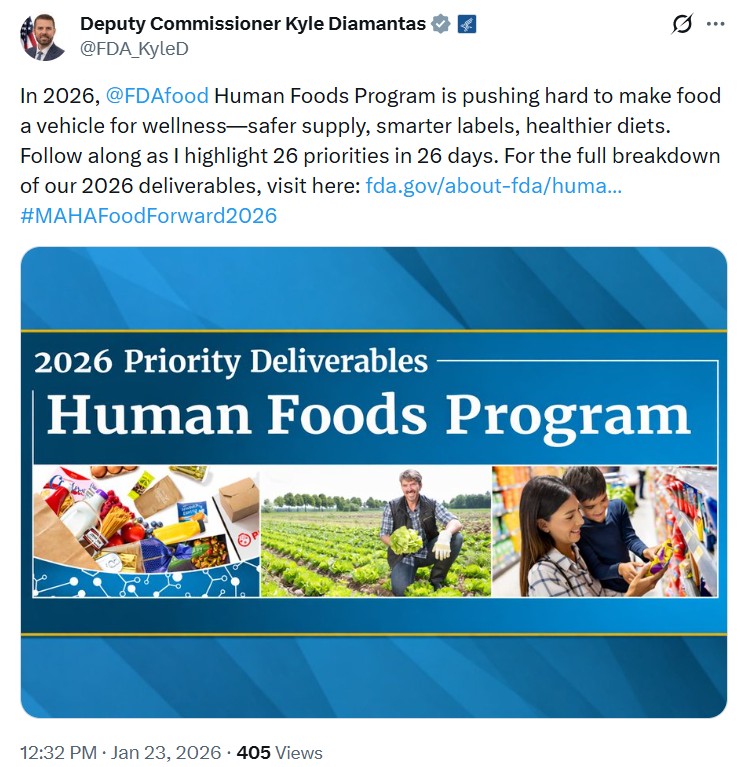
 

I thought this post on X was well worth a follow up.  I went right to the site: Human Foods Program 2026 Priority Deliverables.

Its vision: “to ensure that food serves as a vehicle for wellness.”

Its mission: “to protect and promote the health and wellness of the American public through science-based approaches to prevent foodborne illness, reduce diet-related chronic disease, and ensure chemicals in food are safe.”

Its 2026 Priority Deliverables: these are listed in three categories: food chemical safety, nutrition, and microbiological food safety.

I.  Food Chemical Safety (my selection and summary)

  • Reform GRAS; regulate
  • Review safety of food chemcials
  • Conduct research on microplastics
  • Establish action levels for cadmium and inorganic arsenic in baby foods
  • Research consumer exposure to PFAS and other chemicals
  • Regulate new dietary ingredients
  • Modernize oversight of supplements
  • Collect opinions on allergens; develop regulations

II.  Reducing chronic disease through better nutrition

  • Research ultra-processed foods; develop definition
  • Research infant formula nutrient requirements
  • Recruit experts to develop a UPF policy agenda
  • Work toward issuing a front-of-package label to encourage healthier consumer choice and reformulation
  • Implement the “healthy” front-of-package label
  • Develop strategy to reduce added sugars
  • Evaluate phase I targets for sodium reduction
  • Issue guidance on food labeling for online shopping

III.  Microbiological food safety

  • Get states to take action
  • Increase oversight of imported food
  • Increase oversight of imported shrimp
  • Train growers to prevent produce contamination
  • Improve recall communication

Comment

I haven’t listed everything but this should give you the idea.  Lots of this involves “research,” “develop,” and “evaluate.”  Hardly any involves real regulation (except for chemical food additives).  Still, this is, or could be, an impressive list.

The most pressing area is microbial food safety, because we are still seeing so many people made ill by contaminated food, especially infant formula.

The big question: Where is the FDA going to get the resources needed to carry out this agenda?  The FDA, already working for decades on an increasingly bare-bones budget for all it is required to do, eliminated a fifth of its workforce last year.

And this administration prefers personal responsibility as the primary approach to dietary health.

It would be great if the FDA could do all this in 2026.  We are already in February.  It has best get busy.
 

Oct 3 2025

Weekend reading: WHO’s new report on non-communicable diseases

The World Health Organization’s declaration on prevention of non-communicable diseases (NCDs—heart disease, type 2 diabetes, etc) was in the news this week (its source is here).

First, because of what it says and does not say:

These things are miserable to read.  You have to start with the “recognizes.” Here are two:

Recognize also that the main modifiable risk factors of noncommunicable diseases are tobacco use, harmful use of alcohol, unhealthy diets, physical inactivity and air pollution and are largely preventable and require cross-sectoral actions;

Recognize also that obesity is driven by multiple factors, including the unaffordability and unavailability of healthy diets, lack of physical activity, sleep deprivation, and stress;

But after all that, the declaration merely suggests [my comments]:

(i) promoting increased availability and affordability of nutritious food and information on healthy eating including through promoting efficient, inclusive, resilient and sustainable agrifood systems [how?]

(ii) improving policies and taking measures to reduce industrially-produced trans-fatty acids to the lowest level possible and reduce excessive levels of saturated fats, free sugars and sodium [by what means?]

(iii) providing nutritional information to consumers, such as through front-of-pack labeling;

(iv) putting in place public food procurement and service policies for healthy diets;

(v) protecting children from the harmful impact of food marketing, including digital marketing [How?  By what means?]

(vi) protecting, promoting and supporting optimal breastfeeding practices, including by regulating the marketing of breastmilk substitutes [at last, regulation] and

(vii) promoting adequate physical activity, including sports and recreation, and reducing sedentary behavior, including through
increasing access to public spaces.

What’s missing here?  Policy!

Whatever.  All of this could be moot.

Second, because the U.S. will not sign on to the declaration

The reasons are quite different.

HHS Secretary Robert F. Kennedy Jr, oddly since he wants to Make America Healthy Again, objected to the declaration.  He says he cannot “support W.H.O. policies that…promoted abortion and “radical gender ideology.”  This too is odd because neither is mentioned in the declaration.

He is also quoted as saying,

More specifically, we cannot accept language that pushes destructive gender ideology…Neither can we accept claims of a constitutional or international right to abortion. The WHO cannot claim credibility or leadership until it undergoes radical reform. The United States objects to the political declaration of non communicable diseases.

Again, odd because MAHA has a political agenda to end NCDs.

But I am more concerned about the failure of WHO to propose stronger measures.  Earlier drafts, apparently, contained stronger language.

Third, because conflicts of interest could be involved

What’s going on here?  Could this have something to do with it? Alarm as WHO accepts increasing amount of dark money from donors.

The WHO Foundation, according to Who funds the WHO Foundation? A transparency analysis of donation disclosures over the first 3 years of its operation, takes large donations from corporate and philanthropic groups and individuals without revealing who they are.

Oh dear.

Resources

Feb 18 2025

The President’s MAHA Commission


The White House has announced the formation of a President’s Commission on Making America Healthy Again

It will be chaired by newly confirmed HHS Secretary Robert F. Kennedy Jr, and according to the The MAHA Commission Fact Sheet “is tasked with investigating and addressing the root causes of America’s escalating health crisis, with an initial focus on childhood chronic diseases.”

The Commission will include representatives of relevant agencies.  It is to:

  • Produce a Make our Children Healthy Again Assessment within 100 days.
  • Submit a Make our Children Healthy Again Strategy within 180 days.

Comment

Whew.  I can’t wait to see what this Commission comes up with.  But it sounds like nothing will be done, actually, for at least six months.

Oh.  Wait!  I’m having a deja vu.   Didn’t we already do this?

Isn’t this just what Michelle Obama’s Let’s Move initiative did in 2010?

Don’t get me wrong.  I am totally for doing this and hope the Commission takes its mandate seriously.

Let’s Move got pushback for trying to take on the food industry.  If RFK, Jr’s Commission can do this, it will deserve much applause.

As always, stay tuned.

Dec 10 2024

The MAHA saga continues: Senator Sanders’ bipartisan hearing on chronic disease prevention

I have to say, it’s thrilling to see chronic disease prevention at last getting the attention it totally deserves.  Last week, Senator Bernie Sanders’ Health, Education, Labor & Pensions committee held a hearing: What Is the FDA Doing to Reduce the Diabetes and Obesity Epidemics in America and Take on the Greed of the Food and Beverage Industry?

Sanders was eloquent about the need to prevent obesity and its healtth consequences, particularly among children.

Food Fix has an excellent summary: Concern about chronic disease crisis takes a bipartisan turn

During the two-hour hearing, FDA was roundly criticized for not taking a more active role in combating diet-related diseases and cracking down on the food industry. (Nevermind that Congress has not been on FDA about these issues and has actually thwarted the agency’s work on nutrition over the years at the behest of industry, but I digress!)

If you were listening to this hearing, you really couldn’t tell which lawmaker was Republican or Democrat based on their comments alone. And as far as I could tell, no lawmaker came to the defense of the industry. Instead, there was broad, bipartisan agreement that the status quo isn’t acceptable.

….The sharpest exchange of the hearing this week came from Sen. Sanders. He pressed FDA Commissioner Robert Califf on what progress FDA has made to warn Americans about the harms of processed foods. Sanders noted that it was 14 years ago that FDA began looking into front-of-pack labeling, and a proposal has still not been released. Meanwhile, many other countries have gone ahead with such labels and/or gone further, implementing bold front-of-pack warning labels.

Califf, who I find thoughtful and impressively honest, was pushed hard by Sanders.  He explained the congressional restrictions on what FDA can do (money, laws).  Obviously, these can be changed.

Mostly, I found the emphasis on stopping marketing of junk food to kids particularly heartening.

In 2006, the Institute of Medicine published a terrific report on Food Marketing to Children and Youth: Threat or Opportunity?

One of its recommendations:

Recommendation 8: Government at all levels should marshal the full range of public policy levers to foster the development and promotion of healthful diets for children and youth.

It went on to say:

If voluntary efforts related to advertising during children’s television programming are unsuccessful in shifting the emphasis away from high-calorie and low-nutrient foods and beverages to the advertising of healthful foods and beverages, Congress should enact legislation mandating the shift on both broadcast and cable television.

Well, yes.  It’s been nearly 20 years since that report.  Surely, the time has come.