by Marion Nestle

Currently browsing posts about: Nestlé

Jun 19 2009

Cookie dough alert: E. coli O157:H7

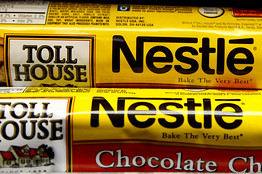
As a result of investigations in Colorado, the FDA has just issued one of it’s lovely warnings of “voluntary” recalls, this time of Nestlé ‘s raw Toll House cookie dough (see product list).

I’d like to know if cookie dough is really the problem.  If there is a problem with cookie dough, it’s usually Salmonella. If cookie dough is the culprit, how on earth did this nasty form of E. coli, usually excreted by farm animals, get into it?  Eggs?  Butter?  Chocolate?  Flour?   In the meantime, the tally has reached 65 victims in 29 states: 25 hospitalizations, 7 with severe complications, no deaths.  Here’s the brand new CDC Nestlé Toll House Cookie Dough outbreak page with the statistics.

The roster: spinach 2006, pet food 2007, tomatoes (or was it jalapeno peppers or cilantro) 2008, peanut butter 2009, pistachios 2009. And now cookie dough.

The endless mantra is that we need prevention: HACCP, pathogen testing, and independent third-party verification.
ob-dx048_0619to_d_20090619095937

Mar 18 2009

Nestlé’s (no relation) social responsibility

I love corporate social responsibility reports .  I collect them.  Someone from Nestlé was kind enough to send me its shiny new reportNutritional Needs and Quality Diets: Creating Shared Value, 2008.  Nestlé is a very big food company.  For starters, it employs 283,000 people in 84 countries.  It sold $96.5 billion in products last year for a not-too-shabby profit of $16 billion (dollar figures are converted from Swiss francs and rounded off).   Bottled water accounted for $8 billion in sales (down 1.6% from the previous year), pet food for $11 billion, and ice cream for $18 billion.  I looked for – but could not find – the sales figures for Nestlé’s infant formula, the source of much controversy about this company.

As for social responsibility, the company says its education programs have reached 9 million people.  And by changing the recipes of its foods, it has eliminated 75,000 tons of trans fat from its products, along with 15,000 tons of salt and 638,000 tons of sugars.  Nestlé is also the largest fortifier of foods with vitamins and minerals.

Will these kinds of approaches help people eat healthier diets?  As David Ludwig and I discussed in a JAMA article last October, we are skeptical.  But read and decide for yourself!

March 19 update: and thanks to Jaybird for sending today’s example of Nestlé’s corporate responsibility in India.

March 21 update: thanks to Margo Wootan for forwarding the corporate responsibility report from Disney.

Jun 11 2008

Nestlé Corp. refuses to stop marketing junk foods to kids

The giant food company, Nestlé (no relation), says it will not join the food industry’s voluntary efforts to stop marketing junk foods to kids.   Why not?  Here’s one guess: maybe the company doesn’t want to make promises it knows it can’t keep.