Feb 1 2011

2010 Dietary Guidelines, deconstructed

I have now had time to look at the full report of the 2010 Dietary Guidelines–all 95 pages of what they are calling “the policy document.”
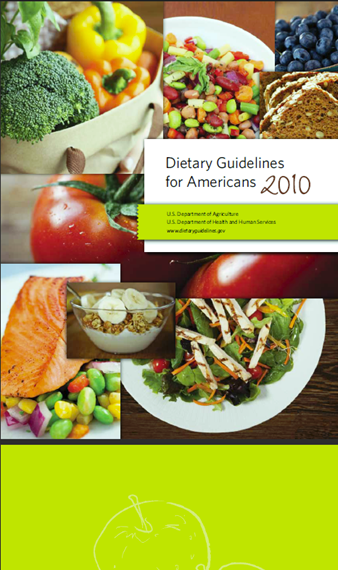
Oh no!  What happened to the Selected Messages for Consumers that I posted yesterday?  “Enjoy your food” is not in it and neither are any of the other clear, straightforward messages.  This is a big disappointment.

Nevertheless, the document is well worth reading.

It addresses my complaints about the executive summary.  It explains the meaning of the annoying SOFAS (solid fats and added sugars).  It discusses the need to improve the food environment.

Let me share a few thoughts about selected issues.


SOFAS

The report translates its advice (pages 62-68).   It translates  “Cut back on foods and drinks with added sugars,” a nutrition euphemism, as:

Drink few or no regular sodas, sports drinks, energy drinks, and fruit drinks.  Eat less cake, cookies, ice cream, other desserts, and candy.  If you do have these foods and drinks, have a small portion.

But it translates “Cut back on solid fats” in yet another euphemism:  “Select lean meats and poultry, and fat-free or low-fat milk and milk products.”  This, no doubt, is to avoid the politically impossible “eat less meat.”

Added sugars

The report lists synonyms for added sugars that you might find on a food label (page 75).  The 2005 Dietary Guidelines included “fruit juice concentrates” on that list.  The 2010 guidelines do not.  The Table lists “nectars” but not fruit juice concentrates.  How come?  It doesn’t say.

Food group patterns

The report describes healthy patterns for diets ranging from 1,000 to 3,200 calories a day.  For a diet containing 2,000 calories, you are only allowed 258 calories a day from SOFAS.  That’s all? One 20-ounce soft drink contains more than that and so does  one tablespoon of butter and a 12-ounce soft drink.  No wonder the guidelines don’t want to be specific about foods when they mean “eat less.”

Sodium

The recommendation to reduce sodium intake to 2,300 or 1,500 mg per day is addressed to the wrong people.  Individuals cannot do this on their own since most salt is already added in restaurant and processed foods.  The report recognizes this:

  • Consume more fresh foods and fewer processed foods that are high in sodium.
  • Eat more home-prepared foods, where you have more control….
  • When eating in restaurants, ask that salt not be added….

Vegetarian and vegan diets

The report includes diet plans for lacto-ovo vegetarians and vegans (pages 81 and 82).  Applause, please.  When I was on the dietary guidelines advisory committee in 1995, we tried to say something useful about vegetarian diets but were forced to add something about the nutritional hazards of such diets, minimal as they are.  Not having to do this is a big improvement.  But you too only get 258 calories for SOFAS.

How about changing the food environment?

The report makes it clear that the food environment strongly influences the food choices of individuals, and it urges efforts to

  • Improve access to healthy foods
  • Empower people with improved nutrition literacy, gardening and cooking skills
  • Develop policies to prevent and reduce obesity
  • And for kids, fix school meals, encourage physical activity, and reduce screen time

In short, there is plenty to work with here.  You just have to look hard and dig deep to find it.

What is the food industry’s reaction?

Just for fun, I’ve been tracking some of the industry reactions.  The soy people love it.  The report mentions soy along with nuts and seeds in the USDA’s meal patterns (page 79), and soy has its own category in the vegetarian and vegan diets (page 81 and 82).

The meat people don’t love it so much.  They are a little worried that seafood is pushed more than meat, but the American Meat Institute is giving it a nice spin, pointing out that the overall meat recommendation has not changed since 2005.

And the Salt Institute?  “Dietary Guidelines on Salt Drastic, Simplistic, Unrealistic.”

I rest my case.

Comments

[...] This post was mentioned on Twitter by Mike Lieberman and birdy27, Meenakshi Budhraja. Meenakshi Budhraja said: Like>> RT “@johnlapuma: 2010 Dietary Guidelines, deconstructed – http://bit.ly/fPzIPr” [...]

  • Anthro
  • February 1, 2011
  • 12:04 pm

Great commentary and I share your dismay at the disappearance of the straightforward messages. What DID happen to them?

You said:

One 20-ounce soft drink contains more than that and so does one tablespoon of butter and a 12-ounce soft drink. No wonder the guidelines don’t want to be specific about foods when they mean “eat less.”

This is the overarching message that needs to be heard. Every time I comment on some diet(ing) column or post, I get a flood of nasty responses telling me all about the latest pop literature diet fad. I keep writing back that the bottom line is how MUCH you eat, not what you eat (which is open to choice to be sure), Now, I don’t mean to say it doesn’t matter what anyone eats, but just that its the amount, in the end, that determines what you will weigh, and that this will vary depending somewhat on exercise, metabolism and individual genetics–but not as much as the food industry and the diet book writers want you to think.

People go on and on about “good fat”, Well, yes, olive oil is way better for you than butter, but one tbsp of butter/day is better for you than 1/2 cup of olive oil–in terms of weight management anyway. As long as we are inundated with advertising and food on every corner, it is going to be difficult to get most people to eat less. As someone who has lost weight and maintained it for five years, I realize that I’m part of a very small group and I can assure you that it was achieved by eating LESS. My choice was to eat healthy foods, but within my daily caloric limit. For some reason, this simple fact eludes people. They keep looking for the magic food or nutrient that will allow them to eat whenever they want to.

Here’s one example of our toxic food environment: http://bit.ly/ibaoKj

  • Sarah
  • February 1, 2011
  • 1:07 pm

What’s the big problem with salt though? Growing up, it was banned from our household (which led to an addiction to salt & vinegar crisps for this salt-starved child that I’ve never quite been able to kick). But lately I have read it’s only an issue if you’re part of the 1/3 of people with high blood pressure who are salt sensitive. Changing Pill prescription has brought my BP right down, so should I be worried?

At home (in New Zealand) over Christmas everyone was raving about my Mum’s potatoes – then I realised she’d put salt in them, the first time I have ever known her to salt food. Or make anything that tastes good (potatoes and all other vegetables used to be steamed in the microwave, with no fat or salt added during or after cooking). It helped that they were freshly dug from the neighbour’s garden too – the Americans in our party had to have the term “new potatoes” explained to them.

Great post, but may I suggest one edit/addition to changing food environment: For kids (and adults): have family dinner!

  • Maman A Droit
  • February 1, 2011
  • 1:16 pm

I’m surprised they’re pushing soy so much. I thought estrogen concerns were turning most healthy food types away from soy?

[...] information that would harm their business interests out of the USDA’s dietary guidelines. Link. Spread the [...]

[...] coffee post, and this article by Marion Nestle about the 2010 Dietary Guidelines released by the FDA yesterday, have me thinking about [...]

The Norwegian Directorate of Health released their new dietary guidelines for healthy, adult Norwegians yesterday, too. In many ways they are quite similar to the American, but are of course based on a more Norwegian food culture.

They draw up 13 recommendations, where number 1 and 2 is based on an overall evaluation of diet and physical activity:

1) Eat a diet that is mainly plant based and contains lots of vegetables, fruits, berries, wholegrains and fish, and limit the amount of red meat, salt, added sugar and energy dense foods.

2) Maintain a balance between energy intake and consumption.

3) Eat at least 5 servings (500 grams) of vegetables, fruits and berries every day (potatoes not included).

4) Eat at lest 4 servings of wholegrain products a day (about 70-90 grams wholegrain).

5) Eat fish corresponding to 2-3 servings a week (300-450 g).

6) Include low-fat dairy products in your diet.

7) Choose lean meats and meat products; limit the intake of read and processed meats. (Red meats should be limited to 500 g/week).

8) Choose oils, liquid or soft margarine.

9) Choose water as beverage (intake of alcohol is not recommended)

10) Limit the intake of added sugars (to less than 10 % of the total calorie intake).

11) Limit the intake of salt (<6 grams of salt or 2.4 grams sodium).

12) Dietary supplements may be necessary for some parts of the population (but not if you eat varied and healthily).

13) Have at least 30 minutes of physical activity each day.

[...] The document clearly contains better and more useful advice than any prior edition, but unfortunately that’s not saying much. Once again, the meat and dairy industries revealed their power to keep important information that would harm their business interests out of the USDA’s dietary guidelines. Link. [...]

  • X_______
  • February 1, 2011
  • 9:12 pm

Seems like the SI wants to conveniently overlook that most often foods high in sodium are processed, non-nutritional, empty calorie foods. Oops.

  • Mitzi
  • February 1, 2011
  • 9:53 pm

I’d say that lowering salt to that level is difficult, but not impossible. Sarah, it is necessary because 90% of Americans are at risk for hypertension at some point in life (yes, we eat that badly), and lowering salt intake has been shown to be beneficial even in people of normal BP, to reduce the rise in BP with age (see the DASH studies). Also, all BP meds have side effects. Some of the most common ones significantly raise your risk of type II diabetes, even if you are not overweight. The doctors just accept that they’ll have to put you on a whole lot more medicine later.
Avoiding salt does cut out most junk and processed food automatically. Most chain restaurant food is out, though a local cafe with an actual cook in the kitchen will often adapt if you are a loyal customer. You learn to cook with spices, peppers, and herbs. I have a rosemary bush out back, so there are no plain potatoes in this house! It is hard, but a determined wife can do pretty much anything. Marion, I appreciate your efforts to make it easier for us to make the right choices.

[...] Be sure to check out Marion Nestle’s Food Politics blog for more insight into the guidelines. [...]

[...] And in case you missed it, the USDA just released their every five-year Dietary Guidelines for Americans, 2010. Because of the above reading, I didn’t get through all 95 pages of this departmental step-in-the-right-direction. Fortunately, Marion Nestle did. [...]

As a health professional, I pay attention to all of this but I’m curious how many people not in the health, food, nutrition field actually listen to the federal government when it comes to eating?

[...] The 2010 Dietary Guidelines are out and this is a big deal! Marion Nestle gives her kick-ass two cents [...]

  • Anthro
  • February 2, 2011
  • 11:54 am

@Mitzi

Great post. I have reduced the salt used in our household to pretty near the recommended levels, but I wouldn’t dream of eliminating it completely. Food cooked with no salt is rather bland. I use lots of herbs and spices as well, but a LITTLE salt is nice too. If you put half a teaspoon in a pot of soup and only have one serving, you aren’t getting much salt.

My sympathies to Sarah in NZ, who grew up with NO salt in her food.

  • Jay, beltway
  • February 2, 2011
  • 11:56 am

Not many people read these things other than us foodies and industry types. What matters more to consumers is price and taste.

For years the government has given massive subsidies to corn, wheat, and soy. Most of these crops are going into refined and processed foods, corn syrup, and animal feed.
I think if the government wanted to make a practical difference they would end these subsidies, or condition them on keeping harvests as whole grains instead of processed foods. Or they could take the money and subsidize veggies and fish. That would have a real impact on real consumers.

  • Jay, beltway
  • February 2, 2011
  • 11:59 am

A side effect of the low sodium push is increased thyroid disease, which in turn exacerbates metabolic syndrome and obesity.

Most Americans have no idea why salt is iodized and why that is important, but the message that salt is unhealthy is coming in loud and clear.

  • Cloud
  • February 2, 2011
  • 12:14 pm

There’s a Salt Institute? I don’t know why that surprises me, but it does. Are they the ones behind the new “artisan salt” craze?

I have very low risk factors for high blood pressure, and so does my husband, so salt is not our primary health concern. But I’d still like to see food companies make an effort to reduce it in their convenience foods. I know I’m in the minority here, but I use some processed foods. I suspect most two income families do. I try to pick them carefully, but I care about the fat, sugar, and salt content and the nutritional value of the foods we eat, not who boiled the tomatoes to make the spaghetti sauce. In my perfect world, I’d have better choices in processed foods- available at my local supermarket, not at the specialty store across town that I don’t have time to get to.

Marion,

Please don’t rest your case – in fact, you haven’t presented a case as far as I have seen. You seem to prefer stereotyping industry and promoting hearsay evidence rather than dealing with the actual evidence. I’m with the Salt Institute, so you can stereotype me as you wish. But I’m here just to pass on the evidence, so please don’t kill the messenger – just address the evidence.
I know, evidence may be very boring for most readers, but peer-reviewed publications do represent the actual clinical evidence that the zealots at the dietary guidelines have neglected to share with the public. For instance the peer-reviewed paper just published in ‘Metabolism, Clinical and Experimental’ by Garg et al, of the Harvard Medical School. It’s entitled, “Low-salt diet increases insulin resistance in healthy subjects” and describes how otherwise healthy people develop insulin resistance (the precursor to diabetes) within 7 days of being placed on a low-salt regime, while those that were on a regular salt diet did not. You can see it at:
http://www.ncbi.nlm.nih.gov/pubmed/21036373
Or perhaps you may be interested in the impact of low salt diets on heart patients – if so, check out the papers by Paterna et al in ‘Clinical Science’ and the ‘American Journal of Cardiology’ – “Normal-sodium diet compared with low-sodium diet in compensated congestive heart failure” which can be found at:
http://www.ncbi.nlm.nih.gov/pubmed/17688420 and http://www.ncbi.nlm.nih.gov/pubmed/19101237

In fact, I am pleased that the dietary guidelines have finally begun to focus on whole foods and eating patterns rather than isolated nutrients. It’s a pity that it took the dietary guidelines 30 years and a public announcement by the Secretaries of Agriculture and HHS to state what granny has always said.

I am also pleased that the Dietary Guidelines talk so highly about the Mediterranean eating pattern, which has been responsible for the excellent health statistics of that part of the world. What the dietary guidelines do not state and what ‘politically correct’ nutritionists omit, however, is that the levels of salt consumption in the Mediterranean diet are much higher than in the US diet. And, as far as increasing consumption of salads and vegetable is concerned, you can forget if you reduce salt – it is the salt that makes these food items more palatable – if not, they taste like grass. Ask the Italians – they eat 40% more salt than we do and have better cardiovascular figures (please ask me for the peer-reviewed reference).

I always find it a bit strange to see the looks of disbelief I get when I tell people that lowering the salt content of foods will greatly increase the obesity epidemic. How can that be?

Well, it’s quite simple really. People will eat more food and calories just to satisfy their innate appetite for salt. Most professional nutritionists at last year’s American Society of Nutrition meeting agreed.

For any skeptics out there, we have a great many similar examples. When ‘light’ beer was produced, people drank far more of it; when we cut the sugar out of soft drinks, people swilled tons more low-cal beverages; when we cut the fat out of foods, people gorged themselves on low-fat, no-fat foods to such an extent, they ushered in the current obesity epidemic.

What do you possibly think people will do when they face a big bag of low-salt chips?

These are not theoretical arguments – they are the facts of life – if you want theories, see the Dietary Guidelines.

  • Michael Bulger
  • February 2, 2011
  • 3:20 pm

@Morton Satin:

For someone from the Salt Institute, you seem to be unfamiliar with the subject. First of all, you seem to over look the fact that the DGs were based on a multitude of peer-reviewed studies (not just three).

I glanced at the abstract of the first study you cite. What you describe as a low-sodium regime might more accurately be depicted as an extremely low-salt regime. The study found risks occurring at <20mmol/d. The new recommendations would be well above that at closer to 70mmol/d. You should reevaluate your use of the study as evidence.

As to your assumption that humans have an innate taste for salty snacks and would not possibly be satisfied by lower-salt options, you once again seem to be facing evidence to the contrary. From the DGAC report: "Taste preference for sodium is neither fixed nor innate. Rather, it is a malleable trait that is influenced by dietary exposure. At birth, there is no indication that salty substances are distinguishable or preferred (Beauchamp, 1986). "

"Studies have demonstrated that reducing dietary sodium intake over a time period of as little as 3 to 4 weeks can decrease preference for salty foods and increase acceptance of foods with reduced sodium content (Bertino, 1982;; Cooper and Sanger, 1984)."

To put it simply, the less salt we eat, the less we care for it. This, I am sure, does not seem good for your business. Think instead of the lives saved and the extended lives (and therefore ability to purchase products) that will result.

If you insist on heaping praise upon salt, please do not insult the public by trying to pass off studies of salt deprivation as evidence that current levels are beneficial.

hello. i’ve been reviewing the guidelines for information on what workplaces can do to improve their employees’ health and, of course, their families. while chapter six nods toward this, they don’t dig deep into the issue or make strong recommendations. when it comes to recommendations, they seem to revert to talking about schools and other public places.

it’s fairly easy to consider how a company can use the information to improve their food choices, up to and including improved cafeteria and vending choices, onsite farmers markets and gardens, and the like. it’s more challenging to consider how they can support more regular physical activity, given the nature of work and the concerns about face-time and productivity.

i’m writing a blog post on the topic and i’d be curious about your thoughts.

fran

  • Pete
  • February 2, 2011
  • 5:19 pm

LOL @ the Salt Institute guy being named Morton.

  • Suzanne
  • February 2, 2011
  • 5:38 pm

One of the most entertaining things about this blog is reading the industry reps defending the honor of their respective paychecks. I only wish Marion would take them on right here, but my fellow readers are also well-suited for the task.

  • Cathy Richards
  • February 2, 2011
  • 8:15 pm

How in the world can our oceans and sea life cope if everybody increases their fish intake to the recommended levels? If our oceans get sicker, what happens to our air, global warming, etc, let alone all the sea life that will suffer? I wish that dietary guidelines would look at sustainability issues. It is so selfish that we want to live 2 or so more years into our 80s or 90s, at the expense of our oceans.

  • Alex
  • February 2, 2011
  • 10:24 pm

@ Cathy

That is the issue with seafood, and it’s a confounding one. On one hand, no one will deny that fish is a great source of B vitamins, iron, protein, calcium (if you’re eating the bones, as in some canned fish), and of course those now famous omega-3′s. That same point, I think, could be extrapolated to most animal products. Which is why, in my mind, the case for going veg is best built on issues of ethics and sustainability, rather than health.

[...] 2010 Dietary Guidelines, deconstructed (Food Politics) Marion Nestle digests the new 95-page “policy document.” Being a vegetarian is no longer high risk. Change the food environment. “Eat less cake, cookies, ice cream, other desserts, and candy.” That’s pretty explicit. [...]

[...] We have talked about the decline in effective regulation guaranteeing that consumers get what they pay for in previous Virtually Speaking programs. Marion Nestle comes to mind, with the discussion of pet food poisoning cats, and entering the human food stream.  She has been writing recently about a similar topic she has also discussed with us, the conflict of the USDA as a source of nutritional guidance, and as a promoter of US food products. [...]

  • Sheila
  • February 3, 2011
  • 1:33 pm

Shaking my head at why it takes the government 95 pages of government-speak to say what Dr. Nestle tells us in a page of simple advice that most people could understand.

Leave a comment