
Feb 13 2011

New York City’s tough anti-soda campaign

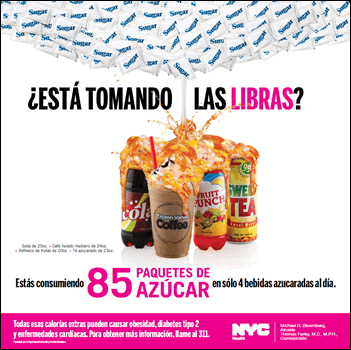
I just got off a subway car adorned with posters advertising the New York City Health Department’s “Are you pouring on the pounds?” campaign.  They are riveting.

They make a simple point, but one that is not always understood:  Soft drinks contain sugar, and lots of it.

Lots of sugar—all those packets—will make you fat.
The campaign also includes a tough video.

New York City’s Health Department is taking on the city’s high rates of heart disease and type 2 diabetes in every way it can.

Take a look.  What do you think?  Will this work?
Comments

[...] This post was mentioned on Twitter by Marion Nestle, Barry A. Martin, David Mermelstein, Sustainable Houston, fadsandfancies.com and others. fadsandfancies.com said: Blogfeed: New York City’s tough anti-soda campaign: I just got off a subway car adorned with posters advertising… http://bit.ly/eTv5BU [...]

  • KB
  • February 13, 2011
  • 9:43 pm

I do think there is a lack of knowledge around the amount of sugar and calories in drinks, especially non-sodas like sports drinks, energy drinks, coffee drinks, etc. However, is there any evidence that those, “you are really eating X teaspoons of sugar” messages work to change behavior, or even increase awareness? I have an advanced degree and I have a hard time translating the “packets of sugar” measurement into calories and weight gain.

Well I am extremely glad the poster is in Spanish!

  • DC
  • February 13, 2011
  • 10:51 pm

KB – Packets of sugar are real and tangible whereas calories and their mechanism of translating into weight on your body is an abstract concept. Calories as a measurement are easily manipulated into a benign thing e.g. 100 cal packs of cookies. This ad gives people a nice easy reference point – most people have to at least seen a packet of sugar on their table at a restaurant.

I agree that sodas should be avoided, but will this just divert people onto “diet” sodas, arguably a bigger chemical minefield and shown not to help people lose weight?

  • Russell
  • February 13, 2011
  • 11:22 pm

I saw this on the train last week and was really excited about it. I think if people see these multiple times it may really sink in how much sugar they are consuming in their beverages.

Knowledge is power!

  • KB
  • February 14, 2011
  • 12:17 am

DC: If “calories and their mechanism of translating into weight on your body is an abstract concept” then how do we expect people to interpret these messages in a way that promotes dietary change and weight loss? If knowing how many sugar packs are in something makes someone think “Wow, that’s a lot” and then forget about it, what’s the point? I’m not saying putting “this soda has 400 calories” on a billboard is any more motivating (although NYC thinks it will change behavior :) , but I’m not sure anyone knows what purpose the ‘sugar packet’ campaign will serve beyond shock value.

  • Sarah
  • February 14, 2011
  • 3:22 am

Do people actually drink that much soft drink? That’s what shocks me!

Actually I have a friend who finally realised how many calories are in alcohol, she stopped drinking alcohol and lost 12 pounds in a week.

Good idea, however, where I travel, I see posters declaring donuts as a food group. Here’s the pic http://bit.ly/4QikjZ

Sugary soft drinks are nothing but cheap empty calories and in my opinion this is a real public health concern. So I’m glad to see this type of message being promoted but I also worry about the ubiquitous ‘packets of sugar’ measurement. I’m not sure that people can really understand the connection between packets of sugar and fat around their waistlines.

I see soft drinks in the same way as cigarette smoking in the 1920′s. Around that time German scientists had discovered the connection between smoking and lung cancer but for various reasons including the distrust in Germans around that time, their discovery was largely ignored. It wasn’t until the 1950′s that the theory again gained momentum and finally led to progressively stricter legislation and ultimately to the decline and taboo associated with smoking nowadays (in developed countries).

How long will it take our governments to react this time? The more educated among us are lucky enough to know about government’s effective sponsorship of the fast food/convenience food industry through shocking agriculture policies. It’s time that this message was clearly broadcast to the people. So I think we should be using these posters to highlight that their freedom of choice has been removed – nudging them towards unhealthy options. It’s time for the people to use their voice and demand and end to corrupt agricultural policies.

  • Anthro
  • February 14, 2011
  • 11:52 am

Hopefully, this is just the beginning. I haven’t had a soda for 40 years, but was overweight for many years until five years ago. It’s a start to cut back (or completely remove) on sugary drinks, but most people still consume too many calories.

Here’s a promising tidbit. I saw a packet of M&M’s (smallest size) and the calories (a whopping 240!) were on the front of the package. While small, the symbol was visible. It certainly stopped ME from buying them, but a point that a couple of commenters made is worth noting: Does the number 240 mean much to most people–even if it is staring them in the face? Do most people have a clue as to how many calories they actually can use in a day? Whether it’s “packets” or “teaspoons”, will it matter to most people?

I wasn’t able to make meaningful changes until I (through a lot of careful reading of valid, broadly accepted science–not the latest food group fad), came to understand that an extra 100 calories/day can translate into a pound (3500 calories) in a bit over a month. That’s is when I faced the fact that calories MATTER and made the effort to count them. Is this a boring way to manage weight? Yes! Has it paid off? Yes! So call me boring, but I like being thinner and healthier.

[...] Food Politics Related Posts:No Related Posts blog comments powered by Disqus /* More [...]

  • Pete
  • February 14, 2011
  • 2:00 pm

This campaignl is HORRIBLY OFFENSIVE to me…. as a marketer. It’s so bad one has to wonder if its true intent is to appease health activists. It is ineffective on every level… 1) no one thinks a packet of sugar is a bad thing, so why are you equating soda to it… 2) Shots of morbidly obese people on the slab just reinforces the rationlization that “hey, as long as I dont look like that I can keep drinking soda”… 3) the extremely graphic images of amputations are totally irrelevant, and that isn’t even the real danger of sugar.

They need to hire a real ad agency and do something effective. You know what would be better…

Root canal $1,500
Diabetes Medication $50 a month
Heart Medication $…
Doctor visits $…
Being there to see your kids grow up

What’s the real cost of that soda?

Obesity is now the #1 cause of death in the US
Sugary drinks are the #1 source of excess calories, the leading cause of obesity.

—-or——

Every year obesity related diseases kill
### Times more Americans than homicide.
### Times more Americans than car accidents.
### Times more than died on 9/11 (if this is a NY ad)

Sugary drinks are the #1 source of excess calories, the leading cause of obesity.

  • Brenda
  • February 14, 2011
  • 5:11 pm

I am 100% on board with these anti-soda and sugary drinks campaign!

  • Elena
  • February 14, 2011
  • 10:54 pm

These have actually been up for quite a while. I was also riveted the first time I saw them, especially considering the graphic (not to mention disgusting) images of physical and visceral fat present along with a clear and simple message. Whether or not these will be effective only time will tell but if we consider the similar approach that has systematically villianized smoking in the public and cultural sphere over the past 50 years I think there is a good chance that these types of advertisements along with some real policy making could be extremely influential in creating the type of cultural shift that is necessary in making Americans change the way the eat. The disparity between the way most Americans are and the way they want to be (read: celebrity culture) goes to show that an ideological shift needs to take place, much like the one that caused Americans to quit smoking. Packs of cigarettes nowadays read: Smoking Kills. Much the same can be said for soda and fast food. And I mean that in a literal way. One or two cigarettes are not going to kill you, nor will one soda or a burger with fries once a while. But habitual consumption of fast food and soda WILL cause health problems that WILL eventually lead to death, exactly the same as cigarettes. Maybe we should start labeling coca cola with: Drinking this Kills. It would be right, and fair.

your question “will this work?” has the same answer as “does the surgeon general’s warning on cigarettes work?”

where cigarette retailers have a sign saying they cannot sell to anyone Under 18, maybe sugar purveyors (ice cream, donuts, soda) need a sign saying they cannot sell to anyone over 200 pounds in weight.

While I believe people should be free to kill themselves by bad living, they should not then rush to the ER looking for help with the result.

  • Amanda
  • February 15, 2011
  • 4:52 am

Pete-the-marketer:

My hope is that scoffers like yourself join the cause. Your expertise will undoubtedly drive the public’s understanding of the soda (sugar sweetened beverage)-obesity connection. If you hate this commercial so, pitch your point to the makers, and join the cause. Better the campaign by encouraging American take heed to YOUR case. Make your message known.

I know this type promotion dawns as the beginning of a good health movement. That said, the word “beginning” shouts, “Improvements needed!”. The approach to obesity, diabetes, heart disease, etc. begs for a multidisciplinary approach. Everyone’s efforts will be the actionable construct enforcing that our society modifies eating patterns. Hail the politician supporting anti-obesity trends. Hail to the health professional prescribing a soda-free diet and exercise. Hail to the advertiser demanding a healthier you. Hail to behavioral psychologists studying food environment and eating behaviors. Hail to the parents organizing health counsels. Hail to the people willing to change a lifetime’s worth of unhealthy.

Just a thought….

  • Amanda
  • February 15, 2011
  • 4:58 am

“Hale” might be the word I was searching for….

  • Pete
  • February 15, 2011
  • 10:44 am

Amanda,

I am way ahead of you. That’s exactly my focus now, using what I have learned for good instead of what I consider evil. Food marketing and marketing to kids are my focus right now. Currently I am working on some new posters and emarketing materials for Screen Free Week in April which is aimed at getting parents to turn off the TV for one week. I’m in the midst of relocating my family right now, but once I get settled I will be able to volunteer more time to these efforts. My goal is to at some point to effectively educate kids and parents on the manipulative nature of media so they can make better, informed decisions.

It just really bothers me to see so much money put towards campaigns that are just not that good. I actually had the privilege of hearing people’s reactions to the ads on the subway just yesterday on my way home. My favorite was “Don’t eat bean soup. It’s got sugar in it,” from one high schooler. People don’t see fat on a daily basis, so they have no clue what they are even looking at. But put a picture of a young girl trying to fit into hear jeans with a muffin top and used cans of soda in the background and you will grab some attention. (yes I know it not a positive body image message)

At the end of the day this campaign strives to do just that “grab attention”. But you have to be clear before clever. These ads are unrelatable to anyone that isn’t already aware of the dangers of sugar. You can even have a very sad looking, modestly overweight girl looking directly at the camera with a headline like “I lost my mom last month to obesity. We used to share 2-liters of soda every day. Now I’ll never share another soda with my mom. Or anyone else.” – then a fact or two about the soda obesity link and obesity death link.

These suggestions are far from perfect, but a serious agency can do much better. I’m sorry, these look to me like beverage manufacturers made these ads to make the anti-soda movement look ridiculous.

Obviously I am all for the messaging, just the proper delivery.

  • B. Koch
  • February 15, 2011
  • 12:57 pm

Education is everything. I stopped drinking soda when I learned (thru a college health class) that there were 13 teaspoons of sugar in a 12-oz can of cola. I wouldn’t put 13 teaspoons of sugar in my coffee or tea and it didn’t make sense to have a cold drink with all that sugar either.

[...] New York City’s tough anti-soda campaign (Food Politics) [...]

  • Amanda
  • February 15, 2011
  • 8:02 pm

Pete, you’re onto something really, REALLY amazing! Something so applicable to the next generation!

As a young Registered Dietitian, nutrition educator for a Pennsylvania education network, and an avid follower of Ms. Nestle–I give you many props for your efforts and intentions!!! Keep forwarding these ideas on!! Please!

Best of luck!

  • Elena
  • February 16, 2011
  • 10:14 am

@ pete et al

i have to say i agree with everyone who says that education is the key, not only in this particular issue but pretty much everything. one of my professors told me that making an educated voter out of each and every one of your college students is absolutely his life’s goal, and i cannot agree more, that is exactly what i aspire to do. it is very inspirational to hear the kind of pro-active work you do pete. what particular organizations are you involved in?

  • M.S.
  • February 16, 2011
  • 2:13 pm

The ads are so gross that I look away, but I don’t find the actual soda bottles to be the gross part. So, not very effective in my case! A soda bottle full of a mound of sugar might be more effective… then I would actually consider what’s inside the bottle. (I like Pete’s comment that no one’s afraid of a packet of sugar… hadn’t thought of that)

  • Pete
  • February 16, 2011
  • 4:55 pm

Thank you so much! It almost brings me to tears when I see other people that get it. Please understand, I am currently a marketing executive for the largest radio network in the country, so I am neck deep in advertisers (especially food advertisers) on a daily basis. I am surrounded by people that just don’t get it no matter how hard I try. It’s easy to lose sight of the fact that there ARE people out there that do care. Which is probably why I read this blog so often. Even though I may disagree with Prof. Nestle sometimes, I know her only agenda is to help and educate people.

I have been going it solo for a little while now, speaking to fellow parents, organizing some groups and talking to kids about the value of exercise and eating well. (I used to be 325+lbs and lost 125lbs of it so kids respond to my before and after photos.) I tie this to the most heavily marketed products to show kids that the more marketing behind something, the more skeptical they must be about it. Young kids desire independence (let’s not get into how marketers exploit that basic developmental stage) so showing them that someone is trying to make them do something, especially in a deceptive manner, usually resonates with them.

I closely follow and sometimes work with Susan @ Campaign for a Commercial-Free Childhood (by work with I mean I sometimes supply some insider advertiser info and consult on research). Recently, I have been looking at their marketing materials and have begun to refresh them (unbeknown to them) so that they are more effective. Their current image is great, if you ARE a four-year-old, but the focus needs to be put on the message, not the organization. I know I can do better and I am sure they will appreciate it. But I am in the middle of a big move form NYC to Florida, so time is pretty tight right now.

I am very much looking forward to working with the Tampa area schools to establish some sort of media education platform – be it in school or online. In just one of my visits there I was able to convince an assistant principal of an elementary school that Pepsi’s Refresh Project was nothing more than a way to infiltrate schools and the money the offer the school isn’t worth sacrificing the sanctity of the environment. She was very responsive and interested in learning more. This was encouraging because Florida school budgets are a contentious subject on the political stage with some high level officials wanting to cut all funding to public schools and give it to the parents so they can pick whatever school they want – for a fee. (Needless to say, that’s utter insanity)

It’s very difficult to one day open your eyes to the career path you’ve chosen and see it for what it really is. The thing I am the best at has now become the very thing I detest – marketing. But I am hopeful. Hopeful that I can find a way to use my powers for good. Hopeful that consumerism won’t consume us as a people. And hopeful more people like yourselves can help shift a culture built on individualism towards empowering individuals to act in the common good.

While I think Pete’s ideas rock, I also think the sad truth is that many people DON’T get how much sugar are in these drinks, and/or that a bottle of sugary (or HFCS-y) tea or “juice drink” is essentially no different than a soda. My husband–hell, he lives with me, he reads my blog, he hears this stuff ALL THE TIME from me (insert joke about husbands and wives and listening skills) still will say things like, “when I took the kids out they were thirsty, and I didn’t want to get the soda, so I got them Gatorade instead.” **headdesk**

People just don’t get it. Lots of people, not just my husband with the questionable listening skills.

Which is my way of saying, YES, this is a good ad. I’m not a marketer, but this works for me.

I hate soda.. i hate the sparkled water and the fact that they have absolutely no health benefits what so ever. what a pointless and useless concoction of chemicals .

Drinking soda is indeed bad for our health when consumed in large ounces. I have to say that the same thing with coffee. I really love tea in return because it is healthy and organic.

Leave a comment