Isn’t it about time GM foods got labels?
I was fascinated to read Cookson Beecher’s Food Safety News’ analysis of current campaigns to label genetically modified foods (GMOs).
It brought back memories of the time I served as an obviously ignored consumer representative on the FDA’s Food Advisory Committee. Back in the early 1990s, the FDA formed this committee to get advice on issues that might be controversial. It asked us for advice about whether to approve GM foods and, if so, whether they should be labeled.
We learned later that the FDA was using the committee to give it a heads up on decisions that were already made. The FDA had every intention of approving GMOs (I wrote about this in my book Safe Food: The Politics of Food Safety).
I and the other three consumer representatives argued as strongly as we could that labeling was essential:
- Consumers have a right to know
- Consumers want to know (polls showed this overwhelmingly, even in 1994)
- Not-labeling will induce distrust of biotech foods and the biotech industry
- Not-labeling will end up hurting the biotech industry (in Europe, definitely. Monsanto is no longer selling GM corn in France and BASF has moved its biotech operations to the U.S.)
- Not-labeling will stimulate the organic industry (it did!)
- The FDA allows plenty of process labeling (e.g., made from concentrate, irradiated)
- Not-labeling will make the FDA look as if it was in bed with the biotech industry
- Transparency is always the right thing to do
Too bad our arguments failed. Eighteen years later, not-labeling has caused no end of problems for the biotech industry. This issue is not going away.
The FDA has approved many GM fruits and vegetables but it is impossible to know whether they are offered for sale in supermarkets (as I discussed in Safe Food, Hawaiian papayas are the most likely candidates).
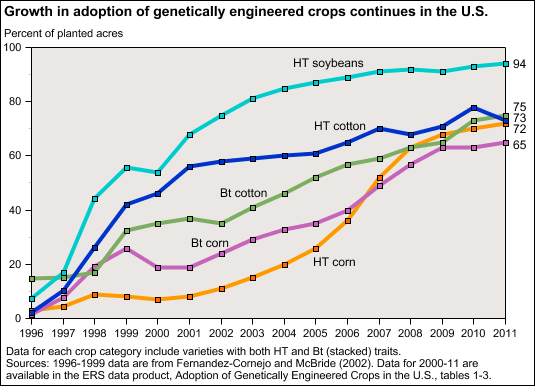
But most corn, soybeans, and cotton grown in America are GM. So are sugar beets.
Campaigns to require labeling of GM foods are heating up.
- Washington state is considering legislation
- California may have a ballot initiative
- 14 states, among them Oregon, New York, Maryland and Vermont, considered bills last year
- Alaska passed a law requiring GMO labeling of fish and shellfish in 2005
- 50 countries require disclosure of GM ingredients
The “Just Label It!” campaign is collecting signatures. If this is an issue you care about, signing on is easy.


Comments
Whee, first bona fide actual employee of a company under discussion to enter the fray. Here’s a big honking hint… when we do so our employer stipulates that we include the following disclaimer (wording is my own, general intent however is company policy)
I’m a Monsanto employee. The views expressed herein are entirely my own and not those of the company. I work in R&D on GMOs, as a (sadly!) unpaid sideline I waffle on the internet about the topic (who’d have thunk it, I have an interest in what I do for a job – shurely some sort of sacrilidge!)
To everyone who would discard what I say as shilling or whatnot, congratulations on failing logic 101 – it is fallacious to discard an arguement simply because it is made by one who has a financial interest in it – sure be more skeptical than you might normally be (although frankly skepticism should be applied thickly wherever time allows) but just because my paycheck is cut by big M doesn’t make a bloody bit of difference as to the veracity of my arguements (some of them may be utterly atrocious due to my penchant for verbal diarrhea, or the occasional brainfart – but these can be dealt with outside of my big M association…. unless you’re chicken mcFly, then by all means resort to cowardly ad hominem)
A lot to cover here, so apologies in advance for the tl;dr nature of the post – I assume anyone who got past the original disclaimer likely has the stamina to make it through the remainder. Possibly not.
Michael Bulger contends early on “The plants are certainly different. How else could a company obtain a patent…” – this has nothing to do with whether things should be labeled – all varieties of all crops are certainly different, but there is no legal mandate that, for instance, food prepared using early maturity group soybeans from Pioneer should have one label, and food prepared using late maturity group soybeans from Monsanto should have another – one can however guarantee that there are more differences between these two sources than there are between a GM and non-GM soybean from the same variety – perhaps you have grievances with Monsanto and not with Pioneer, or are offended by late maturity group soybeans – does this mean there should be mandatory labeling based on your own personal predilictions? I would hope that all but the most batty would answer no to this.
On labeling because that is what people want – I believe the issue has been covered a number of times, but there is no legally mandated labeling (in the US at least) driven simply by the desires of consumers – when it is a desire and not a health issue the labeling is voluntary and is such that the foodstuff the consumer wants is the foodstuff that is labeled, and is where the financial burden of labeling lies – Halal, Kosher etc – I don’t imagine that anyone would argue these should be legally mandated – although I would figure there should be a legal requirement that they are what they say they are.
Back to Michael again “Some people object on religious grounds. Some on ecological or economic” None of these are a reason for mandatory labeling – they certainly make a case for there being a market for voluntary labeling of some form, although frankly other than the religious grounds piece labeling along the lines of whether or not something is GM doesn’t make sense – within industrial Ag it has been shown that both HT and IR traits end up having a lower environmental impact than their non-GM counterparts, as such you’d almost have to mandate a label which reflects the measured environmental impact of the practices utilized in production (whereby one assumes that GM would fare better than non within the same system) within a scientific framework… or you could voluntarily label various things and have consumers assume they know best (produced pesticide free, organic, GM free – all labels which may suggest to some the environmental impact is reduced, but actually says nothing either way on the matter). One wonders in terms of economic grounds how you would label? This seed was originally bred by company X, had a gene from company Y inserted, was grown in state Z, processed by processor… etc etc etc – that’d be a honking great label, and again, the labeling of GM or not, as far as I can tell, is next to meaningless in assessing the economic parameters of the food in question.
“I see a clear difference between truth in labeling and misinformation about the health effects of GMOs. “ when the well is already poisoned it rather plays into the hands of the poisoner to have the product labeled – hey look, scary right! (Particularly with a consumer base who are used to a labeling system where only things which may impact health are subject to mandatory labeling)
On the whole “oh your tone is so bad” schtick Mary has been getting – hurrah for you, tone trolling is so boring – address the issues not the tone (also a good way to figure out if someone is actually just in PR – those folk will bend over backwards to make even the most ludicrously deluded folk feel all warm and fuzzy)
AHN-USA comments “Computer companies tell you what chip is inside, car companies advertise engine type, interesting how biotech companies go out of their way to hide their involvement with your food” well yes, but that is because it is a selling point – you’ll note that computer companies categorically do not tell you where the silicon used in their chip manufacture was mined, or what techniques were used to mine it, car companies don’t go out of their way to disclose the source of each individual component of the engine, and furthermore none of these disclosures is legally mandated. Biotech companies do, actually, go out of their way to make sure that the traits contained within the seed are prominently displayed – they just do it at a point in the chain of sale that makes sense – traits and genetics are plastered all over the bags of seed sold to farmers – there is absolute knowledge of not only the presence of *a transgene* but also the specifics of the transgene being used. (This also addresses Suzanne’s point – identifying labels are widely used where it makes marketing sense)
On Monsanto suing for cross pollination – not even remotely correct – lawsuits are filed when there is clear evidence of deliberate patent violation (Schmeiser for instance) – accidental presence doesn’t a lawsuit make (one assumes not least because if Monsanto tried to pull that crap they’d lose in court) and actually victimizing farmers makes for a crappy business model in an arena where customer trust is key and communities are tight knit.
Computer companies tell you what chips they use?
How much DRAM is in an iPhone 4S? Can you show me on Apple’s web site where it says this? What speed is the CPU?
Why do you spend your time arguing against GMOs for free? Is it due to strong personal convictions? Why is it so hard for you to imagine somebody who disagrees with you doing so out of personal conviction? Why would biotech companies be the only ones using shills? Organic food is a massive industry in the US. Are organic food companies paragons of virtue?
I keep checking back to see if there are some papers for me. Nothing still? Hmm.
I truly don’t understand the shrill “shill” accusations. Really, what good does it do? Even if SkepticalVegan was paid by Monsanto (he is not, to my knowledge, and neither am I) to blog and write comments on websites, what difference does it make? Let’s talk about the facts and the rationale behind labeling. Calling someone a shill doesn’t advance the conversation at all, and just makes the name caller look ignorant since they apparently can’t be bothered to look at the copious information about the person they are declaring a shill. I don’t feel the need to shout shill every time someone posts something I don’t agree with. Why do you?
This is a really silly notion to entertain but I’ll reluctantly add my anecdote to the pile. I’ve known SkepticalVegan for about a year now and he never ever confided in me that he worked for Monsanto in any capacity. We message often and collaborate on many topics that surround veganism, animal rights and science. Our goal is to advocate a healthy skeptical attitude towards these subjects for the betterment of all and especially the oppressed.
Then again, anytime I bring up GMOs in any tone less than vitriolic against them the very first thing that comes out of an anti-GMO advocates mouth is the accusations of being a Monsanto shill, “spy” or “agent”. This says to me that the issue anti-GMO advocates have isn’t grounded in any sort of objective stance but an ideological one that could never be satisfied. Apologists who cuddle up to the ideologues only exacerbate the issue. Science-based professionals, like Marion Nestle whom I admire, would do well to avoid the trappings of this labeling campaign or at least clarify their position so the anti-GMOists can’t further the own irrational agenda. If Nestle has a legitimate point for the singling out of GM foods from conventional methods it would be good to hear so that I may adjust my own views. She’s smarter than me and an expert in these matters so I must assume she has good reason. If not let’s please move forward from the mire of pseudoscience and fear-mongering and empower the people with an better understanding of critical thinking and science!
I’M DESPERATE FOR YOUR HELP – TIME IS OF THE ESSENCE
At some point in the 1990s, Monsanto ran an advertisement in a French magazine saying that GMO food SHOULD be labeled because they are better.
If you know of this advertisement or where I can either get a copy or document this, I would be grateful.
Bob