I was interested to read Charles Blow’s comment in the New York Times (March 12) on the results of a recent Pew Research Center poll. The question: Should the government should have a role in obesity prevention?
Nearly 60 percent said yes. Only about 40 percent said no. Blow comments:
This is a remarkable change in public sentiment from 2005 when the Harvard School of Public Health asked a similar question and got almost the exact opposite result.
So what happened in the intervening years? One major occurrence has been the push by the president and first lady to combat the problem. Their initiatives promote commonsense approaches like increased breast-feeding, better diets and more exercise. Who could argue with that? The right, that’s who.
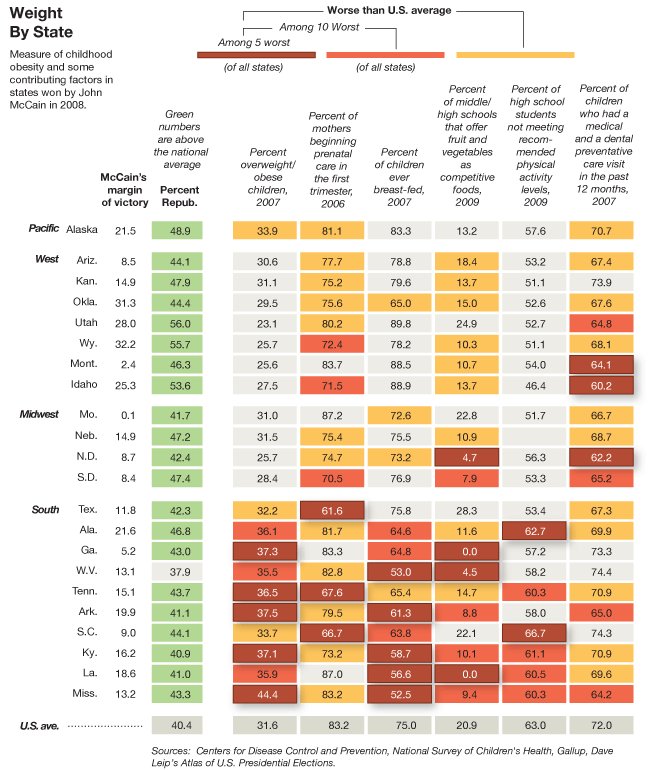
Blow presents the obesity statistics for states won by John McCain in 2008 (see below). His conclusion:
This really shouldn’t be a partisan issue. This should be an all-hands-on-deck issue, including the hands of the government.
And red states, many of which are now the biggest losers in the fight against childhood obesity, have the most to gain.
To me, the interesting thing about this table is what we public health people call “tracking.” Obesity tracks (correlates) with other measures of poor health—diet, activity, prenatal care, health care—all of which also correlate closely with poverty.
The curiosity here is why people who lack access to education, health care, and, for that matter, healthful diets would vote for candidates who don’t want them to have those things, but that’s American politics for you.