Frederick Errington, Tatsuro Fujikura, and Deborah Gewertz. The Noodle Narratives: The Global Rise of an Industrial Food into the Twenty-First Century. University of California Press, 2013.
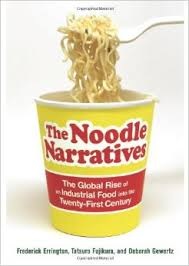
How did it happen that lots of people subsist on instant noodles? As the anthropologist authors explain, Ramen noodles are ubiquitous, quotidian, tasty, convenient, cheap, and shelf stable. The industrial (cheap) versions are loaded with MSG and palm oil. But then, there’s the David Chang Momofuko version, “cosmopolitan and classy,” requiring pounds of meat and taking hours to prepare (not cheap). This book is about the commodification of instant noodles, starting from small Japanese markets and ending up as the world’s most widespread industrial food: “a capitalist provision that provisions capitalism.” But will they feed the world? “Our hope is that the future will provide at least a modest mosaic of choices—a mosaic in which competing orientations toward food, with an emphasis either on security or sovereighty, will continue to challenge one another in a socially and environmentally productive way.