by Marion Nestle

Search results: peanut

Nov 18 2008

Food allergies: OK to eat peanuts if pregnant?

A new study reports that children of women who ate peanuts during pregnancy had lower rates of peanut allergies than women who were told not to eat peanuts.  This could be good news.  But I’m baffled by food allergies.  Why are rates rising?  Why don’t we know more about them?  Why isn’t there more research?  I’m getting lots of questions about them lately.  Good places to start: The National Library of Medicine explains the research.  Organizations like the Food Allergy and Anaphylaxis Network and the Food Allergy Initiative provide basic information.  And for personal experience, Allergic Girl has plenty to say on her blog.

Tags:
Oct 27 2007

ConAgra’s Peanut Butter Recall: the story

CIO, the magazine for corporate Chief Information Officers, has an interesting report on this year’s recall of Peter Pan peanut butter. It’s written from the standpoint of company data managers, the folks responsible for setting up tracking systems for product recalls. Fine, but what about food safety systems?

Sep 13 2007

How’s This for a Use for Peanut Butter?

Peanut butter, it seems, is the basis of a “ready-to-use therapeutic food” (RUTF) for aiding recovery of severely malnourished children in Africa. The announcement of these results doesn’t say what kind. The study itself is published in Maternal and Child Nutrition and the authors make the point that people administering this RUTF do not need to be medically trained so this therapy can be used at home. I’m always amazed when researchers discover that feeding malnourished children helps them to recover. Peanut butter is highly concentrated in calories and the investigators mixed in some vitamins along with it, so I guess it can be considered a superfood.

Jul 7 2026

Contaminated infant formula: Unsafe, unpunished, corrupted

My days of having small children are long past, but my heart breaks for families trying to decide what to feed infants who cannot be breastfed.

Powdered infant formula is the least expensive option.  Unfortunately—and tragically these days—it is not sterile.

Ordinary bacterial contaminants are not a problem.  Pathogens are.

In recent years, there have been all too many illnesses and deaths among infants unknowingly fed contaminated formula.

What got me started was an article in the Wall Street Journal:The Baby Formula Probe Produced a Pile of Evidence. Then the DOJ Dropped the Case,”

The Justice Department spent years investigating Abbott Laboratories over how it managed a baby formula facility where potentially deadly bacteria was discovered and suspected of causing infant deaths, worsening a national shortage.

Some prosecutors believed they had evidence to criminally charge the company under a law they have used to pursue other businesses for allegedly selling contaminated foods, according to people familiar with the matter. Some supervisors also thought it was a good case, they said. Top decision makers instead closed the probe, the people said, opting for a lighter-touch option: clawing back money the company earned from selling formula through federally funded nutrition programs. The outcome, which hasn’t been previously reported, illustrates how the Justice Department under President Trump has moved away from strict approaches to corporate enforcement and raised the bar for punishing companies. Trump in an executive order last year called for minimizing the use of criminal sanctions, where civil penalties could be used instead.

And then, KFF Health News and USA Today co-published “A Mom Said Infant Formula Killed Her Baby. The Manufacturer Closed the File.”

When doctors, hospitals, parents, or others alert manufacturers that babies got sick or died while receiving infant formula, what happens next is left largely to manufacturers such as Abbott Laboratories and Mead Johnson Nutrition, giants of the industry…Under federal rules, if a complaint about an infant formula — such as a report of an adverse event — shows a possible health hazard, the company must investigate. But it doesn’t always have to inform the government agency that oversees the safety of infant formula. A company must complete an investigation and notify the Food and Drug Administration within 15 days only if it finds “a reasonable possibility of a causal relationship between the consumption of an infant formula and an infant’s death.” If that happened even once over more than a quarter century, the FDA could find no record of it, according to information obtained through public records requests.

I was curious to know what food safety lawyer Bill Marler, who represents victims of food poisonings, had to say about all this.  Plenty, starting with The Fox Has Been Guarding the Henhouse for Years: Infant Formula Makers Decide for Themselves Whether Baby Deaths Get Reported to the FDA.

The headline finding should stop every parent, pediatrician, and member of Congress in their tracks…Here is what KFF Health News found when it asked the FDA, through the Freedom of Information Act, for every such notification manufacturers had submitted since January 1, 2020: none. The reporters then asked the agency to search all the way back to January 1, 2000. Again: no responsive records.…This is not an academic problem for me. I currently represent families in two infant botulism outbreaks tied to powdered infant formula — the November 2025 ByHeart outbreak that sickened at least 48 infants across 17 states, and the spring 2026 Nara Organics outbreak that so far has sickened three. In those cases, we have dug deeply into the same regulatory framework KFF Health News just exposed…The adverse event reporting system for infant formula is not a system at all. It is an honor code — for an industry that litigation has shown may not deserve it.

On his Publisher’s Platform, Marler writes: Mr. Abbott, You Are Not Going to Jail After All

Four years ago, I wrote two posts with titles I meant: “Mr. Abbott, you are going to face criminal sanctions” and, a few weeks earlier, “Mr. Abbott, you are going to jail for manufacturing tainted infant formula.” I was wrong. Not about the facts — about the willingness of this Justice Department to do anything about them….A DOJ spokeswoman explained that this Justice Department “does not believe in regulation by prosecution”….There are two details in the Journal’s reporting that should make every parent’s stomach turn. First, even if DOJ had wanted to prosecute, the office that does this work — the Consumer Protection Branch — was being disbanded as a cost-cutting measure, the same branch that put away the executives behind the Peanut Corporation of America salmonella outbreak. Second, one of Abbott’s defense lawyers — a former deputy attorney general — reportedly urged the incoming administration to overhaul that very office and strip it of its ability to bring criminal cases at all. Read those two sentences together and ask yourself who is writing the rules now.

Why is this happening?  500,000 Reasons to Drop a Criminal Investigation

Here is why the families I represent — and every parent who lived through the 2022 [Abbott formula] shortage — should be furious.

Abbott gave $500,000 to President Trump’s inaugural fund. Public Citizen has documented that Abbott was one of 58 corporations facing federal investigations or enforcement that together poured some $50 million into the inauguration…And then there is the stock. As Common Dreams reported this week, the President’s own annual financial disclosure…shows that Trump began buying Abbott stock in late September of last year and picked up roughly $500,000 worth of Abbott shares over the course of 2025. The buying happened while his Justice Department was still sitting on a criminal case against the company.

$500,000 into the inauguration. $500,000 in stock in the President’s own portfolio.

As Marler is careful to say, “No court and no investigator has found that the donation or the stock purchases caused this case to be dropped. What is undisputed is the sequence: the money, and then the vanished prosecution. Whether one caused the other is a question no one in a position to answer has been willing to answer.”

I’d say it sures gives the appearance of conflicted interest if not bribery and corruption at the highest levels of government.

Excuse me, but we are talking about helpless newborn and very young infants here, utterly dependent on formula as their sole source of nourishment.

Cases of contaminated formula may be rare, but they have affected commercial, alternative, and organic brands, and their consequences are devastating (take a look at the case studies in Marler’s letter of support for the Infant Formula Safety Modernization Act of 2026).

Congress needs to pass this act, and right away.  And is needs vigorous enforcement.

Legal slaps on wrists will not stop food safety violations.

In the meantime, the safest formula is the liquid form, pasteurized to kill spores as well as living pathogens.   Otherwise, powdered formula is a risk, a small risk, but finite.  You do not want your infant to be one of the unlucky ones.

Jun 4 2026

The eye-rolling protein craze: some thoughts

Nutritionists like me cannot understand why people think they need more protein, so much so that the food industry is putting protein into everything.

Most Americans consume close to twice the amount of protein needed, and practically anyone who consumes enough calories gets plenty.  Protein is in lots of foods and it’s really hard not to get enough unless you aren’t eating much.

I’m endlessly entertained by protein in everything, and am tracking its effect on the food industry.

Guess what.  There’s a shortage.

Protein powder shortage threatens America’s biggest food craze: Companies are now grappling with whether to raise prices at a time when consumers are already reeling from a prolonged period of inflation.

The food industry views the protein craze as a growth opportunity.

How protein is shaping active nutrition in 2026:  Sustained demand for protein continues to define the active and performance nutrition space. But where are the growth niches?… Read more

And it’s not just food.  Look what’s happening with drinks.

From coffee to soda: How protein is making waves in beverage innovation:  Drinks are a new frontier for protein innovation… Read more

And just because a product contains protein, doesn’t necessarily mean its healthy.

The new paradox: Protein vs processing:  Protein is the snack industry’s hottest claim but if the foods delivering it are still ultra-processed, the sector may be building its next health halo on shaky ground… Read more

Unusual sources of protein are not doing so well these days.

Insect protein’s reality check: High costs, failed ventures and slower-than-expected market growth temper early optimism.

But peptides—smaller chains of amino acids—are another craze, despite lack of evidence for their benefits.

Peptides Move From Fringe Biohacks to Functional Food Frontier:  As demand surges for targeted health solutions, Nuritas’ Nora Khaldi discusses how AI is transforming peptide discovery, and why food and beverage may be the industry’s next big play… Listen now

As always, I’m for getting protein from foods, largely plant sources.  Yes plant proteins sometimes are low in essential amino acids but the low ones differ among plant sources, so variety takes care of gaps: rice, wheat, and corn with beans, peanut butter sandwiches.  Easy.


May 15 2026

Weekend warning: pets and cannabis edibles

I am a big fan of Whole Dog Journala terrifically interesting and useful publication about anything you might want to know about having a dog as a pet—or family member.

One of its recent articles: What to Do If Your Dog Eats Marijuana (Edibles, Weed, Vape Cartridges, etc.)

I wrote about cannabis edibles in a chapter in my latest book, What to Eat Nowand discussed edibles as pet food in that chapter.  That section starts like this:

Pet treats and supplements constitute a sub-genre of edibles, and one that is highly profitable. Owners of dogs and cats spent an estimated $426 million on CBD [non-psychoactive cannabidiol],  pet products in 2020, an amount expected to increase in parallel with reports of increasing anxiety, stress, and behavioral problems in companion animals. For the cannabis industry, pet anxiety is a market opportunity, one that easily explains Honest Paws Calm CBD Peanut Butter for dogs or D Oh Gee CBD turkey and cranberry chewies for calming support and joint wellness.

Every cannabis store in my Manhattan neighborhood sells CBD—but also THC (psychoactive delta-9 tetrahydrocannabinol)—treats for dogs.

The Whole Dog Journal article warns: “The amount and type of THC-containing product consumed will determine the seriousness of this event for your dog, and dictate the level of your emergency response.”

A variety of products are available as cannabis edibles, including gummies and other candies, mints, chocolates and chocolate bars, beverages, potato chips, and baked goods such as brownies and cookies. Unfortunately, many of these sweet or savory options are also attractive to our dogs. While we may have more self-control regarding how many edibles we consume at one time, dogs are more likely to ingest an entire package of any edibles they can reach because they taste delicious.

The writer warns that if you see signs of THC toxicity in your dog “listlessness, incoordination when walking, falling over when standing, dilated pupils, slow heart rate, dribbling urine, and an exaggerated response to light, touch, and sound,” take it to a veterinarian immediately.

My advice:

  • If you have edibles in your home, lock them up where your pets—and your children—cannot get at them.  Edibles are an increasing cause of kids’ visits to hospital emergency rooms.
  • If you have pet edibles in your home, keep them away from your pets (so they don’t overeat them)—but also keep them away from your children.  Young kids can’t tell the difference between gummies for pets, grownups, and them.
Mar 17 2026

Lawsuit #1: David’s protein bars

This week, I’m going to be writing about lawsuits against food companies, starting with the class action lawsuit filed against David Protein, which states that the company misrepresented the calorie and fat content of its bars.

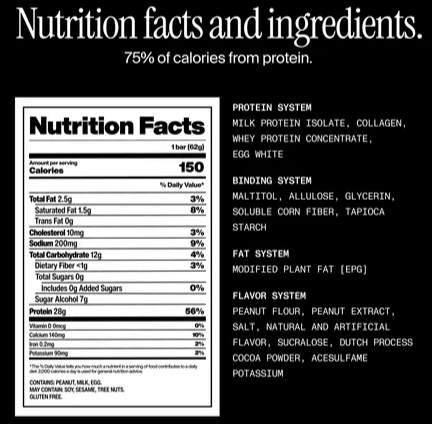
Here is a Nutrition Facts panel from the company’s website.

The FDA allows several methods for counting calories in food products, one of which is to apply Atwater values, 4 calories per gram for protein and carbohydrate, and 9 calories per gram for fat (this is why fat is fattening).

Doing that here gives:

Fat: 2.5 x 9     =    23 (rounded off)

Carbs: 12 x 4  =    48

Protein: 26 x 4 = 104

Total calories  =   175

This is higher than what’s on the label.  But calories are difficult to measure accurately, so the FDA allows a 20% margin of error.

But the difference must have gotten the attention of the plaintiffs.

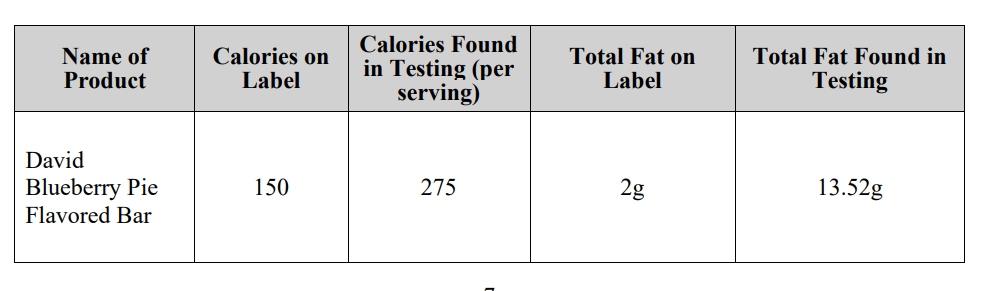
They took the product and burned it in a bomb calorimeter, a device that measures the heat produced when foods are burned to completion.  This heat is equivalent to calories, when corrected for the nitrogen in protein.

Here is what the plaintiffs got when they did this.

Wow.  That’s quite a difference.

But David’s has a rebuttal.

…bomb calorimetry is not the right testing method for determining calories in foods containing certain ingredients, such as dietary fiber, certain sweeteners, and, critically for us, fat substitutes like esterified propoxylated glycerol (EPG)…If you burn ingredients like complex carbohydrates, fiber or EPG in a calorimeter, these ingredients would appear to deliver far more calories than the body actually metabolizes.

This took me right to the ingredient list (see above)

PROTEIN SYSTEM: MILK PROTEIN ISOLATE, COLLAGEN, WHEY PROTEIN CONCENTRATE, EGG WHITE. | BINDING SYSTEM: MALTITOL, GLYCERIN, ALLULOSE, TAPIOCA STARCH, SOY LECITHIN. | FAT SYSTEM: MODIFIED PLANT FAT (EPG), COCONUT OIL. | FLAVOR SYSTEM: UNSWEETENED CHOCOLATE, PEANUT FLOUR, NATURAL AND ARTIFICIAL FLAVOR, PEANUT EXTRACT, SALT, DUTCH PROCESS COCOA POWDER, SUCRALOSE, ACESULFAME POTASSIUM.

My first question: Why would anyone want to eat a collection of concocted ingredients like this with hardly any of them recognizable as food?  These bars are quintessential ultra-processed products.

Whatever.  EPG is esterified propoxylated glycerol, a fat substitute. It provides less than one calorie per gram.

Here’s my quote from the New York Times

Dr. Marion Nestle, a professor emerita of nutrition and food studies at N.Y.U., told DealBook that the plaintiffs’ claims were based on counting calories from a “concocted ingredient that’s not absorbed” by the body. The lawsuit was likely to be dismissed, she added.

Not that Nestle was weighing in on the healthfulness of David bars: “Whether anyone should be eating non-absorbable fat is another discussion,” she said.

Precisely.

Mar 6 2026

Sweet thought for the weekend: Reese’s v. Hershey’s

This story starts here with this post.

Really? When I go to the Hershey’s site, I get this:

Milk Chocolate (Sugar, Cocoa Butter, Chocolate, Skim Milk, Milk Fat, Lactose, Lecithin, PGPR); Peanuts; Sugar; Dextrose; Salt; TBHQ & Citric Acid (TO MAINTAIN FRESHNESS)

Four kinds of sugar and ultra-processed; it’s hard to believe it could get worse.

Even so, the Reese family doesn’t like what is happening to its iconic brand.

Hershey blasted by Reese’s family over core ingredient changes: Reese family sends open letter to Hershey, challenging whether the confectionery giant is protecting the Reese’s legacy… Read more

Hershey facing criticism from Reese family

  • Reese family member accuses Hershey of lowering core product quality
  • Brad Reese claims formulations replaced milk chocolate and real peanut butter
  • Open letter argues changes threaten brand heritage and consumer trust foundations
  • Criticism pressures Hershey to address transparency concerns amid evolving brand strategy
  • Debate highlights tension between cost efficiencies and protecting long-held product identity

Comment

As described in yesterday’s post, the chocolate industry is in trouble because of diminishing supplies, increased costs, and climate change.  Hershey’s must think its customers can’t tell the difference between simple real food ingredients and ultra-processed concoctions.

Real foods cost more.  That’s a problem for food companies.

Tags: