
by Marion Nestle

Currently browsing posts about: Personal-responsibility

May 1 2026

Weekend reading: It’s all your fault

Nick Chater & George Loewenstein.  It’s On You: How the Rich and Powerful have convinced us that we’re to blame for society’s deepest problems.  WH Allen, 2026.  345 pages.
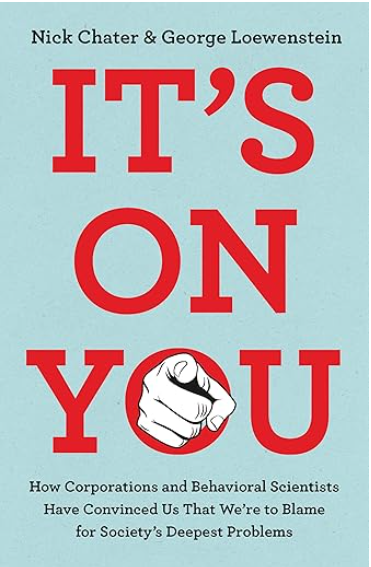
This book directly addresses an issue I’ve fussed about for ages: putting the blame for poor diets on individuals and ignoring the social and political forces that make eating healthfully so difficult and expensive.

As I like to put it, if you are trying to eat healthfully in today’s food environment, you are fighting an entire food system on your own.

Chater and Loewenstein take on much more than diets; their book deals with such matters as pollution, climate change, health care, and inequality from the standpoint of how the issues are framed: i-frame (individual behavior is at fault) versus s-frame (the system makes healthy choices impossible).

As they put it,

Instead of making people fat and then providing them with expensive drugs to curb their appetites, clearly our first collective priority should be to tackle the root cause of obesity—and this means a radical overhaul of how the food industry is regulated, taxed, and subsidized, and reversing the trend toward energy-dense, high processed foods and drinks deliberately engineered to be as difficult to stop consuming as possible.  This means forcing the food industry, through regulations or financial incentives, to create and market products that promote, rather than damage, human health.  p. 76.

How can we do better?…We’ll see that the answer is not primariy about inventing new, innovative policies: For most of the problems we have discussed, there are examples of successful policies implemented in other countriesthat could provide almost off-the-shelf solutions.  Social and environmental problems exist not because we can’t figure out how to solve them, but because powerful interests benefit from the status quo.  So the key question is how to build support for, and to frame, those policies in ways that can attract the coalition of support required to drive change.  p. 209.

We’ve seen throughout this book that rigged rules, not flawed individuals, lie at the heart of many of society’s most persisstent problems.  But if this is right, a natural question arises: Why aren’t the rules reformed to work in the intersts of the many, not the few, given that in a democracy the many have, by definition, the majority of the votes?  The answer, as we gave seebm us that the demoncratic process has been hacked by the powerful and wealthy.  This corrupting influence of power and money on politics is an ever present threat…. p.259

We’ve argued in this book that many of our most pressing and persistent social and environmental problems remain unsolved not because we don’t collectively know how to solve them, but because powerful interests beneft from their not being solved.  Indeed, the powerful typicallt do everything they can to ensure that the rules of the game are rigged in their favor….multinational food companies use their influence to expand their global markets for unhealthy ultraprocessed foods and to push back against legislative restrictions aimed at improving public health….  p. 271

This is an important argument, one that bears endless repeating—along with action to change the system.

Get money out of politics!
Oct 11 2024

Thoughts about the state of nutrition III. Personalized nutrition

III.  Personalized, as opposed to Public Health, Nutrition

Stephanie Rogus, a former doctoral studentt in my NYU department, and Peter Lurie, director of the Center for Science in the Public Interest, have a new paper out: Personalized nutrition: aligning science, regulation, and marketing. Health Affairs Scholar, Volume 2, Issue 9, September 2024, qxae107, https://doi.org/10.1093/haschl/qxae107

Proponents of personalized nutrition assert that population-based approaches to dietary recommendations have had limited impact because they have failed to take interindividual differences into account. Proponents argue that increasing or reducing consumption of particular foods in response to the results of a survey or diagnostic test allows for the development of more personalized and, it is argued, more effective recommendations.

Their paper does not deal with the flaws in individualized approached to nutritional health—“precision” nutrition: the cost, the difficulty, the lack of support, the inability to reach those who most need support, etc.  Instead, it focuses on the commercialization of personalized nutrition:

regulatory gaps have led to market growth of products with unknown efficacy that are making bold, and possibly unsubstantiated, claims. As personalized nutrition products and related treatments continue to enter the market without regulation, unreliable products may cause consumers financial, psychological, and physical harm. Stronger regulation will help engender trust in these products among consumers and ensure their safety and effectiveness.

Hard to argue with that.  Glad they wrote it.

Mar 9 2012

The Lancet on nudging and nagging vs. environmental change

I’m getting caught up on my journal reading and just ran across an editorial from The Lancet, January 21It takes on the UK government’s “personal responsibility” approach to health promotion based on the idea that

gently ‘nudging’ people to change their unhealthy behaviours was the key to public health.

Even the UK government has to admit that the nudge approach isn’t working.  Now it is telling physicians in the National Health Service (NHS) to nag:

use every contact with patients and the public to help them maintain and improve their physical and mental health and wellbeing.

The Lancet asks:

Is this a realistic, sensible, and effective recommendation? We would say not.

Effective, evidenced-based public health measures do not include nudging people into healthy behaviours or getting NHS staff to lecture patients on healthy lifestyles.
They include measures such as raising taxes on cigarettes, alcohol, fatty foods, and sugary drinks, reducing junk food and drink advertising to children, and restricting hours on sale of alcoholic drinks….Focusing on other approaches is foolish.
The nudge and nag approaches need one thing: the firm elbow.
I do enjoy reading The Lancet.  Its editors are so clear about the need for environmental changes to make it easier for people eat better diets and be more active.
Aug 17 2008

USDA: it takes more than education to change dietary choices

USDA economists have just produced a theoretical study proposing – surprise! – that knowledge of nutrition is not sufficient to change dietary behavior. What they call “immediate visceral factors” (i.e. hunger, food in front of you, large portions) overpower “cognitive dietary information.” They don’t put it this way, but that’s why personal responsibility doesn’t work. You have to change the food environment to make it easier to make better choices. It’s nice to have some evidence….