
Jan
8
2011
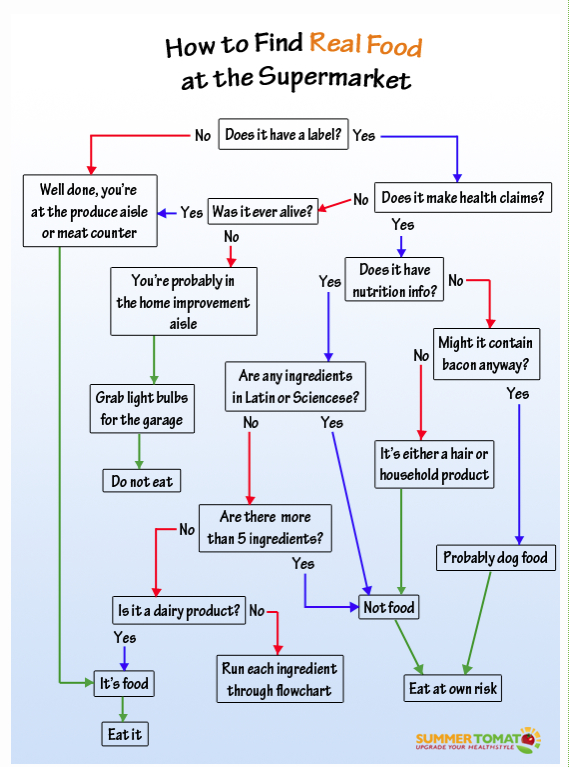
Darya Pino’s guide to supermarket navigation
This diagram is flying all over the Internet and has been sent to me by so many people (thanks to all) that I’m eager to share it.
I particularly like it because it’s just what I used to say in lectures after What to Eat came out in 2006. My What to Eat rules say never to eat a food with:
- More than five ingredients (too processed)
- An ingredient you can’t pronounce (ditto)
- Anything artificial (ditto)
- A health claim on the front (these are always about marketing, not health)
- A cartoon on the package (it’s being marketed to kids)
Much praise and many thanks to the designer, Darya Pino (of Summer Tomato):
Leave a comment
Next public appearance
May
31
2012
NYU: Fales Library panel
The topic: “How would Julia Child vote on the 2012 farm bill? 4:00 p.m., Fales Special Collections at Bobst Library. Open to public. Details are here.
Search
Related posts
Topics for this post
All Topics
5-a-Day
AAFP(American Academy of Family Physicians)
AAP(American Academy of Pediatrics)
Acrylamide
ACSH(American Council on Science and Health)
Activity
ADA(American Dietetic Association)
Addiction
Additives
Advocacy
Agave
Aging
Agriculture
AHA(American Heart Association)
Alcohol
Alice-Waters
Allergies
American-Diabetes-Association
Animals
Antibiotics
Antioxidants
Arsenic
Artificial-sweeteners
ASN(American Society of Nutrition)
Asthma
Açaí
Beef
Bill-Marler
Biofuel
Blogs
Books
Bottled-water
BPA
BPA(Bisphenol-A)
Bread
Breakfast
Breast-feeding
Brian-Wansink
Bribery
Burger-King
Caffeine
CAFOs(Concentrated Animal Feeding Operations)
calcium
Calorie-labeling
Calories
Campbell
Canada
Cancer
Candy
Cantaloupe
Carcinogens
Cargill
CCF(Center for Consumer Freedom)
CDC(Centers for Disease Control)
Cereals
Charlie-Rose
Checkoff
Cheerios
Cheese
Chicken
Chickens
China
Chinese-infant-formula
Chocolate
Cholesterol
Climate change
Cloned-animals
Coca-Cola
Coffee
Colbert
Comments-Monitoring-Policy
Comments-Policy-Monitoring
ConAgra
Conflicts-of-interest
Consolidation
Consumer Reports
Cookie-dough
Cooking
Cooking-measurements
COOL(Country of Origin Labeling)
Corn
CSPI(Center for Science in the Public Interest)
CSR(Corporate Social Responsibility)
Dairy
Del Monte
Denmark
Diabetes
Diet-and-dieting
Diet-and-energy-drinks
Diet-drugs
Dietary-Guidelines
Diets
Disney
E.coli
Eat-less-and-move-more
EatingLiberally
EFSA
EFSA(European Food Safety Authority)
Eggs
EPA
Eric-Schlosser
Ethanol
Ethics
Events
Excerpt
FAO
FAQ
Farm-bill
Farm-policy
Farm-workers
farmers markets
Farms
Fast food
Fats-and-oils
FDA
feed efficiency
Fiber
films
First Amendment
Fish
Flaxseed
FMI(Food Marketing Institute)
Food
Food-access
Food-and-Water-Watch
Food-art
Food-assistance
Food-availability
Food-choice
Food-colors
Food-composition
Food-crisis
Food-culture
Food-deserts
Food-guide
Food-Inc
Food-industry
Food-industry-regulation
Food-magazines
Food-marketing
Food-miles
Food-movement
Food-policy
Food-quality
Food-safety
Food-security
Food-stamps
Food-studies
Food-supply
Food-systems
Food-trade
Food-waste
FOP(Front-of-Package)Labels
Fortification
Framingham-Heart-Study
Fruits-and-vegetables
FTC (Federal Trade Commission)
Functional-foods
Futures-markets
GAO
GAO(Government Accountability Office)
Gardens
Gary-Taubes
General-Mills
Gluten
GM(Genetically Modified)
GMA(Grocery Manufacturers Association)
Grassfed
Green-food
HACCP(Hazard Analysis and Critical Control Point)
Hannaford
Health-aura
Health-claims
Health-statistics
Heart-disease
HFCS (High Fructose Corn Syrup)
HHS(Department of Health and Human Services)
Hormones
Hugo drinks
Hydroponics
hyperactivity
IASO
India
Infant-formula
International
Interviews
IOM (Institute of Medicine)
iraq
Irradiation
IWG(Interagency Working Group)
Jamie-Oliver
Japan
Job-Ads
Joy-of-Cooking
Juice-drinks
juices
Junk food
Kellogg
Kelly-Brownell
KFC
Kids' diets
King-Corn
Korea
Kraft
krill
Label-scoring-systems
Labels
Lawsuits
Legislation
Let's Move!
Letters-From-Food-Companies
Listeria
Lobbies
Local-food
Lévi-Strauss
Mad-cow-disease
Malnutrition
Manure
maps
Margarines
Marketing to kids
Mark Hegsted
Mars
McDonald's
meal frequency
Meat
Meat safety
Meat substitutes
media
Melamine
Mercury
Michael-Pollan
Michael-Taylor
military
Milk
Monsanto
Movies
MSG
MyPlate
Nanotechnology
Natural
neighborhoods
Nestlé
New-York-City
New-Zealand
Niman
Nutrient-availability
Nutrition-education
Nutrition-standards
Nutritionism
Obama
Obesity
Obesity-in-kids
Obesity-policy
Occupy
Omega-3-fats
Organic-fish
Organic-standards
Organics
orthorexia
Oysters
Pakistan
Partnerships
Passover
Patents
Paula Deen
Peanut-butter
Peanuts
PepsiCo
Personal-responsibility
Pesticides
Peter Jennings
Pet food
Phil Lempert
Photos
Pink-slime
Pistachios
pizza
Pork
Portion sizes
Potatoes
pregnancy
Pric
Price-fixing
Price-of-food
Probiotics
Processing
Protein
Public-health
Pyramid
Quotes from What to Eat
Radioactivity
Raw-foods
Raw-milk
rBGH
recipes
Red-Bull
Research
Restaurants
Revolving-door
Right-to-food
Rosa DeLauro
RWJ Foundation
S.510
Salmonella
Salt
San-Francisco-Chronicle
scho
School-food
Seeds
shrek
Single-food-agency
Slow Food
Smart Choices
Snack foods
Socioeconomic-factors
Soft drinks
soy
Spinach
Splenda
Sprouts
Starvation
Stevia
sticky
Sugar
Supermarkets
Supplements
Supreme court
Surveys
sushi
Sweeteners
Swine flu
Taste
Taxes
Techno-foods
Television
Thomas Friedan
Tim Lang
Tobacco
Tomatoes
Toxins
Trans-fat
Tufts
Twitter
Tyson-foods
United Nations
Urban-farming
USDA
Vegetables
Vegetarian-and-vegan
Vending-machines
Videos
Vitamin-water
Vitamins
Wall-Street
Walmart
Washington-Square-News
Water
WHO(World Health Organization)
Whole Foods
Whole grains
Why-Calories-Count
WIC
World hunger
Yearly Kos
Yogurt

Comments
[...] This post was mentioned on Twitter by Marion Nestle, Sharon Maraj, Linda Sgoluppi, Tom & Lori Leavitt and others. Tom & Lori Leavitt said: RT @marionnestle: Darya Pino’s guide to how to find real food in the supermarket http://bit.ly/eUWTzz [...]
Science is scary, we must avoid it! I hate to tell you, but those fruits and meats have scary sounding chemicals in them, as does all matter in the universe.
The only things that makes a health claim that count as food are dairy products?
This is so stupid.
Says a person who doesn’t eat food (see previous comment).
Eat food. Not too much. THE END.
The split-pea soup I made on Friday had more than five ingredients. Should I have stopped when I got to the celery?
I wanted to just get some water but when I got home I found that the supermarket gave me a bottle of hydroxylic acid instead! It’s in sciencese so I’m very very scared. Should I drink it or take it back?
Nice post! I actually hadn’t seen the diagram before, and it makes a lot of sense to me. My partner and I have nevertheless even decided to go a step further, and explained in a recent post why we have decided to stop buying food from supermarkets altogether… (http://makingsenseofthings.info/2011/01/why-weve-decided-to-stop-buying-food-from-supermarkets/) It will probably sound weird for most, but to us, it just makes sense!… Anyway, where do you buy your food then?
jsr
Vitamin B12 is called Cobalamin
Vitamin C is Ascorbic Acid
See a theme here?
I agree. All too often at the supermarket I see people with carts full of frozen and boxed goods. Those types of foods aren’t too good for the brain and body. I always stick with meats, vegetables, eggs, milk, and grains. But hey, if corndogs and microwaveable pizza flavored pocket microwave snacks are your thing, enjoy!
Have you EVER found a ripe non-rock-hard peach (in the “fresh” veggie section of a typical grocery store) while shopping?
Not I.
If it wasn’t for peaches in a can (same with pears) I would have to hop a freight train and trek to where those fruits are grown and seek a tree where those fruits were allowed to mature to a stage of ripeness that would allow a human without jaws and teeth of steel to eat them as evolution intended.
Ascorbic Acid is not a food – it’s a sugar acid that can be isolated from food or synthesized in a labratory. Even the USDA’s organic certification program asserts this, limiting the potential for a product to be certified organic if it has more than a very small amount of ascorbic acid added. Vitamin C is so easy to get in food – even if the nutritional value of taking ascorbic acid weren’t controversial, it seems sill to pay for a product that adds it to make their non-food look healthier.
On the other hand, Cobalmin, aka vitamin B-12, is the natural form of that vitamin but it’s very hard to find a supermarket product with cobalmin added – usually you’ll find cyclocobalmin as the B-12 additive, which is synthesized in a lab, much cheaper to use in production, and when the body breaks it down, it leaves a small amount of cyanide behind to be dealt with by the liver. Nice.
B-12 is really tough to get in your food though, which points out to me the basic flaw in this diagram. It is based on an idealism that few people in this country, or world, can attain. If you happen to be particularly fond of liver, giblets, oysters and clams, or can afford to have Alaskan king crab on a regular basis you may be ok on B-12! If you do dairy and include a lot of swiss cheese and whole milk in your diet, you may still be ok.
Otherwise, you probably need a supplement. Maybe we need a different diagram for that, to help us navigate all the synthesized versions of nutrients that may not be as helpful as the sellers would like us to believe.
So, I can eat nothing but red meat, organic ice cream and bananas, and that’s okay, because it’s real food? But I should avoid a fruit puree smoothie from the health food store- health claims and more than 5 ingredients.
Plus, when I buy unprocessed food, I usually bring it home- and process it myself by cooking, blending, etc, and most of the time by combining more than 5 ingredients.
These rules seem kind of arbitrary, similar to some people’s very strict religious eating guidelines.
A general rule I follow is to keep to the outside of all the aisles i.e. shop around the perimeter. That’s where you’ll find the produce, dairy, butcher. As one ventures into the aisles the foods tend to get more processed.
I’ve seen health claims on bags of spinach and containers of roasted almonds. They’re both (relatively) unprocessed, natural foods. One ingredient in the spinach (spinach), two in the almonds (almonds, salt). Admittedly, you shouldn’t buy it because of the health claims on the box, but health claims don’t imply it’s not real food.
This diagram makes no sense.
Is salt not food? Can we not use iodized salt (both never alive and chemical names), despite the fact that iodized salt has single-handedly vastly improved thyroid health in this country?
Why is dairy the only food that is allowed to be highly processed and fortified? That’s a big clue that this diagram has little to do with eating healthy, minimally processed foods and everything to do with eating foods that people believe are “traditional” and therefore acceptable.
It’s one thing to say that you should avoid nutritionally-deficient highly processed foods (like added sugars and oils), it’s quite another to say that processing in and of itself makes a food non-nutritive. It doesn’t. It often makes it MORE nutritious (see dairy, salt).
Dairy Product -> Does it contain starch, gum, pectin or other coagulation ingredient? (YES) -> Return to shelf.
Almost anything with flour in it uses enriched flour, so you’ll see half a dozen vitamins as well as the actual wheat, so you’re ruling out bread – did you really mean to do that? And what about the breads that have nine kinds of grain or whatever? On the other hand, some tortillas just have corn, lime, and water, while others have a dozen kinds of preservatives and texture modifiers, and I don’t buy those. (Preservatives provide a useful function, and are probably better to eat than mold, but keeping tortillas in the freezer works fine too.)
And my father was a chemist, and I took Latin in high school, so there aren’t any chemicals I can’t pronounce. But when I buy frozen vegetables at the Chinese grocery store, sometimes they’ll use give the Latin name of the plant if it doesn’t have an English name, and that’s just fine. (The cooking instructions are probably in Chinese, but that just means that cooking it is more experimental.)
[...] Source: Darya Pino’s guide to supermarket navigation. [...]
I think many posters are missing the point of this diagram…it’s supposed to be funny!
I love the “Might it contain bacon anyway?” question, still chuckling to myself .
This is great. Now i’m really confusled. There is truely insight to this rethoric *~*
GEE WHIZ…..LIghten up, people! Use your common sense here….it’s supposed to be funny with a touch of reality mixed in. The five ingredient thing is for PROCESSED food, not things you make in your kitchen or get at the smoothie bar. Good Grief! Does someone really need to explain that to you??
I think this is a brilliant chart. Makes great sense and is simple to follow. However, those wonderful fruits and vegetable have been sprayed with harmful chemical and pesticides that can cause harm to our bodies. What I do is make a spray that will clean some of the harmful things. I use 1 cup of clean water, 1 cup of peroxide and
3-5 teaspoons of dish soap. Mix this together in a spray bottle and keep it near your sink and it will always be ready to use on your fruits and veggies. Just remember to rinse the items very well or you will get a soapy taste in you mouth.
Novel idea, but fails in its execution.
But, if this is just a draft, here is some feedback- The arrows don’t make sense, the questions are trivial and nonsense as well. Reframe them. The five ingredient rule is ridiculous as others have pointed out- I make a great Pumpkin Soup that has about 10 ingredients and is loaded with antioxidants, vitamins, and superfoods.
In addition the chart diminishes the value of whole grains. Rice, oatmeal, quinoa, amarynth … all have significant nutritional values. I eat them quite often … and they all have labels on them. Even when bought in the bins- the store still puts the label on it. Nutritional labels can be a helpful tool to us, which is why the consumer essentially demanded them from year’s past!
Silly chart, just going to get people frustrated on eating healthy and making the claim- see, it really is hard to eat right.
This is great! Real food comes from a farm, not a factory.
This chart is fun, and at least thought provoking – and maybe helpful to some people, for example someone who is new to healthy eating, but doesn’t know much. As long as they are up for preparing everything from scratch from whole ingredients, this would be helpful. But once you learn more, for example what some of the “science-y” names mean, you can label read and make these decisions without these blanket guidelines. Canned soup may not be the nectar of the gods but if it is organic and has 10 perfectly fine ingredients, I might eat it on occasion without losing sleep over it. Or if they added ascorbic acid to something as a preservative. Etc.
It’s like the “only the outer aisles” shopping technique. That doesn’t really pan out, though. If you want some brown rice, or a can of tomato paste, or some coconut milk, whoops, had to go down an inner aisle. There is usually something reasonable on almost every aisle, I mean, even the chips and soda aisle has bottled water and wine at my store. Since I don’t impulse purchase chips whenever I walk past them, this is not a problem (might be for some) as I go get an occasional San Pellegrino.
“Dairy Product -> Does it contain starch, gum, pectin or other coagulation ingredient? (YES) -> Return to shelf.”
Exactly when have starch, gum (presumably xanthan gum), or pectin become bad for you?
OMG. Lighten up people! This is a humorous take on a real issue. Guess it just proves how truly confused about what to eat we all are.


