Dec
12
2012
We eat what we buy. Both need improvement, says USDA.
USDA’s Economic Research Service has just issued a report, Assessing the Healthfulness of Consumers’ Grocery Purchases.
The bottom line? Americans buy fewer fruits and vegetables than recommended but far more refined grains, sugars, and meat.
Here’s the summary diagram:
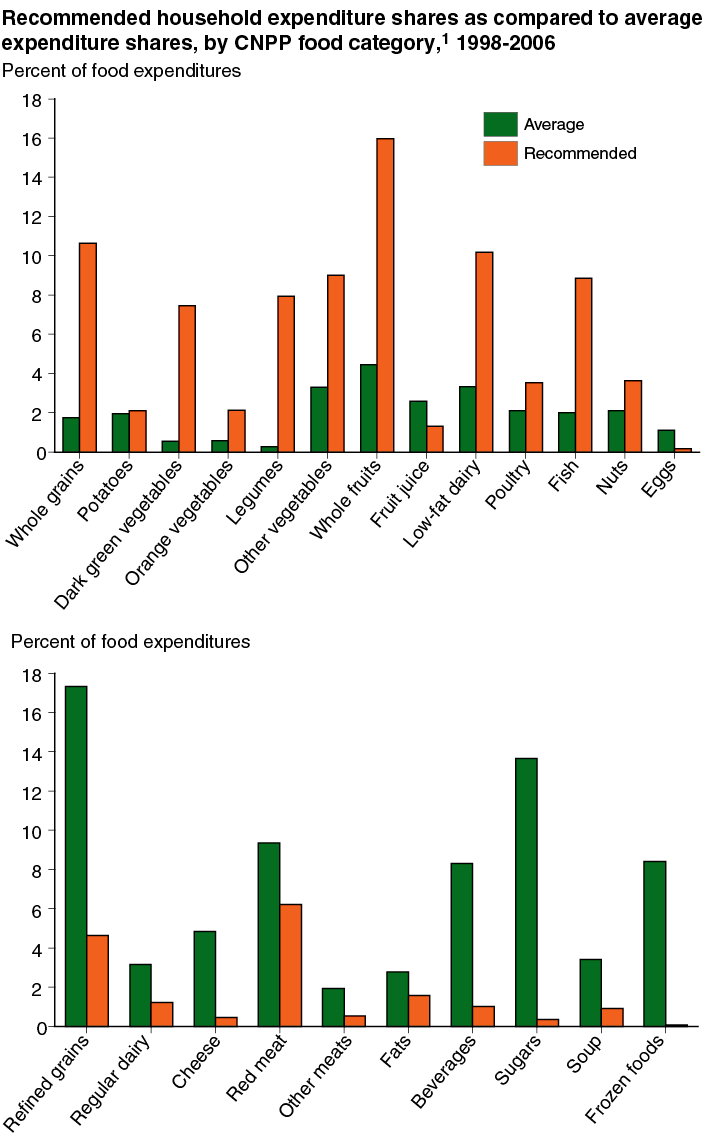
These results should not come as a surprise. According to the 2010 Dietary Guidelines, the leading sources of calories in U.S. diets are:
- Grain-based desserts
- Breads
- Chicken and chicken dishes
- Sodas and other sugary beverages
- Pizza
- Alcoholic beverages
- Pasta and pasta dishes
- Tortillas, burritos, tacos
- Beef and beef dishes
- Dairy desserts
We eat what we buy (or are given).
That’s why congressional pressure to increase grains and meat in school lunches (see yesterday’s post) is questionable from a public health standpoint.
- USDA proposes new standards for school meals
- “Pink Slime:” Some questions about what’s really at stake
- USDA commodities in school meals
- I’ve been lobbied! Intense efforts to save pink slime aimed at governors, USDA officials, and me
- USDA to allow flexibility in school meal standards: food politics in action
Leave a comment
Next public appearance
May
29
2013
New York: 92nd St Y, Tribeca
This is a conversation about 101 Classic Cookbooks, 501 Classic Recipes (Rizzoli Books, 2013), with Clark Wolf, Marvin Taylor (curator NYU Fales Library), Rose Levy Beranbaum (author, The Cake Bible), and Madhur Jaffrey (actor and author). 7:30 p.m. 92ndY Tribeca, 200 Hudson St, Price $15, RSVP: here

Search
Related posts
- USDA proposes new standards for school meals
- “Pink Slime:” Some questions about what’s really at stake
- USDA commodities in school meals
- I’ve been lobbied! Intense efforts to save pink slime aimed at governors, USDA officials, and me
- USDA to allow flexibility in school meal standards: food politics in action
Topics for this post
All Topics
5-a-Day
AAFP(American Academy of Family Physicians)
AAP(American Academy of Pediatrics)
Acrylamide
ACSH(American Council on Science and Health)
Activity
ADA(American Dietetic Association)
Addiction
Additives
Advocacy
Agave
Aging
Agriculture
AHA(American Heart Association)
Alcohol
Alice-Waters
Allergies
Amercan Beverage Association
American-Diabetes-Association
Animals
Antibiotics
Antioxidants
Arsenic
Artificial-sweeteners
ASN(American Society of Nutrition)
Asthma
Açaí
Beef
Bees
Bill-Marler
Biofuel
Blogs
Books
Bottled-water
BPA
BPA(Bisphenol-A)
Bread
Breakfast
Breast-feeding
Brian-Wansink
Bribery
Burger-King
Caffeine
CAFOs(Concentrated Animal Feeding Operations)
calcium
Calorie-labeling
Calories
Campbell
Canada
Cancer
Candy
Cantaloupe
Carcinogens
Cargill
CCF(Center for Consumer Freedom)
CDC(Centers for Disease Control)
Cereals
Charlie-Rose
Checkoff
Cheerios
Cheese
Chicken
Chickens
China
Chinese-infant-formula
Chocolate
Cholesterol
Climate change
Cloned-animals
Coca-Cola
Coffee
Colbert
Comments
Comments-Monitoring-Policy
Comments-Policy-Monitoring
ConAgra
Conflicts-of-interest
Consolidation
Consumer Reports
Cookie-dough
Cooking
Cooking-measurements
COOL(Country of Origin Labeling)
Corn
CSPI
CSPI(Center for Science in the Public Interest)
CSR(Corporate Social Responsibility)
Dairy
Del Monte
Denmark
Dental-disease
Diabetes
Diet-and-dieting
Diet-and-energy-drinks
Diet-drugs
Dietary-Guidelines
Diets
Disney
E.coli
Eat-less-and-move-more
Eating Liberally
EFSA
EFSA(European Food Safety Authority)
Eggs
Energy drinks
EPA
Eric-Schlosser
Ethanol
Ethics
Events
Excerpt
FAO
FAQ
Farm-bill
Farm-policy
Farm-workers
farmers markets
Farms
Fast food
Fats-and-oils
FDA
feed efficiency
Fiber
films
First Amendment
Fish
Flaxseed
FMI(Food Marketing Institute)
Food
Food-access
Food-and-Water-Watch
Food-art
Food-assistance
Food-availability
Food-choice
Food-colors
Food-composition
Food-crisis
Food-culture
Food-deserts
Food-guide
Food-history
Food-Inc
Food-industry
Food-industry-regulation
Food-magazines
Food-marketing
Food-miles
Food-movement
Food-policy
Food-quality
Food-safety
Food-security
Food-stamps
Food-studies
Food-supply
Food-systems
Food-trade
Food-waste
Food aid
FOP(Front-of-Package)Labels
Fortification
Framingham-Heart-Study
Fruits-and-vegetables
FTC (Federal Trade Commission)
Functional-foods
Futures-markets
GAO
GAO(Government Accountability Office)
Gardens
Gary-Taubes
General-Mills
Gluten
GM(Genetically Modified)
GMA(Grocery Manufacturers Association)
Grassfed
Green-food
HACCP(Hazard Analysis and Critical Control Point)
Hannaford
Health-aura
Health-claims
Health-statistics
Heart-disease
HFCS (High Fructose Corn Syrup)
HHS(Department of Health and Human Services)
Hormones
Horsemeat
Hugo drinks
Hunger
Hydroponics
hyperactivity
IASO
India
Infant-formula
International
Interviews
IOM (Institute of Medicine)
iraq
Irradiation
IWG(Interagency Working Group)
Jamie-Oliver
Japan
Job-Ads
Joy-of-Cooking
Juice-drinks
juices
Junk food
Kellogg
Kelly-Brownell
KFC
Kids' diets
King-Corn
Korea
Kosher
Kraft
krill
Label-scoring-systems
Labels
Lawsuits
Legislation
Let's Ask Marion
Let's Move!
Letters-From-Food-Companies
Listeria
Lobbies
Local-food
Lévi-Strauss
Mad-cow-disease
Malnutrition
Manure
maps
Margarines
Marketing to kids
Mark Hegsted
Mars
McDonald's
meal frequency
Meat
Meat safety
Meat substitutes
media
Melamine
Mercury
Michael-Pollan
Michael-Taylor
military
Milk
Monsanto
Movies
MSG
Museum exhibits
MyPlate
Nanotechnology
Natural
neighborhoods
Nestlé
New-York-City
New-Zealand
Niman
Nutrient-availability
Nutrition-education
Nutrition-standards
Nutritionism
Nuts
Obama
Obesity
Obesity-in-kids
Obesity-policy
Occupy
Omega-3-fats
Organic
Organic-fish
Organic-standards
Organics
orthorexia
Oxfam
Oysters
Pakistan
Partnerships
Passover
Patents
Paula Deen
Paul Ryan
Peanut-butter
Peanuts
PepsiCo
Personal-responsibility
Pesticides
Peter Jennings
Pet food
Phil Lempert
Photos
Pink-slime
Pistachios
pizza
Pork
Portion sizes
Potatoes
pregnancy
Pric
Price-fixing
Price-of-food
Probiotics
Processing
Protein
Public-health
Pyramid
Quotes from What to Eat
Radioactivity
Raw-foods
Raw-milk
rBGH
recipes
Red-Bull
Regulation
Research
Restaurants
Revolving-door
Right-to-food
Rosa DeLauro
RWJ Foundation
S.510
Salmonella
Salt
San-Francisco-Chronicle
scho
School-food
Seeds
shrek
Single-food-agency
Slow Food
Smart Choices
Snack foods
Socioeconomic-factors
Soft drinks
soy
Spinach
Splenda
Sponsored-research
Sprouts
Starvation
Stevia
sticky
Sugars
Sugars
Supermarkets
Supplements
Supreme court
Surveys
sushi
Sweeteners
Swine flu
Taste
Taxes
Techno-foods
Television
Thomas Friedan
Tim Lang
Tobacco
Tomatoes
Toxins
Trans-fat
Tufts
Twitter
Tyson-foods
United Nations
Urban-farming
USDA
Vegetables
Vegetarian-and-vegan
Vending-machines
Videos
Vitamin-water
Vitamin D
Vitamins
Wall-Street
Walmart
Washington-Square-News
Water
WHO(World Health Organization)
Whole Foods
Whole grains
Why-Calories-Count
WIC
World hunger
Yearly Kos
Yogurt


Comments
Your blog is an outstanding public service. Thank you! So which USDA will we see in the future: the one that provides useful numbers like the ones you show today, or the one that proposes setting back hard-fought efforts such as those of the Food Corps to improve nutrition in school lunch programs? Is this the USDA that according to Michael Pollan tells us (see: http://www.nytimes.com/2008/10/12/magazine/12policy-t.html?pagewanted=9&_r=0) objected to Eleanor Roosevelt’s White House garden, the model for Victory Gardens, because it might not be good for the US food industry?
Yes!! I was just thinking about this.
Time to change the low-hanging fruit!!!!
Historically, nutrition education has not been successful at instilling healthful eating behaviors in Americans.
The question is… WHY?
Basically, nutrition education is not sufficient enough for people to change their habits because these habits were formed due to 4 million years of conditioning.
A common concept in economics is the rational consumer. The rational consumer chooses the low-hanging fruit every time. This has been true since our cavewoman days. In today’s food environment fast food and processed food are the low-hanging fruit. Our food environment is flooded with these products, so they are easy to obtain, and they are calorically dense for quick energy that we are conditioned to think will last. It is our primal instinct to reach for these foods first. And food scientists have exploited this for far too long.
Using nutrition education to fight unhealthful eating behavior in today’s world is like trying to reverse 4 million years of conditioning.
Good.Luck.with.That.
Instead, perhaps, we could simply change today’s low-hanging fruit from McDonald’s to ..well…fruit.
(This is not to say that nutrition education is not important. It’s just not the whole solution. It’s the long game, and complementary to changing our food environment.)
Not surprising at all, but definitely interesting to see it portrayed graphically like this.
I think there’s a revolution going on in the food world–one in which more and more people are spreading the word about the benefits of eating whole, natural foods sourced from local, sustainable farms. Time will tell …
It is disappointing that the data lag is over 6 years old that we continue to disseminate and use as the gospel. It is not to say that Americans most certainly should increase their fruit and vegetable consumption, but at the same time whole grains have proliferated in the marketplace over the past 10 years, it has been documented that calories from beverages are down and this week alone there is a glimmer of hope in the obesity efforts – with major cities reporting decreases in child obesity rates. Perhaps instead of such a heavy focus on everyone shopping at the farmer’s market and only buying fresh we should put more effort into promoting frozen and canned fruits and vegetables that are often bastardized. Heck canned beans in the grocery store are the same as those I canned from my garden this summer. I wish we could have a conversation based in 2012, not 2006. Sigh.
When you look at the health of people around us, and the leading causes of disease its no surprise that buying habits reflect eating habits. You can blame the economy but meats, fats and sugars are high-cost in terms of dollars and calories.
How do we change this?
That list is even worse than I imagined.
With another mild winter underway, my kale is still growing and the last of the tomatoes are ripening in the window–hence I don’t get into the statistics of those who buy their veggies!
Do you think the “frozen foods” category includes frozen plain vegetables, or just frozen convenience foods?
[...] in the latest Dietary Guidelines for Americans. As Marion Nestle said in her Food Politics post of December 12, “We eat what we buy.” And we seem to buy a lot of pizza, fried chicken and [...]
I think as Americans we’ll try just about anything. We even accept major food companies to give us bigger burgers, bigger pizza, endless pasta servings… etc.
I think it will take a very long time to change people’s eating habits but it must be for a healthier lifestyle & fitter you not just because the government says so.