by Marion Nestle

Archives

Jan 5 2012

The new study of protein and weight gain: calories count!

I was intrigued by the new study from the Pennington Research Center concluding that weight gain depends on calories, not how much protein you eat.

The idea that the protein, fat, or carbohydrate content of your diet matters more to weight than how many calories you eat persists despite much evidence to the contrary.

This study did something impressive.  It measured what people ate, how much they ate, and how much energy they expended under tightly controlled conditions.

This is unusual.  Most studies of weight gain and loss depend on participants’ self reports.

Measuring is much more accurate, as I discuss in my forthcoming book with Malden Nesheim, Why Calories Count: From Science to Politics (out April 1).  If you want calorie balance studies to be accurate, you have to measure and control what goes in and out.  The Pennington is one of the few laboratories in the country that can do this.

Pennington researchers got 25 brave people to agree to be imprisoned in a metabolic ward for the 12 weeks of the study.  The volunteers had to eat nearly 1,000 extra calories a day over and above what they needed to maintain weight.  Their diets contained either 5%, 15%, or 25% of calories from protein.

All of the volunteers gained weight (no surprise), although the low-protein group gained the least.  Most of the weight ended up as body fat.  The medium- and high-protein groups also gained muscle mass.  The low-protein group lost muscle mass.

All of the differences in weight gain among individuals could be accounted for by energy expenditure, either as activity or heat (protein causes higher heat losses).

The Wall Street Journal (January 4) did a terrific summary of the results:
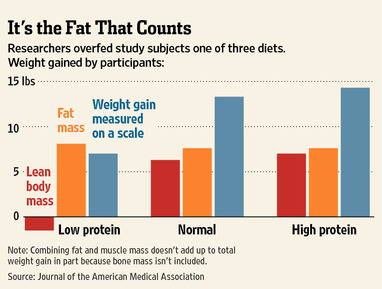
This tells you that low-protein diets cause losses in muscle mass (not a good idea), and that there isn’t much difference between diets containing 15% protein (the usual percentage) and higher levels.

The study also suggests that higher protein diets won’t help you lose weight—unless they also help you cut calories.  That calories matter most in weight gain and loss is consistent with other studies based on measurements, not estimations.

Of course the quality of the diet also matters: it’s easier to cut calories if you are eating plenty of vegetables, fruits, whole grains and a varied diet based largely on relatively unprocessed foods—and it’s harder to gain weight on such diets.

Jan 4 2012

Peevish about “protein”

Reading the New York Times dining section this morning kicked up my annoyance at use of the term “protein” to refer to meat.  A story about what to do with holiday leftovers says “…repurposing top-quality proteins into dinner is easier than it seems.”

Another on Simon Doonan’s new book, Gay Men Don’t Get Fat, quotes him as pointing out that “straight food…tends to be leaden, full of protein, thick with fat.” Now you know.

But protein is a nutrientFoods are sources of nutrients.

Nutritionists like me consider protein a “macronutrient,” meaning that foods contain many grams of protein and also that protein is a source of calories (4 per gram as opposed to 9 for fat and 4 or so for carbohydrate).

Diets contain about 15% of calories from protein on average, an amount much greater than most people need—about twice the minimum required for maintenance and growth.

“Protein” is most definitely not a synonym for meat or even tofu (see table).  I’ve listed the plant sources of protein in Italics.

FOOD SOURCES OF PROTEIN IN U.S. DIETS

PROTEIN SOURCE % TOTAL PROTEIN
Poultry 17
Dairy 16
Refined grains 15
Beef 11
Seafood  7
Pork  6
Vegetables  6
Whole grains  4
Eggs  4
Fruit  2
Nuts and seeds  2
Sweets  2
Legumes (beans, peas)  1

Source: J Am Diet Assoc. 2010 February ; 110(2): 291–295.

Grains, vegetables, and fruits are not the biggest sources, but they are important contributors.  Vegans, who consume no animal products at all, do not lack for protein.

And while proteins from meat resemble our own proteins more than do proteins from vegetables, their constituent amino acids are the same in all foods.  Varying food intake and eating enough food takes care of amino acid balance.

Hence, my peevishness at the use of “Protein” as a separate category in USDA’s MyPlate (see previous post).

Grains and dairy, each with its own sector, are important sources of protein in American diets.

Why protein?  USDA used to call the group “meat” even though it contained beans, poultry, and fish.  The meat industry ought to be happy about “protein.”  Meat producers have spent years trying to convince Americans to equate meat with protein.

A plea: let’s keep terms clear and talk about nutrients when we mean nutrients and foods when we mean foods.  Protein is not food.

NOTE: More about protein tomorrow when I discuss the new JAMA study on whether high-protein diets help you lose weight (spoiler alert: they don’t).

Jan 3 2012

Musing about organics leads me to the Farm Bill

Sales of organic foods continue to increase at a faster pace than sales of conventional foods.  This alone makes people suspicious of the organic enterprise.

Another reason is confusion about what organic production methods are, exactly.  If you are part of the food movement, you probably want your foods to be organic, local, seasonal, and sustainable.  You might also want them produced by farm workers who have decent wages and living conditions.

Unfortunately, these things do not necessarily go together.

  • Organic means crops grown without artificial pesticides, fertilizers, GMOs, irradiation, or sewage sludge, and animals raised without hormones or antibiotics.  Certified Organic methods follow specific rules established by USDA.
  • Local means foods grown or raised within a given radius that can range from a few to hundreds of miles (you have to ask).
  • Seasonal refers to food plants eaten when they are ripe (and not preserved or transported from where they were grown).
  • Sustainable means—at least by some definitions—that the nutrients removed from the soil by growing plants are replenished without artificial inputs.

That these are different is illustrated by a recent article in the New York Times about industrial organic production in Mexico.  The story makes it clear that organics do not have to be local, seasonal, sustainable, or produced by well paid workers.

While the original organic ideal was to eat only local, seasonal produce, shoppers who buy their organics at supermarkets, from Whole Foods to Walmart, expect to find tomatoes in December and are very sensitive to price. Both factors stoke the demand for imports.

Few areas in the United States can farm organic produce in the winter without resorting to energy-guzzling hothouses. In addition, American labor costs are high. Day laborers who come to pick tomatoes in this part of Baja make about $10 a day, nearly twice the local minimum wage. Tomato pickers in Florida may earn $80 a day in high season.

The cost issues are critical.  Dairy farms in general, and organic dairy farms in particular, are entirely dependent on the cost of feed for their animals, and the cost of organic feed has become almost prohibitively expensive.  This has caused organic dairy producers to cut back on production or go out of business.  As another New York Times article explains,

The main reason for the shortage is that the cost of organic grain and hay to feed cows has gone up sharply while the price that farmers receive for their milk has not.

While the shortage may be frustrating for consumers, it reveals a bitter truth for organic dairy farmers, who say they simply need to be paid more for their milk.

Why is the price of feed rising?  Simple answer: because 40% of feed corn grown in the United States is being used to produce biofuels.

Why do farmers grow corn for biofuels?  Because the government gives them tax credits and other subsidies to do so.

But in a small step in the right direction, the ethanol tax credit program was allowed to expire last week,”ending an era in which the federal government provided more than $20 billion in subsidies for use of the product.”

One person quoted in the article connected the dots:

Production of ethanol, with its use of pesticides and fertilizer and heavy industrial machinery, causes soil erosion and air and water pollution. And it means that less land is available for growing food, so food prices go up.

Organics do not exist in isolation.  Their production is connected to every other aspect of the food system.

Wouldn’t it be nice to have a food system that promoted organic, local, seasonal, sustainable agriculture and paid farm workers a living wage?

Wouldn’t it be nice if the 2012 Farm Bill supported that kind of a food system if not instead of than at least along side of the one we have now?

I will be watching to see what Congress does with the Farm Bill.  Stay tuned.