
This will be a moderated discussion with Debbie Stabenow, who will receive the Carver-Carson award that evening, for members of the Carver-Carson Society.

by Marion Nestle
Feb
6
2015
Weekend reading: The U.S. Food System
Roni Neff, editor. Introduction to the U.S. Food System: Public Health, Environment, and Equity. Johns Hopkins Center for a Livable Future, Jossey-Bass, 2015.
This is an undergraduate textbook for students in courses dealing with almost anything having to do with food as it relates to larger societal issues of economics, policy, marketing, culture, security, health, and the environment. It is large (542 pages, 8.5 x 11), easy to read, and well illustrated. It ought to be terrific in stimulating thinking about these issues, particularly because it covers everything you can think of that’s important in this area, from farm subsidies to school lunches. The only thing missing is international dimensions, but that would take another book of this size.
Also focused on the U.S. food system is the Institute of Medicine’s report I wrote about a couple of weeks ago: A Framework for Assessing Effects of the Food System.
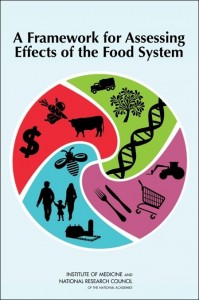
Between the two, you have a full course on food systems, especially because the IOM report comes with:
- Infographic (PDF)
- Key Figures (PDF)
- Report Brief (PDF)
- Introductory slide
- Archived Webinar




