Thanks to Habib Benzian for telling me about this study.
Price information influences the subjective experience of wine: A framed field experiment. Christoph Patrick Werner, et al. Food Quality and Preference; 2021;92:104223
Highlights
- First study manipulating wine prices using a framed field experiment.
- Blind intensity ratings differ for 3 wines of different price and expert rating.
- Blind pleasantness ratings do not differ for the same three wines.
- Pleasantness of the budget wine increased when presented with a fake higher price.
The study: The authors got 140 people to taste wines of three different price ranges with open, deceptive, or no price information, and rate them for taste.
The main result: When price information was accurate, participants’ ratings were parallel to cost. When price information was missing or deceptive, pleasantness ratings did not differ.
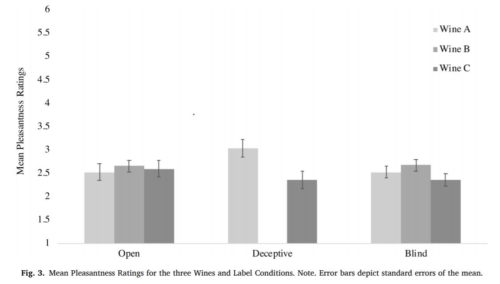
Wine A is inexpensive; Wine B is more expensive and rated as medium quality; wine C is expensive and rated outstanding
Authors conclusions: .”Thus, pricing information differentially influences the consumer’s subjective experience of wine, with no effects on intensity of taste ratings and no effects on pleasantness ratings with correct or no price information, but increased pleasantness of low-price wine when provided with a deceptive higher price. Thus, in wine may lay the truth, but its subjective experience may also lie in the price.”