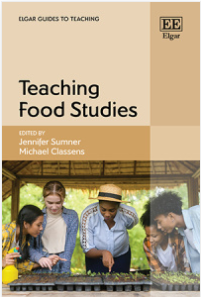
I wrote the Foreword to this book (see below), but when it arrived I was stunned and utterly honored to see its dedication: “To Marion Nestle and Mustafa Koç, principled and generous food justice leaders. And to our families who inspire and nourish us.”
In 1996, my NYU department was lucky enough to turn proverbial lemons into lemonade by taking advantage of an academic crisis and creating the first degree-granting programs in Food Studies, undergraduate, master’s, and doctoral. At the time, Boston University offered a master’s degree in Gastronomy. There may have been a few courses on food in other university departments, but food was widely considered unworthy of serious inquiry. The first question everyone asked me was “why would anyone want to study about food?”
Now, I laugh when I remember that question. As I and my NYU colleagues recount in our book, Practicing Food Studies (NYU Press, 2024), we did not realize we were starting a movement. We viewed food as a lens through which to view, engage with, and critically investigate the most urgent issues raised by food systems, their societal, economic, and behavioral determinants, and their consequences for health and the environment.
By now, I can no longer count the number and breadth of currently available food studies and food systems programs, domestic and international; they can be found through two professional organizations that meet together every summer: the Association for the Study of Food and Society and the Agriculture, Food & Human Values Society. Members have access to a wide range of online course syllabi and teaching materials.
Teaching Food Studies is a welcome and I predict a soon-to-be-utterly-essential addition to these materials. As far as I can tell, food studies courses, concentrations, and programs are now offered in practically every academic discipline, with their content determined by the theory and methods of each particular discipline but also by the specific interests of the teaching faculty. If you are a assigned a course on food, begin with this new volume, quirky and individualistic as it is.
This book covers an astonishing range of topics from course titles (e.g., culinary diplomacy, food politics, food systems policy), to concepts (being critical, nutritionism, intersectionality), to food categories (ultra-processed, local food, school food), to practices (food podcasts, sustainable consumption, vertical plant factories), to food advocacy (collective action, digital food activism, voting with your fork). One quirk is that the chapters are listed alphabetically, making them head-spinning to read in order.
But they are wonderful to read, and this book is one terrific resource. Each chapter introduces a concept, the debates around that concept, and how the concept fits into food studies. Most rewarding, the author(s) give deeply personal, opinionated, experience-based accounts of how teach the concepts and engage students. The chapters are short, but packed with useful information, especially actual course assignments ranging from theory to application.
The authors, mostly unknown to me, are real teachers dealing with real students from real classrooms. This book is about teaching, the real deal. I did not write the chapter on food politics, Gyorgyi Scrinis did not write the one on nutritionism, and Carlos Monteiro did not write the ultra-processed chapter. Instead, all of us are honored by having our work taught and cited.
I found this book to be fun to read. Some of the chapters describe concepts that are new to me, prefigurative politics, for example, defined here as the values and principles of the society we aspire to create in the future. I also found it inspirational. I particularly liked its emphasis on finding ways to overcome students’ feelings of hopelessness when they realize that dealing with systemic food system (and global) problems requires more than changing individual behavior. I also appreciated the citations to the resources in the wide range of fields unfamiliar to me. Anyone reading this book will learn new and fascinating things about food and food systems. I certainly did.
I also appreciated the editors’ focus on the importance of teaching critical thinking about food issues, while never neglecting the need to provide students with ample reasons for agency and hope. I can’t think of a better way to do this than through food studies. This book is a treasure. Use it, and enjoy!
Marion Nestle, New York University
October 2025