Wish Fast Food Nation a happy 25th anniversary.
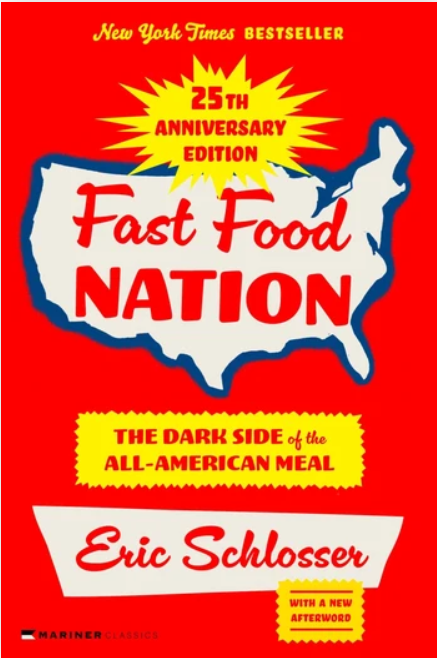
It’s hard for me to believe it’s been 25 years since this book first appeared, but 25th anniversary editions of my Food Politics and Michael Pollan’s Omnivore’s Dilemma are also in the works.
The book is about the beef industry and what it does to the animals, packing house workers, the environment, and human health.
Eric Schlosser wrote a new Afterword for this edition.
Here are two excerpts.
As of this writing…highly pathogenic avian influenza (H5N1) has not yet caused a deadly epidemic among human beings. Pasteurization kills H5N1 in milk, and the virus hasn’t yet mutated to become for contagious or more lethal. But H5N1 has become endemic among wild birds, chickens, turkeys, and dairy cattle in the United States, allowing a continual mixture of its genes. A bird flu epidemic that kills millions of people may never emerge from America’s factory farms—or it may next week, next month, next year. The industrialization of livestock, the transformation of sentient creatures into commodities, and the absence of government oversight have created an efficient system for creating dangerous new pathogens. As this book argued twenty-five years ago, that’s the price we pay for cheap meat. That price doesn’t appear on the menu. (p. 312)
Economists often use the four-firm concentration ratio as a measure of the competition in a market for goods and services. When four companies gain a combined market share of 40 percent or higher, an oligopoly has formed. The prices offered to suppliers, the prices charged to consumers, and the wages paid to workers are no longer determined mainly by market forces. A handful of companies have gained control of the market. Effective government regulation becomes more difficult, as state and federal agencies readily become “captive” to the corporations they’re supposed to oversee. Today, four companies control about 60 percent of the worldwide market for seeds and 61 percent of the market for pesticides. Four companies control about 70 to 90 percent of the worldwide trade in grain. Four companies are responsible for processing about 70 percent of America’s hogs and 85 percent of its cattle.
This book kicked off the food movement 25 years ago. If you haven’t read it, now is the time. We need it more than ever.