by Marion Nestle

Search results: dietary guidelines

Nov 13 2025

The 2025-2030 Dietary Guidelines: Some preliminary speculation

As I noted last May, I get asked all the time about what they will say, but have no inside information.  But this may be a good time to go over the clues.

The process

  • A scientific advisory committee reviews the research and writes a report.  This was released in December.
  • Unspecified (to date) people in USDA and HHS write the guidelines.

The promises

What they won’t say

  • They will not continue the tradition of “leftist ideology”  [I think this must mean plant foods]
  • They will not promote seed oils (RFK Jr prefers beef tallow).
  • They will not promote sugar; RFK Jr says sugar is poison.  [But declared a MAHA Win for Coca’ Cola’s replacement of high fructose corn syrup with cane sugar]
  • They won’t say anything about sustainability [anything about climate change is forbidden]

What they will be about

[According to Reuters] Kennedy said the new guidelines would change the kind of food served to military service members and children in schools, but gave no details on the new recommendations.

“If we want to solve the chronic disease crisis, we have to tackle obesity,” Kennedy said. “Obesity is the number one driver of chronic disease,” he said, adding that 50% of the adult U.S. population was obese or overweight, driving costs up for diabetes care and cardiac diseases.

What they might say

Beef

  • In its Plan to Fortify the Beef Industry, the USDA says the 2025–2030 Dietary Guidelines will “encourage protein as the foundation for every meal.”
  • In an announcement to ranchers, USDA quotes RFK Jr, “we are restoring whole foods as the foundation of the American diet and ending the decades-old stigma against natural saturated fat in beef and dairy products. We will strengthen America’s ranching industry so families can choose nutrient-dense, minimally processed foods.”

Dairy

In a news conference, officials gave some clues.

We are going to be there for the dairy industry…our agencies are about to release more dietary guidelines in the next several months that will elevate those products to where they ought to be…There’s a tremendous amount of emerging science that talks about the need for more protein in our diet, and more fats in our diet, and there’s no industry that does that better than this industry.

Speculation

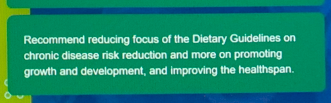
When RFK Jr first talked about the new guidelines, he said they would ignore the scientific advisory committee report and would be simple, short (5 pages), easy to understand, and out by September.  I’m guessing that the conflict between the science and ideology is proving more difficult to resolve than anticipated.

The science continues to argue for a largely (but not necessarily exclusively) plant-based diet, reduced in meat and ultra-processed foods from current levels.  RFK Jr initially talked about the need to reduce intake of ultra-processed foods, but the second MAHA report merely asked for a definition.

This administration seems obsessed with protein, a nutrient already in excess in US diets.

If it wants to do something about obesity, it needs the guidelines to suggest ways to reduce calories.  Nobody has mentioned that word so far.

As I keep saying, I can’t wait to see what the new guidelines will look like.  Stay tuned.


Sep 16 2025

Alcohol industry lobbying scores wins against Dietary Guidelines

The alcohol industry must be exceptionally powerful (that’s why it is regulated by the Treasury Department, which cares about revenues, rather than an agency of Health and Human Services.  Its lobbying is highly effective, especially when it comes to Dietary Guidelines.

That is also most likely why the Senate Agriculture appropriations bill contains this clause [my emphasis]:

SEC . 759. The National Academies of Sciences, Engineering and Medicine (NASEM) were tasked with providing findings and recommendations on alcohol consumption for the purposes of inclusion in the 2025 Dietary Guidelines for Americans as required by section 772 of division A of the Consolidated Appropriations Act, 2023 (Public Law 117–328): Provided, That the Secretary of Health and Human Services and the Secretary of Agriculture shall only consider the findings and recommendations of the NASEM report in the development of the 2025 Dietary Guidelines for Americans and further, both Secretaries shall ensure that the alcohol consumption recommendations in the 2025 Dietary Guidelines for Americans shall be based on the preponderance of scientific and medical knowledge consistent with section 5341 of title 7 of United States Code.

To understand what this is about, consider the NASEM and two other reports on alcohol that came out recently.

As I discussed here previously,

I.  The National Academies of Sciences, Engineering, and Medicine’s Review of Evidence on Alcohol and Health says moderate drinking

  • Reduces all-cause mortality (moderate certainty)
  • Reduces the risk of cardiovascular disease (moderate certainty)
  • Increases the risk of breast and colorectal cancer (but can’t decide about others)

My summary: OK, moderate drinking increases breast and colorectal cancer, but reduces risks for heart disease and overall mortality—a net benefit (unless you happen to get one of those cancers).

II.  The Surgeon General, Vivek Murthy, says in his Advisory on Alcohol and Cancer Risk

  • Consuming alcohol increases the risk of developing at least 7 types of cancer.
  • The causal relationship between alcohol consumption and cancer is firmly established.

My summary: Oops.  Alcohol absolutely increases the risk of at least 7 cancer types.

III.  The report from the Interagency Coordinating Committee on the Prevention of Underage Drinking (ICCPUD).  

  • Males and females who consumed 1 drink per day had an increased risk of liver cirrhosis, esophageal cancer, oral cancer, and injuries, but a lower risk for ischemic stroke…females had a higher risk for liver cancer and a lower risk for diabetes mellitus when they drank 1 drink per day…even infrequent high per-occasion drinking may eliminate the lower levels of risk for ischemic stroke.
  • Alcohol use is associated with increased mortality for seven types of cancer (colorectal, female breast, liver, oral cavity, pharynx, larynx, esophagus [squamous cell type]). Increased risk for these cancers begins with any alcohol use and increases with higher levels of use. Women experience a much greater risk of an alcohol-attributable cancer per drink consumed.

My summary: Oops again.  Everyone, especially women, who drink any alcohol at all is at higher risk of 7 cancer types.

As reported in Vox and Stat, HHS is withdrawing this report and sending it to report heaven, as if it never existed.

Reuters says the forthcoming Dietary Guidelines will not mention alcohol.

For the background on all of this, see my previous reports:

Jul 9 2025

Alcohol in the 2025-2030 Dietary Guidelines: The Rumors

I have no inside information about what the new Dietary Guidelines will say beyond what I’ve read and what RFK Jr has said: They will be coming out soon and will be short and to the point.

But according to Twitter (X), the source of much leaked information, the new administration “plans to introduce partial bans on alcohol advertising, to bring it ‘closer in line with advertising of unhealthy food.'”

And we now have a Reuters’ Exclusive: US to drop guidance to limit alcohol to one or two drinks per day, sources say

Its summary:

  • Americans have long been told to drink two or fewer drinks per day
  • New guidelines due as soon as this month
  • Expected to include brief statement on limiting drinking
  • Alcohol industry faces growing scrutiny of health risks

Reuters’ anonymous sources say “The new guidelines are set to move away from suggesting consumers limit alcohol consumption to a specific number of daily servings, according to the three sources, who asked not to be named to speak freely.”

Reuters also reports:

Major industry players, including Diageo (DGE.L) and Anheuser-Busch InBev (ABI.BR) have lobbied lawmakers throughout the review process. Senate records show the companies spent millions on lobbying efforts related to the guidelines and a range of other issues such as tax and trade in 2024 and 2025. Both companies declined to comment.

What is at stake here?

As I explained in January (Alcohol in the Dietary Guidelines: What the Fuss is About), everyone agrees that too much alcohol is bad for you.  The question is whether any alcohol is bad.

The dietary guidelines have advised since 1990 that women have no more than one drink a day and men no more than two, suggesting that such levels are safe.  But are they?

I discuss the recent reports arguing one way or the other on January 7 (The big fight over alcohol recommendations: not over yet) and January 22 (The Alcohol Saga continues).

Neither RFK Jr nor President Trump drink alochol.

And we have evidence that the Majority of Americans Unaware of Cancer Risks Linked to Alcohol Consumption.

Recent research conducted by The University of Texas MD Anderson Cancer Center unveiled that only approximately 40% of American adults recognize alcohol as a cancer risk factor. This stark gap in knowledge persists despite alcohol’s status as a leading preventable cause of cancer, highlighting the urgent need for enhanced public health communication and policy reforms.

Dietary guidelines are a key component of federal nutrition policy.

I can’t wait to see what they say about alcohol consumption (and everything else), in the light of the MAHA (Make America Healthy Again) agenda.

May 14 2025

What’s happening with the dietary guidelines

I get asked all the time about what’s happening with the dietary guidelines.  I have no inside information, but am exhausted at the thought that we have to go through all this again.

By law, dietary guidelines have to be re-done every five years, even though they always say the same things: eat more fruits, vegetables, and whole grains; eat less sugar, salt, and saturated fat; balance calories.  OK.  They take take more than 150 pages to say that, but that’s what it all boils down to.

Will they be different in the new MAHA (Make America Healthy Again) era?  I can only speculate.

To review the process:

  • A scientific advisory committee reviews the research and writes a report.  This one released its report in December.
  • Now, the Departments of Agriculture and Health and Human Services appoint a committee—or somebody—to write the actual guidelines.

USDA Secretary Brooke Rollins says the two departments are working on them and they will come out “hopefully early fall.”  If they do, this will set records.  The guidelines typically are released in late December or early January.

The secretaries have promised they will not continue the tradition of “leftist ideology”  I’m not sure what tradition that is, exactly, although I suspect it means “plant-based.”

I can’t wait to see what happens with:

  • Beef: USDA has always been sensitive to the demands of beef, corn, and soybean farmers.  Suggestions to eat less beef are typically phrased euphemistically (“eat lean meat”).
  • Fats: RFK Jr wants seed oils replaced with beef tallow.
  • Sugar: USDA has always been sensitive to the concerns of sugarbeet and sugarcane producers, historically a powerful lobby.  RFK Jr says sugar is poison.
  • Ultra-processed foods:  The scientific advisory committee ducked the issue.  The MAHA folks are concerned about them.
  • Emphasis on plant foods: Will the guidelines continue to promote their health benefits?
  • Calories: The “C” word.  Will the guidelines bring back a discussion of calories, their principal food sources, and how their intake is affected by ultra-processed foods?
  • Sustainability: The “S” word.  I would guess this one stays off the table, but you never know.

This one will be fun to watch.

Mar 19 2025

Dietary Guidelines in the MAHA era

USDA and HHS have announced an update on the dietary guidelines process.

A quick recap: The Dietary Guidelines Advisory Committee released its report last year.  The agencies are responsible for writing the actual guidelines, based on that report or not.

The USDA Secretary, Brooke Rollins, writes:

Secretary [of HHS] Kennedy and I have a powerful, complementary role in this, and it starts with updating federal dietary guidance. We will make certain the 2025-2030 Guidelines are based on sound science, not political science. Gone are the days where leftist ideologies guide public policy.”

Leftist ideologies?  She has to be kidding.  Since when did leftist ideologies influence the dietary guidelines?

Oh.  Wait.  Silly me.  I get it.  She means meat. 

Plant-based = leftist ideology.

You don’t believe me?  See Nina Teicholz’s editorial in the Wall Street Journal:  Meat will make America Healthy Again.

Ms. Rollins and Mr. Kennedy should reject suggestions from an expert committee that the 2025-30 federal guidelines place an even greater emphasis on plant-based proteins and that they recommend “reducing intakes of red and processed meats.” As the Agriculture Department found in 2010, there is either “no relationship” or a “limited inconsistent” relationship between any protein type and chronic diseases, including obesity, diabetes and cardiovascular disease.

Protein, sure.  But meat?  Consistent evidence for years indicates that people in industrialized countries would be healthier eating less meat and more plants.  Less does not necessarily mean none; it means less than currently consumed and a lot less in some cases.

If USDA and HHS are serious about Making Americans Healthier Again, they will revise the Dietary Guidelines according to the science.  In my view, that means advising eating less of ultra-processed foods, as well as meat.

Jan 14 2025

Alcohol in the Dietary Guidelines: What the Fuss is About

The 2025-2030 Dietary Guidelines Advisory Committee did not make a recommendation about alcohol.  The agencies, HHS and USDA, will do that later based on two expert reviews.

I wrote about the first, from the National Academies, last week: Review of Evidence on Alcohol and Health.

I also wrote about the Surgeon General’s Advisory on Alcohol and Cancer Risk

Still to come is the report from the Interagency Coordinating Committee on the Prevention of Underage Drinking (ICCPUD).

At issue is the amount of alcohol that is safe to drink, if any.

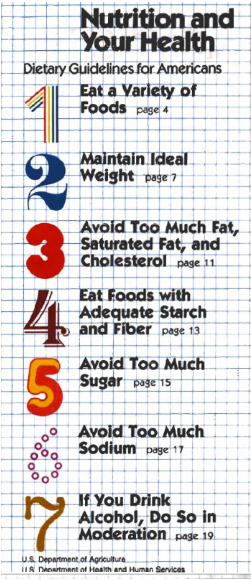
Just for fun, I did a summary of what the Dietary Guidelines say about alcohol from 1980 to 2020.  Note that the Moderation advice has not changed since 1990 (but then see the note on 2020).

                                      Alcohol recommendations: Dietary Guidelines for Americans

YEAR ALCOHOL ADVICE BENEFITS MODERATION
1980 “If you drink alcohol, do so in moderation.” “One or two drinks daily appear to cause no harm in adults.”
1985 “If you drink alcoholic beverages, do so in moderation.” “One or two standard-size drinks daily appear to cause no harm in normal, healthy, nonpregnant adults.”
1990 Ditto “Some studies have suggested that moderate drinking is linked to lower risk for heart attacks.” No more than 1 drink/day for women, and 2 for men.
1995 Ditto “Alcoholic beverages have been used to enhance the enjoyment of meals by many societies throughout human history…Current evidence suggests that moderate drinking is associated with a lower risk for coronary heart disease in some individuals.” Ditto
2000 Ditto “Even one drink per day can slightly raise the risk of breast cancer…Drinking in moderation may lower risk for coronary heart disease, mainly among men over age 45 and women over age 55.” Ditto
2005 “Those who choose to drink alcoholic beverages should do so sensibly and in moderation.” “Alcohol may have beneficial effects when consumed in moderation.  The lowest all-cause mortality  [and heart disease mortality] occurs at an intake of one or two drinks per day…compared with women who do not drink, women who consume one drink per day appear to have a slightly higher risk of breast cancer.” Ditto
2010 “If alcohol is consumed, it should be consumed in moderation…and only by adults of legal drinking age.” “Strong evidence from observational studies has shown that moderate alcohol consumption is associated with a lower risk of cardiovascular disease….[and] reduced risk of all-cause mortality among middle-aged and older adults and may help to keep cognitive function intact with age…[but also] increased risk of bfreast cancer, violence, drowning, and injuries from falls and motor vehicle crashes.” Ditto
2015 Ditto [heart disease and breast cancer not mentioned Ditto
2020* “Limit foods and beverages higher in added sugars, saturated fat, and sodium, and limit alcoholic beverages” “Emerging evidence suggests that even drinking within the recommended limits may increase the overall risk of death from various causes, such as from several types of cancer and some forms of cardiovascular disease. Alcohol has been found to increase risk for cancer, and for some types of cancer, the risk increases even at low levels of alcohol consumption (less than 1 drink in a day). Caution, therefore, is recommended.” Ditto

*From the 2020 Dietary Guidelines Advisory Committee report: “evidence points to a general rule that drinking less is better for health than drinking more. Therefore, the focus should remain on reducing consumption among those who drink, particularly among those who drink in ways that increase the risk of harms. The Committee concluded that no evidence exists to relax current Dietary Guidelines for Americans recommendations, and there is evidence to tighten them for men such that recommended limits for both men and women who drink would be 1 drink per day on days when alcohol is consumed.

Despite the language in the 2020 guideline, the agencies did not change the overall recommendation about moderate drinking.

Will the Surgeon General’s Advisory and the upcoming third report cause the agencies to suggest no more than one drink a day for men?  Or suggest that no level of alcohol intake is safe?

I’m looking forward to finding out.

Resource: the process for alcohol in the Dietary Guidelines

Dec 17 2024

The Dietary Guidelines Advisory Committee releases its report

The USDA announced last week the arrival of the Scientific Report of the Dietary Guidelines Advisory Committee (DGAC).

The DGAC deserves much praise for getting this job done on time under what I consider to be difficult constraints (large committee size, large areas of research to review, requirement that all recommendations be “evidence-based” which sounds good, but is unreasonable given the inability to conduct long-term controlled clinical studies).

The report is now open for public comment (see information at bottom of post).

The process to develop the Dietary Guidelines for Americans, 2025-2030 is under way. Get involved by providing written and oral comments to the Departments on the Scientific Report of the 2025 Dietary Guidelines Advisory Committee (Scientific Report). You may also sign up to receive email updates on news related to the development of the next edition of the Dietary Guidelines…For more information, visit the Public Comments to the Departments page.

A reminder about the process:  The DGAC report is advisory.  Since 2005, the agencies appoint an entirely separate internal governmental committee to write the actual guidelines.  This, of course, makes the process far more political and subject to lobbying (file comments!).

The recent election will install new leaders of USDA and HHS.  If they follow the same process, they will appoint and instruct the new committee.  Or, they can change the process entirely.

Another reminder: When I was on the DGAC in 1995, our committee chose the research questions, did the research, wrote the scientific report, and wrote the actual guidelines.  Those were the days.

Comments on the DGAC report

For starters, it’s 421 pages.

Its bottom line:

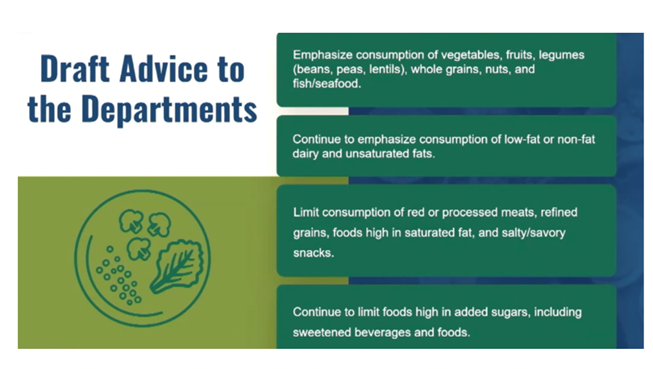
This healthy dietary pattern for individuals ages 2 years and older is: (1) higher in vegetables, fruits, legumes, nuts, whole grains, fish/seafood, and vegetable oils higher in unsaturated fat; and (2) lower in red and processed meats, sugar-sweetened foods and beverages, refined grains, and saturated fat. A healthy dietary pattern, as indicated by the systematic reviews, may also include consumption of fat-free or low-fat dairy and foods lower in sodium, and/or may include plant-based dietary options.

The proposed guidelines:

  1. Follow a healthy dietary pattern at every life stage. At every life stage—infancy, toddlerhood, childhood, adolescence, adulthood, pregnancy, lactation, and older adulthood—it is never too early or too late to eat healthfully.
  2. Customize and enjoy nutrient-dense food and beverage choices to reflect personal preferences, cultural traditions, and budgetary considerations.
  3. Focus on meeting food group needs with nutrient-dense foods and beverages, and stay within calorie limits.
  4. Limit foods and beverages higher in added sugars, saturated fat, and sodium, and limit alcoholic beverages.

This looks like all the other Dietary Guidelines since 1980.  Its bottom-line statement is more explicit than previously about reducing red meat and sugar-sweetened beverages.

Worth reading

  • Support federal data.  I especially appreciated the strong support for strengthening nutrition monitoring, food composition data (FoodData Central, an invaluable resource), and updating the Dietary Reference Intakes.  Yes!
  • The chapter on portion size.  At last!  Larger portions have more calories!

What’s missing

  • A separate chapter on calories stated explicitly.  The report discusses concerns about obesity and diet-related chronic disease in an excellent paragraph on page 1, and mentions calories but “stay within calorie limits” doesn’t get at what’s needed.  I want more on “…adults and children [should] consume smaller portions of foods and beverages that are high in energy density and low in nutrient density.”
  • A guideline to reduce consumption of ultra-processed foods.  This committee, unwisely in my view, chose not to advise minimizing intake of ultra-processed foods, deeming their definition too uncertain and ignoring what are now three controlled clinical trials demonstrating that diets based on these food induce people to overconsume calories.

What’s confusing

–The addition of recommendations for diets in early childhood.  This was done for the 2020-2025 guidelines and it involved doubling the size of the committee. This makes the committee’s work much harder and its report insufferably long.  I would rather see a separate report on children (this could deal with the effects of food marketing as well).

–The health equity lens.  I’m all for this but its discussion dominates the report.  It is discussed in a separate chapter but then in boxes and other places throughout.  The word “equity” is mentioned 217 times and “health equity lens” 38 times.

Although prior Committees incorporated basic demographic factors such as age, race, and ethnicity into their reviews of the science, this Committee considered additional factors and did so in a holistic manner as it reviewed, interpreted, and synthesized evidence across data analysis, systematic reviews, and food pattern modeling. In particular, this Committee considered factors that reflect social determinants of health (SDOH). In doing so, the Committee could interpret the evidence based on both demographic factors (which are considered to be downstream, i.e., more proximal in terms of their influence on behavior) and socioeconomic and political factors (which are considered to be upstream, i.e., broader societal factors that influence the distribution of power and resources). Addressing SDOH is considered key to achieving a just, equitable society.

Other comments

From the Meat Institute:  Meat Institute Issues Statement on the Scientific Report of the 2025 Dietary Guidelines Advisory Committee

“The Meat Institute remains strongly opposed to the Report’s recommendation to reduce meat consumption and will urge the agencies to reject it,” said Meat Institute President and CEO Julie Anna Potts.

From the Physicians Committee for Responsible Medicine: Prioritizing Plant-Based Protein in the Scientific Report of the 2025-2030 Dietary Guidelines for Americans Committee is a Step Forward, Doctors Say

For the first time, the advisory committee tasked with making scientific recommendations for revising the Dietary Guidelines for Americans recommended that the 2025-2030 Dietary Guidelines “include more nutrient-dense plant-based meal and dietary recommendation options,” prioritize plant-based protein over animal protein, and recognize the many benefits of beans, peas, and lentils as a protein source. The Dietary Guidelines Advisory Committee (DGAC) continued to discourage consuming foods like red meat, eggs, and dairy that are high in saturated fat, while also suggesting that the next Dietary Guidelines for Americans specifically recommend plain drinking water as the primary beverage for people to consume.

I can’t wait to see what comes next.

How to commennt

A 60-day public comment period on the Committee’s Scientific Report is open through February 10, 2025. More information about how to provide written and oral comments to the Departments is available at DietaryGuidelines.gov.

  • Read about opportunities to provide public comments, including requirements for oral comments 
  • Register to provide oral comments to the Departments.   Note: do this now.  Spaces are limited.
  • Submit written public comments to the Departments
  • Register to attend the virtual public meeting to hear oral comments on the Scientific Report  

Read the Committee’s Scientific Report 

Nov 21 2024

Benefits of the dietary guidelines: resources

DietaryGuidelines.gov provides handouts on Food Sources of Select Nutrients.

Alas, calories are not among these handouts, even though 75% of American adults are now considered overweight or obese.

These are meant for nutrition professionals but are fun to see if you want to see what they get.

The page lists lots of other resources.

Will these help you make healhier dietary choices?

Nutrients are not the problem; calories are the problem.

To do something about them, we need a healthier food environment.

I wish the USDA would give that as much attention as it gives nutrients.