Dec
31
2015
Food art: final thoughts for the year
May your new year be filled with beautiful food, beautifully presented, nutritious, and always delicious. Happy new year!

“Cubes,” by Lernert & Sander.

May your new year be filled with beautiful food, beautifully presented, nutritious, and always delicious. Happy new year!
“Cubes,” by Lernert & Sander.
Milan’s Trienniale Museum is offering an Arts & Foods exhibit in conjunction with the Food Expo. Your Expo pass lets you in.
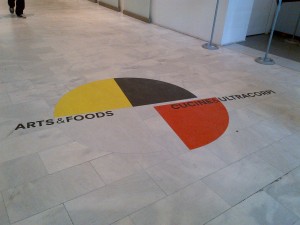
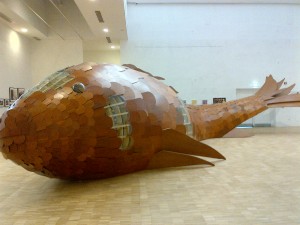
I’ve been to many food-and-art exhibits, but this one is beyond enormous. I seems to have everything.
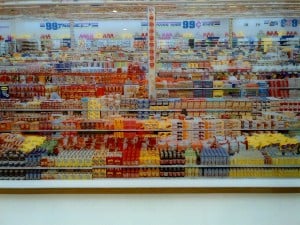
Gursky:
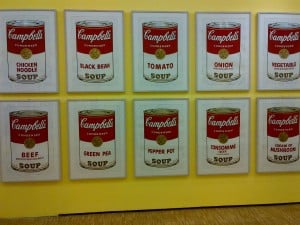
Warhol:
 Gehry:
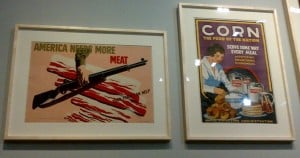
American World War II posters:
Food-related items—paintings, yes, but also teaspoons, coffee pots, refrigerators, and anything else you can think of that might have something to do with food—take up almost the entire museum.
And movie clips! Buster Keaton!
The catalog is 4-inches thick, weighs at least 5 pounds, and costs 60 Euros.
Go.
But plan on many hours.
Don’t miss the Kara Walker installation at the old, molasses-stained, about-to-be-demolished Domino sugar refinery in Brooklyn, practically under the Williamsburg bridge.

the colossal sphinx is plastered with 35 tons of sugar, much of it on the floor by this time.
What is this about?

The sign says:
At the behest of Creative Time Kara E. Walker has confected:
A Subtlety
or the Marvelous Sugar Baby
An Homage to the unpaid and overworked Artisans who have refined our Sweet tastes from the cane fields to the Kitchens of the New World on the Occasion of the demolition of the Domino Sugar Refining Plant
The installation is open Friday to Sunday, free. Details here.
A word of advice to Citibike users: Check the availability of docking stations before setting out.
At the last minute, I caught the exhibit of student art at the School of Visual Arts (209 East 23rd street @3rd Avenue) just before it closed.
The exhibit was called “Putting it All on the Table.”
The instructor must have asked students to create installations that comment on the most important issues in food politics today: hunger, obesity, corporate control of food systems, garbage and food waste, pesticides and their effects, globalization, immigrant labor, and others.
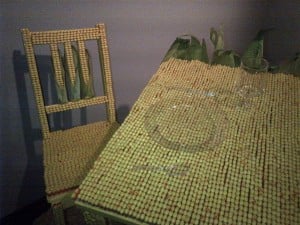
This one commented on the ubiquity of corn (in this case, candy corn) in the food supply.
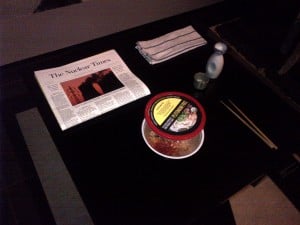
And this one looked at issues related to nuclear waste in the food supply.
Worth the visit? I thought so. Food for thought and all that.
Thanks to Juan Pablo Peña-Rosas of the World Health Organization for sending this photo.
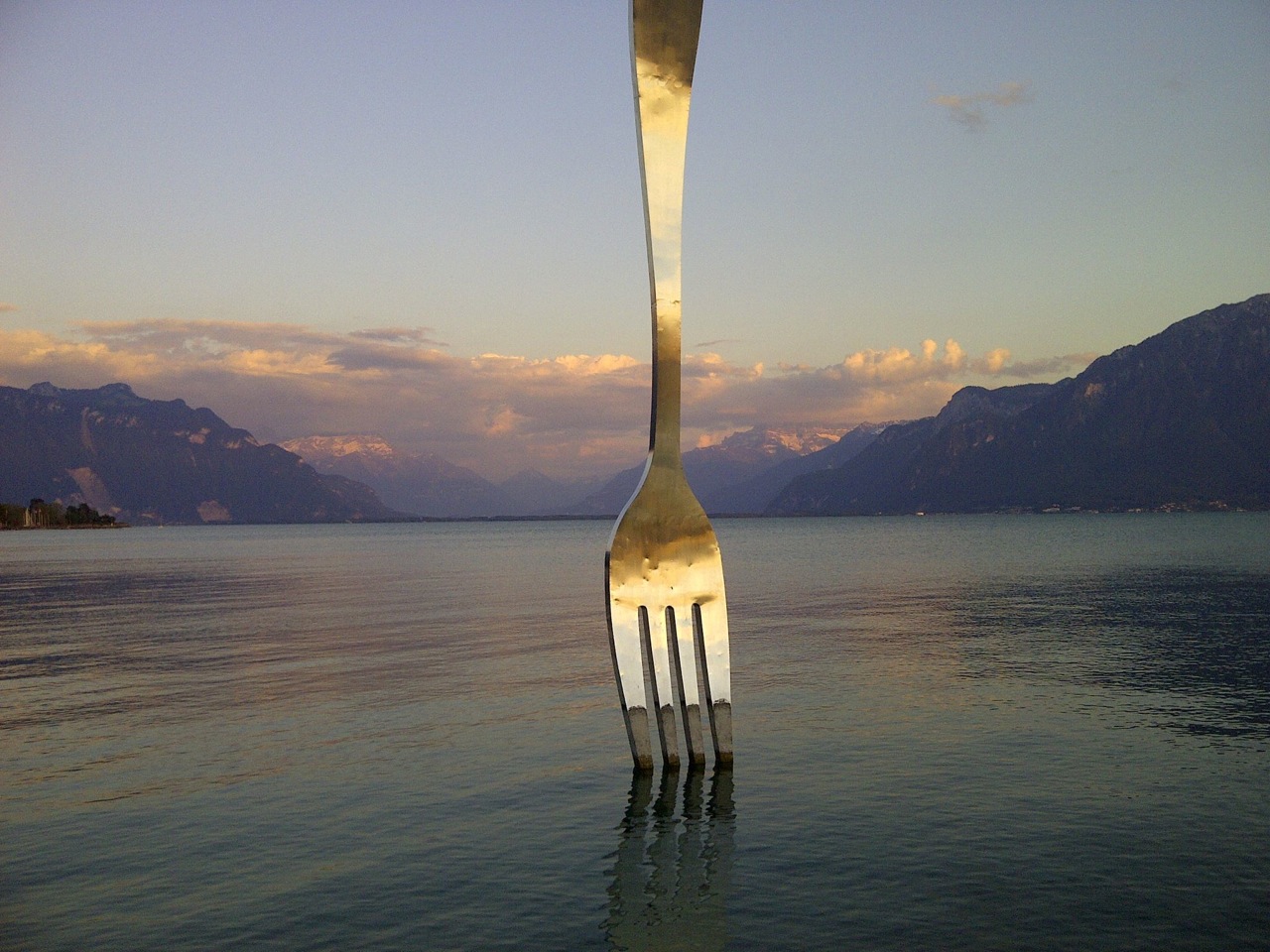
It’s of Lake Geneva in front of Nestlé’s (no relation) food museum in Vevey.
The museum’s current exhibit is called COLLECTIONNEZ-MOI! It includes thousands of such things as sardine cans, fruit wrapping papers, soft drink bottles, and—my favorite—sugar cubes obsessively accumulated by private collectors, and well worth the visit (I was there a month or so ago).
And the fork!
I love food posters. Thanks to Food Safety News for the heads up about the National Library of Medicine’s exhibit of marvelous food posters from World Wars I and II. Many of these can be seen online at the Smithsonian’s site. The exhibit was curated by Cory Bernat, who comments on it and also has a collection posted on the web (I’ve seen it and it’s wonderfully downloadable, but seems to have a bandwidth problem at the moment). Enjoy!
Thanks to “babka101” for sending this link to the landscapes constructed of food and photographed by Carl Warner. This slide show comes with explanations of how he did it.
I’ve been reluctant to post all the photos sent recently of clever food sculptures and carvings, mainly because they typically arrive without attribution. But today’s New York Times has a worthy account of this kind of food art, with links to slides of work by various artists. And then there’s the video of James McMahon carving a portrait of James Beard – “the father of American gastronomy” – on a watermelon.
This will be a moderated discussion with Debbie Stabenow, who will receive the Carver-Carson award that evening, for members of the Carver-Carson Society.