Sep
15
2011
Harvard plate v. USDA MyPlate: an improvement?
Scientists from the Harvard School of Public Health have come up with a new Healthy Eating Plate as an alternative to USDA’s MyPlate released last June.
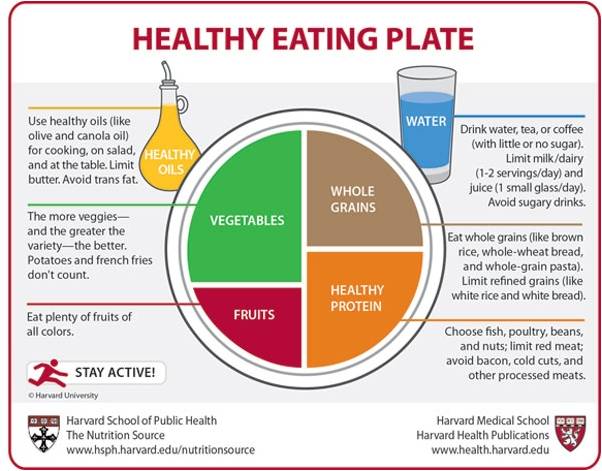
For an explanation, see the Harvard group’s press release. Harvard intends this as an explicit challenge to the USDA’s version:
Recall my deconstruction of the USDA plate when it first came out.
I’d love to hear what you think of the Harvard version.
Is it better? Likely to be more effective?
Weigh in, please.
Leave a comment
Next public appearance
May
31
2012
NYU: Fales Library panel
The topic: “How would Julia Child vote on the 2012 farm bill? 4:00 p.m., Fales Special Collections at Bobst Library. Open to public. Details are here.
Search
Related posts
Topics for this post
All Topics
5-a-Day
AAFP(American Academy of Family Physicians)
AAP(American Academy of Pediatrics)
Acrylamide
ACSH(American Council on Science and Health)
Activity
ADA(American Dietetic Association)
Addiction
Additives
Advocacy
Agave
Aging
Agriculture
AHA(American Heart Association)
Alcohol
Alice-Waters
Allergies
American-Diabetes-Association
Animals
Antibiotics
Antioxidants
Arsenic
Artificial-sweeteners
ASN(American Society of Nutrition)
Asthma
Açaí
Beef
Bill-Marler
Biofuel
Blogs
Books
Bottled-water
BPA
BPA(Bisphenol-A)
Bread
Breakfast
Breast-feeding
Brian-Wansink
Bribery
Burger-King
Caffeine
CAFOs(Concentrated Animal Feeding Operations)
calcium
Calorie-labeling
Calories
Campbell
Canada
Cancer
Candy
Cantaloupe
Carcinogens
Cargill
CCF(Center for Consumer Freedom)
CDC(Centers for Disease Control)
Cereals
Charlie-Rose
Checkoff
Cheerios
Cheese
Chicken
Chickens
China
Chinese-infant-formula
Chocolate
Cholesterol
Climate change
Cloned-animals
Coca-Cola
Coffee
Colbert
Comments-Monitoring-Policy
Comments-Policy-Monitoring
ConAgra
Conflicts-of-interest
Consolidation
Consumer Reports
Cookie-dough
Cooking
Cooking-measurements
COOL(Country of Origin Labeling)
Corn
CSPI(Center for Science in the Public Interest)
CSR(Corporate Social Responsibility)
Dairy
Del Monte
Denmark
Diabetes
Diet-and-dieting
Diet-and-energy-drinks
Diet-drugs
Dietary-Guidelines
Diets
Disney
E.coli
Eat-less-and-move-more
EatingLiberally
EFSA
EFSA(European Food Safety Authority)
Eggs
EPA
Eric-Schlosser
Ethanol
Ethics
Events
Excerpt
FAO
FAQ
Farm-bill
Farm-policy
Farm-workers
farmers markets
Farms
Fast food
Fats-and-oils
FDA
feed efficiency
Fiber
films
First Amendment
Fish
Flaxseed
FMI(Food Marketing Institute)
Food
Food-access
Food-and-Water-Watch
Food-art
Food-assistance
Food-availability
Food-choice
Food-colors
Food-composition
Food-crisis
Food-culture
Food-deserts
Food-guide
Food-Inc
Food-industry
Food-industry-regulation
Food-magazines
Food-marketing
Food-miles
Food-movement
Food-policy
Food-quality
Food-safety
Food-security
Food-stamps
Food-studies
Food-supply
Food-systems
Food-trade
Food-waste
FOP(Front-of-Package)Labels
Fortification
Framingham-Heart-Study
Fruits-and-vegetables
FTC (Federal Trade Commission)
Functional-foods
Futures-markets
GAO
GAO(Government Accountability Office)
Gardens
Gary-Taubes
General-Mills
Gluten
GM(Genetically Modified)
GMA(Grocery Manufacturers Association)
Grassfed
Green-food
HACCP(Hazard Analysis and Critical Control Point)
Hannaford
Health-aura
Health-claims
Health-statistics
Heart-disease
HFCS (High Fructose Corn Syrup)
HHS(Department of Health and Human Services)
Hormones
Hugo drinks
Hydroponics
hyperactivity
IASO
India
Infant-formula
International
Interviews
IOM (Institute of Medicine)
iraq
Irradiation
IWG(Interagency Working Group)
Jamie-Oliver
Japan
Job-Ads
Joy-of-Cooking
Juice-drinks
juices
Junk food
Kellogg
Kelly-Brownell
KFC
Kids' diets
King-Corn
Korea
Kraft
krill
Label-scoring-systems
Labels
Lawsuits
Legislation
Let's Move!
Letters-From-Food-Companies
Listeria
Lobbies
Local-food
Lévi-Strauss
Mad-cow-disease
Malnutrition
Manure
maps
Margarines
Marketing to kids
Mark Hegsted
Mars
McDonald's
meal frequency
Meat
Meat safety
Meat substitutes
media
Melamine
Mercury
Michael-Pollan
Michael-Taylor
military
Milk
Monsanto
Movies
MSG
MyPlate
Nanotechnology
Natural
neighborhoods
Nestlé
New-York-City
New-Zealand
Niman
Nutrient-availability
Nutrition-education
Nutrition-standards
Nutritionism
Obama
Obesity
Obesity-in-kids
Obesity-policy
Occupy
Omega-3-fats
Organic-fish
Organic-standards
Organics
orthorexia
Oysters
Pakistan
Partnerships
Passover
Patents
Paula Deen
Peanut-butter
Peanuts
PepsiCo
Personal-responsibility
Pesticides
Peter Jennings
Pet food
Phil Lempert
Photos
Pink-slime
Pistachios
pizza
Pork
Portion sizes
Potatoes
pregnancy
Pric
Price-fixing
Price-of-food
Probiotics
Processing
Protein
Public-health
Pyramid
Quotes from What to Eat
Radioactivity
Raw-foods
Raw-milk
rBGH
recipes
Red-Bull
Research
Restaurants
Revolving-door
Right-to-food
Rosa DeLauro
RWJ Foundation
S.510
Salmonella
Salt
San-Francisco-Chronicle
scho
School-food
Seeds
shrek
Single-food-agency
Slow Food
Smart Choices
Snack foods
Socioeconomic-factors
Soft drinks
soy
Spinach
Splenda
Sprouts
Starvation
Stevia
sticky
Sugar
Supermarkets
Supplements
Supreme court
Surveys
sushi
Sweeteners
Swine flu
Taste
Taxes
Techno-foods
Television
Thomas Friedan
Tim Lang
Tobacco
Tomatoes
Toxins
Trans-fat
Tufts
Twitter
Tyson-foods
United Nations
Urban-farming
USDA
Vegetables
Vegetarian-and-vegan
Vending-machines
Videos
Vitamin-water
Vitamins
Wall-Street
Walmart
Washington-Square-News
Water
WHO(World Health Organization)
Whole Foods
Whole grains
Why-Calories-Count
WIC
World hunger
Yearly Kos
Yogurt


Comments
I just saw the “with little or no sugar.” So I take back the comment about no distinction in quality. But I still wouldn’t recommend the two juxtaposed with water even if they have significant water content.
I absolutely love the increase in the vegetable portion of the plate and emphasis on healthier proteins and whole grains. When it comes to research results, vegetables are icnreadibly protective against a range of debilitating chronic diseases. However, it’s pretty wordy compared to the USDA graphic.
It’s also little odd to have the oil off to the side… it almost suggests that you follow your meal with a shot of cod liver oil, and vaguely favors added oils over good fats already present in foods like olives, nuts, or avocados.
There is no doubt that the Harvard ‘plate’ is filled with better, more accurate information. The majority of us here see that.
What you all need to understand is that the reason why the USDA ‘plate’ is great, is its simplicity. It’s “Marketing 101″. Put out the advertisement that will be understood easily by the most people (in your target market). The USDA’s target market is essentially everyone.
With the exception of the people that read blogs like this one, most people out there will not analyze their food before they ingest it – “is this really whole grain?” or “did I already eat veggies of this color today?”. They’re not scientists or nutritionists. They’re just normal people going through life.
The USDA created their simple brightly color coded plate to be quickly read, quickly absorbed, and (hopefully) easy to remember – essentially educational eye candy. Perfect for those everyday people out there.
In contrast, the Harvard plate lists a lot of information on a rather dull diagram. There’s just too much going on for it to be a good option for people to consider.
Happy to see the oils in there (though why canola?), but I still think half the plate should be veggies and fruits should be in a bowl on the side. Also happy to see dairy is off the plate–i.e. optional and not necessary.
[...] Harvard plate v. USDA MyPlate: an improvement? <<I think it is. I like the addition of oil and the removal of dairy. But it’s still not perfect. (Food Politics) [...]
All in for the removal of dairy and specifying fish, poultry(?), beans and nuts rather than meats! The “stay active” symbol on the side tops it all! And i loved that “Potatoes and French fries don’t count” as veggies, people always ask that!
I believe it is smarter, it seems less influenced by food politics, hopefully I am right and let’s hope it will serve its purpose in increasing healthier lifestyles!
I think its a big improvement but agree with the strangeness of the oils section. Healthy fats would have been a better choice.
[...] from Marion Nestle’s blog, Food Politics, the Harvard School of Public Health has released its food-guide plate as a response to the [...]
The extra information is good for those who want it, but I wonder how many people really pay any attention to either diagram? Do we have any information on whether any consumers actually take guidance from either diagram?
@Catrina
Good point about the coffee and tea. As an adult who only drinks drip coffee or latte, I hadn’t thought about all those goofy beverages that, while they include a bit of coffee or tea, they are mostly flavoring and sugar. I see lots of young women and girls ordering things at coffee shops that would be much cheaper to get at Dairy Queen.
@Alex
Thank you for that! As an Anthropologist, I cringe every time I read that paleolithic people supposedly ate only meat and shunned grains. Nonsense. Only Neanderthals lived primarily on meat (and later on, far north peoples, but they ate parts of the animal none of us would consider in order to get vitamins). Homo Sapiens has always subsisted primarily on the gathered foods, not the hunted ones. Meat was important in brain development, but not in the quantities that are often implied. Scavenging was the earliest way to get meat and hunting was never a completely dependable source. People who later raised animals tended to consume their milk or blood, and reserved flesh for special occasions/feasts. Our molars are made for grinding grains, and our canines hardly compare to those of the real carnivores. We are omnivores who have mostly depended on roots, grasses, nuts and berries–as decidedly un-macho as that may sound.
I like this version of the plate graphic
Sorry link didn’t work but you can find it here
http://www.aquick.org/blog/2011/06/26/choose-real-food/
I like the Harvard version. The simplicity of the USDA’s has its place too. Both can be used as nutrition education tools in the classroom and with patients and clients. I like the addition of healthy oils, but would have filled in the color less (below the healthy oil text) to avoid any confusion about how only a minimal amount is needed in the diet. I don’t think the oil bottle itself needs to be smaller. I also liked the fitness symbol. That was an addition in the previous MyPyramid icon that was missed in the new version. Interesting reading everyone’s comments. Wish more people favored whole grains. I completely disagree with Harvard discounting potatoes! Even the popular smiley fries (that are generally “baked” since most schools are doing away with their fryers) in school lunches are not all bad; high in sodium, but not fat. Potatoes eaten too frequently is more the problem, limiting other nutrients found in green, red and orange vegetables. More thoughts on my blog: http://gardencuizine.com/2011/09/keep-joy-in-cooking-and-eating.html
Both “plates” show more sense than the pyramid. I like that the Harvard plate specifies whole grains and promotes water. What I do not understand about the Harvard plate is calling out canola oil as a great fat and damning potatoes. Canola oil is just another cheap refined seed oil and potatoes are a simple whole food. These two details baffle me.
While the dairy industries influence is not represented in the Harvard plate (a major plus), the fact that a bottle of oil is elevated to the status of water, is a major no-no in my opinion
Heated canola oil=oxidized fat=trans fats. Funny how Harvard tells us to avoid trans fats, but includes canola oil as a healthy fat option for us to consume.
I like it and I like the de-emphasis (how do you spell that?) on milk.
[...] Eating Plate here and discussions on both “plates” in the Wall Street Journal and the Food Politics blog. Eco World Content From Across The Internet. Featured on EcoPressed Barefoot math [...]
I agree with Chris that, while the Harvard plate provides much more pertinent information and attempts to demystify the quantity and quality much better, it is too much information that most people don’t have the time or concern to follow. Maybe three dimensional plate models would be more approachable than either static image, neither of which sufficiently addresses portion sizes beyond plate surface area. Both are fine for now, but this initiative will need continuous tweaks and adjustments.
This is a bit goofy. Oils off to the side, fats not a component part of proteins. Sugars in fruits not addressed, starchy or sugary vegetables not addressed (except to say that potatoes and fries don’t count)
This to me reads far more as politics than a constructive guide to healthy eating. Until fats, proteins, fiber, starch, sugars are treated together in a coherent manner, I don’t see how it can be very functional.
I would nix the dairy. Check out the cancer research done with regard to casein (dairy protein). You won’t ingest it again. And why would you? Humans are the only animal that ingests another animals breast milk after we are weaned. Could you imagine putting human breast milk into containers and buying it for consumption? Yeah, disgusting.
I would also avoid red meat altogether. No fiber, not much nutrient wise. Heck, go vegan.
Read The China Study for Cornell University’s take on the plate.
Potato as bad? (Anything deep fried or bathed in animal fat is bad). The potato, prepared in a number of ways, can be the cornerstone of a healthy and sustainable diet. Too bad Harvard doesn’t communicate that fact.
The government is supporting GMO crops (grains) and dairy. Why shouldn’t that be big on their recommended food groups?
I would argue that grains & cereals don’t belong there at all, or, if they must, in drastically smaller portions.
See “The Case Against Grains” http://www.moderndaypaleo.com/2010/10/17/how-to-learn-about-grains/
I still don’t believe the science will pan out to support a single diet as appropriate for all Americans. We are simply not a homogenous people, and science is more and more demonstrating a significant diversity in the metabolisms of different peoples.
Furthermore, as the comments here demonstrate, people want to politicize the recommendations, or at least justify their own diets, even in the absence of scientific support for their assertions. Fact is people eat particular foods for a myriad of reasons, of which only a small proportion involve consideration of nutritional value. No diagram or set of recommendations is going to satisfy even most of the people.
Finally, policymakers have to carefully strike a balance between advocacy for public health, while avoiding dogmatism concerning the recommendations. Fact is, the empirical science is still fairly weak on many of the assertions in the diagram. For various reasons, the quality of nutritional science is still well behind many of the other biological disciplines. If we prove to be too dogmatic, when the science changes in 5-10 years (and it will; I’m in the lab, and I’m already seeing some of these assertions fail under close scrutiny), we’ll be left with a very distrusting public.
I’m a vegan, so I appreciate the validation of the way I eat. Does the USDA think I’ll be unhealthy without dairy? My nutritionist doesn’t… nor do Harvard scientists!
and including water! so important despite not having government lobbyists. I really comment Harvard for this.
[...] Learn more about Harvard’s Choose My Plate. [...]
[...] (typeof(addthis_share) == "undefined"){ addthis_share = [];}Food Politics has a post about Harvard’s own version of USDA’s [...]
[...] What are whole grains? – portion size and Harvard University’s Choose my Plate tool. The USDA recently came out with a new food guide to replace the old food pyramid called Choose My Plate. Unfortunately, is doesn’t provide enough information to be entirely helpful in making good choices. Compare it to Harvard’s version where you will get more relevant information. [...]