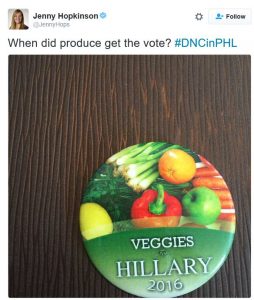
Food Policy Action wants presidential candidates to talk about food issues. Its Plate of the Union campaign says:
Our food system is out of balance, and it’s time to take action. Current food policies prioritize corporate interests at the expense of our health, the environment, and working families. This has led to spikes in obesity and type-2 diabetes, costing taxpayers billions of dollars each year. If you are elected president, I urge you to take bold steps to reform our food system to make sure every American has equal access to healthy, affordable food that is fair to workers, good for the environment, and keeps farmers on the land.
Here’s what the campaign is doing, courtesy of today’s New York Times:
In an e-mailed press release (which I can’t find online), Food Policy Action says:
Plate of the Union leaders Tom Colicchio, Ricardo Salvador and Navina Khanna spoke with Congressional members and staff, delegates and other convention-goers about commonsense steps the next president can take to change the status quo of the nation’s food policy, which currently prioritizes corporate interests at the expense of food and farm workers, and which is making Americans increasingly sick.
“When elected leaders talk about creating good jobs and boosting the economy, they absolutely have to consider food and farm policies,” said Navina Khanna, director of HEAL Food Alliance. “Six of the eight worst-paying jobs in America are in the food system. Our current food system was designed to benefit a few corporations at the expense of working families. That’s got to change.”