by Marion Nestle

Currently browsing posts about: Dietary-Guidelines

Jan 15 2026

The MAHA Dietary Guidelines VI. Some Concluding Thoughts.

Let’s start with what I like about the 2020-2030 Dietary Guidelines and New Pyramid, taken together.

Eat Real Food

It’s how I eat, and prefer to eat.

It’s consistent with Michael Pollan’s Eat food.  Not too much.  Mostly plants.

Pollan’s version, to which I subscribe, is supported by at least three of the guidelines:

  • Eat vegetables & fruits throughout the day
  • Focus on whole grains
  • Limit highly processed foods, added sugars, & refined carbohydrates

The New Pyramid

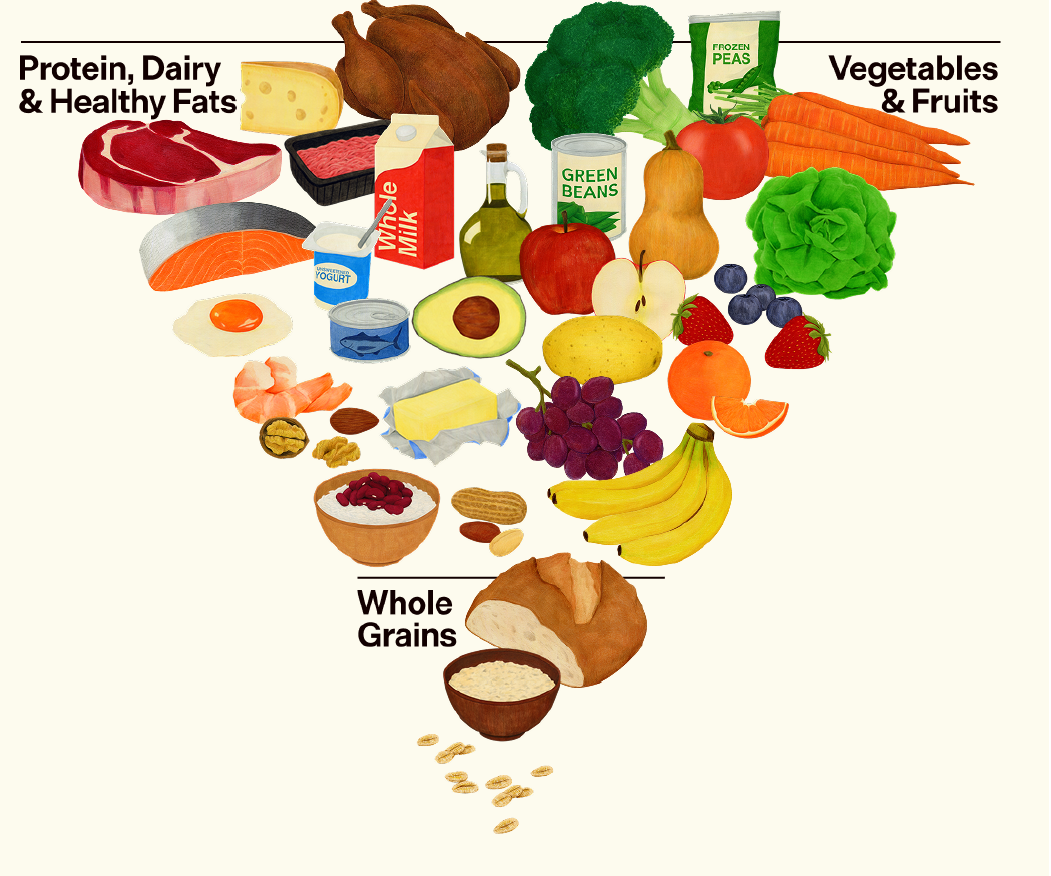
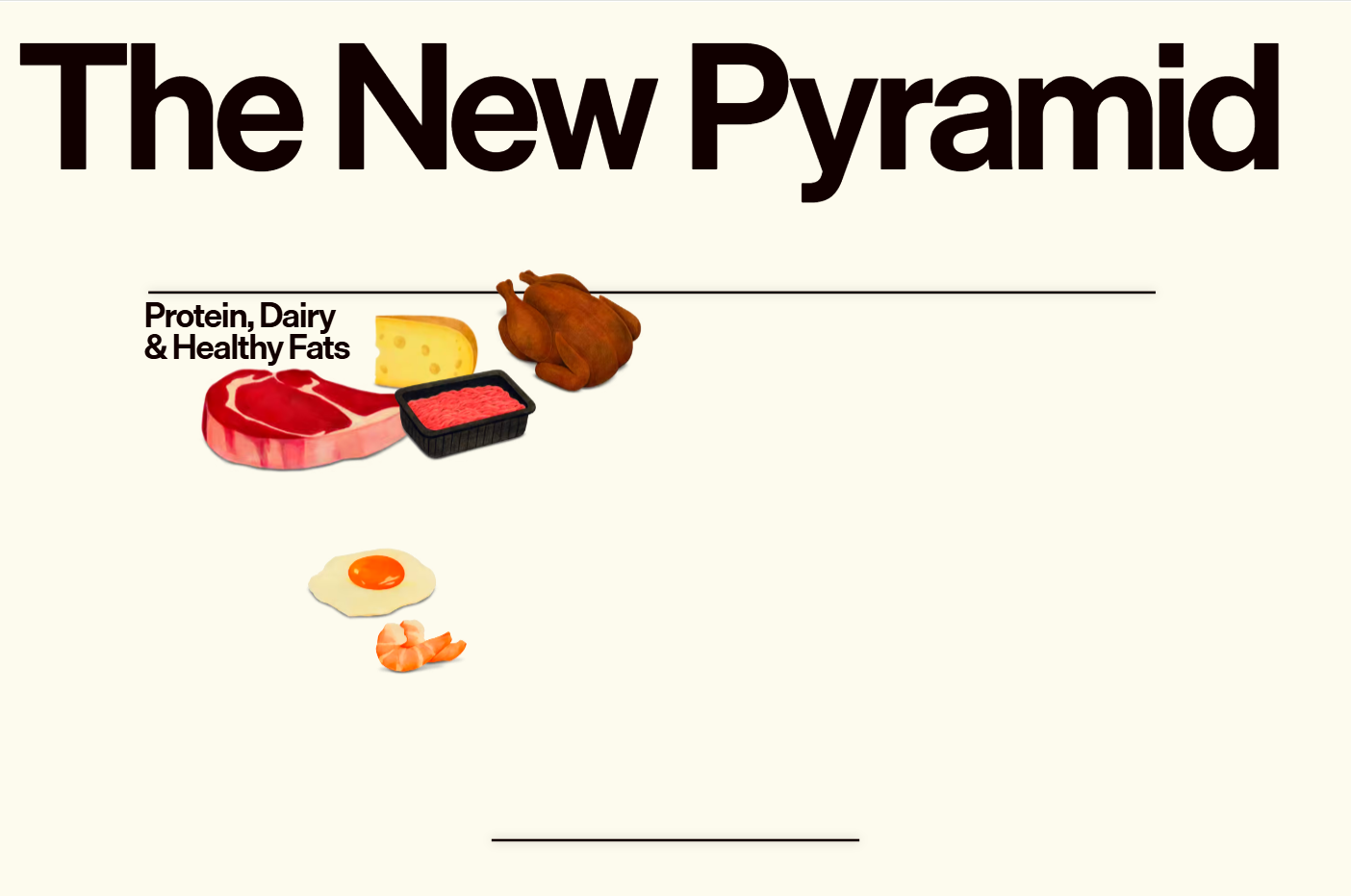
It’s bright and cheerful.

It illustrates a basic nutrition message: eat a wide variety of foods from all food groups.

It’s possible to eat healthfully following this diagram if eating a wide variety of foods and balancing calories.

It’s consistent with food movement objectives, and is bringing attention to these objectives.

What’s missing and I wish were included

  • Eat Real Food as the first dietary guideline
  • Greater emphasis on plant sources of protein
  • Inclusion of whole grain foods in the “eat more” part of the pyramid
  • Policy support

The need for policy

Much about these guidelines and food guides connects with long-desired objectives for a food system aimed at promoting the health of people and the planet.  As I noted in an earlier post, these guidelines focus explicitly on personal responsibility, not system change.

To create a food system that supports eating according to these guidelines and pyramid, we need:

  • Agricultural subsidies: for foods for people (not feed for animals or fuel for automobiles, as the current system does)
  • School food: kitchens and cooks in every school, gardens wherever possible, and enough money to pay for real food
  • Education: cooking classes for kids and adults, men as well as women
  • Equity: enough money to buy real food, and the space, equipment, and time to prepare it

I will have more to say about all this as time goes on, so stay tuned.

Jan 14 2026

The MAHA Dietary Guidelines V. The Alcohol Non-Recommendation

The Dietary Guidelines for America 2025-2030 simply say “Limit alcoholic beverages: Consume less alcohol for better
overall health.”  They go on to specify who should not drink alcohol.

People who should completely avoid alcohol include pregnant women, people who are recovering from alcohol use disorder or are unable to control the amount they drink, and people taking medications or with medical conditions that can interact with alcohol. For those with a family history of alcoholism, be mindful of alcohol consumption and associated addictive behaviors.

This guideline

  • Does not specify what is meat by “limit” or “less.”
  • Does not mention cancer as a risk of alcohol consumption.

These are big issues.  Excessive alcohol intake poses problems for society as well as for individuals: car accidents and gun violence, for example.

From a public health perspective, the lower the overall level of alcohol consumption in a population, the fewer the health and societal problems it causes.  The overall message always should be: drink as little alcohol as possible.

This message is complicated by evidence, highly contested, that low levels of alcohol might reduce risks for heart disease and overall mortality.  Even if correct, advice about alcohol would need to balance the purported benefits for heart disease against risks for cancer, particularly breast cancer.

The Biden-era 2025 Dietary Guidelines Advisory Committee did not discuss alcohol because the agencies were waiting for the results of commissioned reports on alcohol and health.  As it happened, three reports came out just after the DGAC submitted its report late in 2025.

Even so, the take-home lesson from all of these reports is that less alcohol is better.

At issue is how much less.

As I’ve explained previously, the dietary guidelines have long stated that 2 drinks a day for men and 1 for women (because women metabolize alcohol differently) is a safe amount.

The omission of these limits is difficult to interpret.  Do these guidelines consider those limits too low or too high?

At the press conference, Mehmet Oz said:

Alcohol is a social lubricant that brings people together. In the best-case scenario, I don’t think you should drink alcohol, but it does allow people an excuse to bond and socialize, and there’s probably nothing healthier than having a good time with friends in a safe way..You look at the Blue Zones, for example, around the world, where people live the longest. Alcohol is sometimes part of their diet…Again, small amounts. There is alcohol on these dietary guidelines, but the implication is don’t have it for breakfast.

Yes, but what is a “small amount?”  And what about cancer risk?  Shouldn’t people be warned?

As Roni Rabin put it:

Though there is robust debate within the medical community as to the relationship between moderate drinking and various forms of cardiovascular disease, there is more scientific certainty about the link between alcohol and at least seven types of cancer. Warnings about alcohol increasing the risk of breast cancer were included in the dietary guidelines 25 years ago. Former Surgeon General Dr. Vivek Murthy last year called for putting cancer warning labels on alcoholic beverages, similar to those for cigarettes.

The alcohol industry works unceasingly to convince everyone that alcohol poses no health risks.  Unfortunately, it does.

Yes, consume less, but how much less?  The guidelines leave this up to you to decide.

I see these dietary guidelines as a big win for the alcohol industry.

No wonder it supports them so enthusiastically: Distilled Spirits, Beer & Wine Associations Support New Health and Human Services 2025-2030 ‘Dietary Guidelines for Americans’

Moderation?  Whatever you think it means.

Jan 13 2026

The MAHA Dietary Guidelines IV: Eat more meat!

The Eat Real Food Website says “We are ending the war on protein. Every meal must prioritize high-quality, nutrient-dense protein from both animal and plant sources….” But here’s what comes up first and is clearly the first priority.

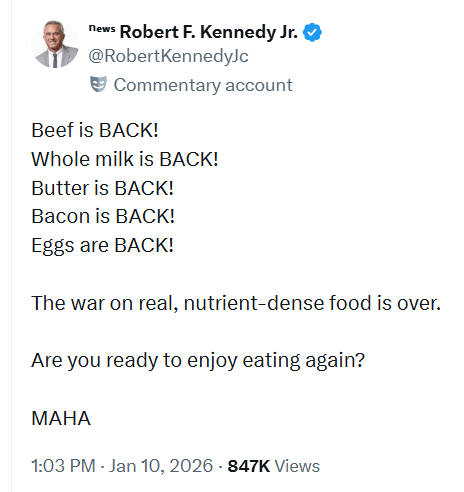
And here’s an exultant RFK Jr on X:

Protein is well understood to be a euphemism for meat.  I’ve already written about how most people already eat twice the protein needed so advice to eat more of it is unlikely to do anyone any good.

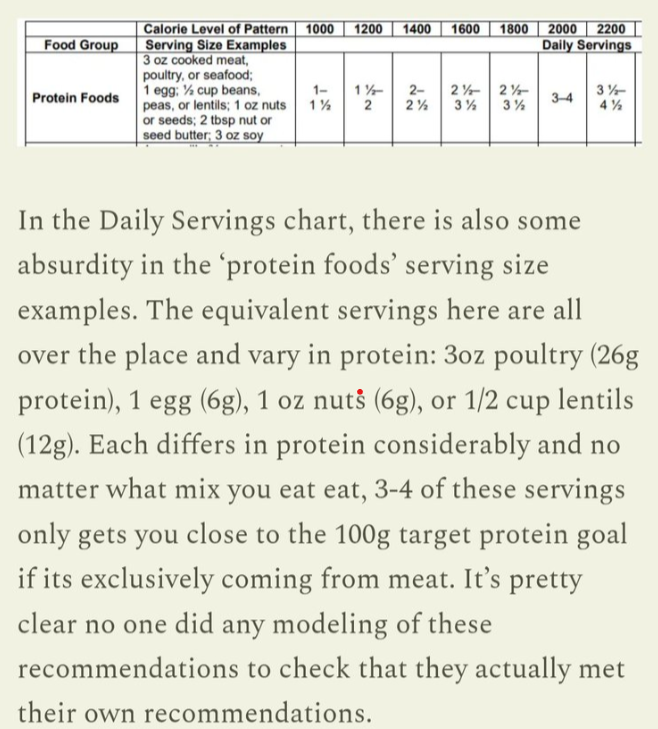
And the document, Daily Servings by Calorie Level, makes it clear that you have to eat meat if you are going to reach the level of protein intake recommended.  For this, I am indebted to Kevin Klatt, who posted this on X.

What’s wrong with recommending more meat?

  • It’s healthier getting protein from plant sources.
  • The way we produce meat pollutes the environment with pesticides and herbicides to grow their feed.
  • It also presents major food safety hazards (see Eric Schlosser’s update on Fast Food Nation)
  • Cattle burp methane and are the single largest food source of greenhouse gas emissions.
  • Beef cattle are raised in CAFOs under crowded and dirty conditions.
  • The meat industry exploits workers.
  • Consolidation in the meat industry keeps prices high (Tyson’s just agreed to an $82.5M settlement in a beef price-fixing lawsuit)
  • Producing meat the way we do is not sustainable and adds to inequities.

Of course, sustainability and equity are non-topics for this administration.  But they matter and should very much be on the table for discussion.

We already eat plenty of meat—more than 100 pounds per capita per year of red meat alone (according to USDA).  We don’t need to be eating more.

Correction

In my first post on these dietary guidelines, I said:

Some of the instructions don’t make sense: “Consume meat with no or limited added sugars?”  Who does this?

Several readers wrote to object.  Renata M, for example, said she could think of so many examples, she just had to say something.

  • BBQ sauce
  • Ketchup
  • Teriyaki sauce
  • Other popular “Chinese” foods
  • Brown sugar-glazed pork chops
  • Pasta sauce
  • Sloppy Joe’s
  • Brines and marinades
  • and more, if honey and maple syrup are considered added sugars [they are]

Oops. Sorry about that.  Thanks!

Jan 9 2026

The MAHA Dietary Guidelines II: Personal Responsibility vs. Public Health Policy

This is the second in a series of posts I will be writing about the new Dietary Guidelines for America, 2025-2030.

Yesterday, I gave an overview of the guidelines, finding them cheerful, but muddled, contradictory, ideological, and retro.

I do like the cheerful message: Eat Real Food.

But after reviewing lsome of the rest of the materials that come with the guidelines, I think those terms miss a more important concern: they are about personal responsibility, not public health.

This is most explicit from the Eat Real Food Website.

Our nation is finding its footing again, moving past decades of unhealthy eating and rebuilding a food culture rooted in health, science, transparency, and personal responsibility.

In March, I posted a a comment about a statement made by USDA Secretary Brooke Rollins.

Secretary [of HHS] Kennedy and I have a powerful, complementary role in this, and it starts with updating federal dietary guidance. We will make certain the 2025-2030 Guidelines are based on sound science, not political science. Gone are the days where leftist ideologies guide public policy.

I could not imagine how anyone could think the dietary guidelines reflected leftist ideology and guessed that she must have been talking about plant- as opposed to meat-based diets.  I wasn’t entirely wrong.  Eating meat is the first priority of the guidelines, a matter I will discuss next week.

But now I think she must have meant personal responsibility as opposed to public health policy.

This approach leaves it entirely up to you to make healthful food choices, never mind that if you try to eat healthfully, you are fighting the entire food system on your own.

The goal of food companies—even those selling real food—is to get you to buy as much of it as possible, regardless of how their products affect your health or that of the planet.

Given this administration’s destruction of the public health system in America, you really are on your own.

The groups in America who eat most healthfully are educated; have decent jobs, money, and resources; have homes with functioning kitchens; can cook; live in safe neighborhoods with grocery stores; and have access to affordable health care.  That’s what public health is about.

If the government leaves it to you to “do your own research” and fight the food system on your own, it is saying it has no responsibility for creating a food environment that can help you eat and enjoy real food.

It’s all on you.

The eat-real-food message is cheery and for sure it’s how I eat, at least most of the time.  I will have more to say about it next week too.

But the focus on personal responsibility troubles me.  Shouldn’t all of us be able to eat as healthfully as possible?

The Fact Sheet rejects health equity out of hand, but then says:

We reject this logic: a common-sense, science-driven document is essential to begin a conversation about how our culture and food procurement programs must change to enable Americans to access affordable, healthy, real food.

Isn’t that what health equity is about?  For that we need policy backed by resources.  Personal responsibility won’t work without it.

Jan 8 2026

The MAHA 2025-2030 Dietary Guidelines have arrived: Cheerful, Muddled, Contradictory, Ideological, Retro

The new Dietary Guidelines  [The guidelines are in bold; my summary follows]

  • Eat the right amount for you: balance calories
  • Prioritize protein foods at every meal: prioritize animal sources
  • Consume dairy: prioritize full-fat
  • Eat vegetables & fruits throughout the day: eat more, but not as much as previously recommended
  • Incorporate healthy fats: prioritize animal fats
  • Focus on whole grains: prioritize, but eat less than previously recommended
  • Limit highly processed foods, added sugars, & refined carbohydrates: eat less
  • Limit alcoholic beverages

These were released along with a fact sheet, scientific report, and interactive website.  I’ve summarized the details below in a table comparing these guidelines to the previous version.

Why muddled?  The lists of guidelines differ among the various documents.  The prioritization of protein is hard to understand; most Americans already eat plenty.  Some of the instructions don’t make sense: “Consume meat with no or limited added sugars?”  Who does this?

Why contradictory?  If you increase the amount of protein, meat, and full-fat dairy in your diet, you will not be able to keep your saturated fat intake below 10% of calories, and will have a harder time maintaining calorie balance (fat has twice the calories of protein or carbohydrate).  If you want to increase the amount of fiber in your diet, you need to prioritize vegetables, fruits, and whole grains, not meat and dairy.

Why ideological? The fats recommended as sources of essential fatty acids—olive oil, butter, and beef tallow—have little or no essential linoleic or alpha-linolenic acids. For those, seed oils (not mentioned in these guidelines) are much better sources.  The prioritization of animal-based as opposed to plant-based is inconsistent with research on diet and health.  USDA Secretary Rollins said these guidelines would no longer reflect leftist ideology.  The fact sheet and website make the ideology explicit.

Why retro?  Except for the excellent advice to reduce intake of highly processed foods, which were not particularly prevalent back then, these guidelines take us back to the diets of the 1950s when everyone was eating lots of meat and dairy and not worrying much about vegetables, and heart disease was rampant.  I’m all for eating whole foods but these guidelines dismiss 75 years of research favoring diets higher in plant foods.   

Bottom line:  A mixed bag.  These guidelines are big wins for the meat, dairy, and alcohol industries (alas).  The loser: ultra-processed foods (yes!).  The recommendation to reduce highly processed foods (a euphemism for ultra-processed) is the one great strength of these recommendations.  Following that advice might help Make America Healthy Again.  But the rest must be viewed more as ideology than science, and also must be interpreted in the light of  this administration’s destruction of what was once a reasonably effective public health service (CDC, FDA, NIH) and system.  Eating more meat and fat is unlikely to help people resist measles and other illnesses preventable by vaccination.

I will have more to say about the specific recommendations in subsequent posts.  In the meantime, here’s my quick summary.

Dietary Guidelines: 2020-2025 vs. 2025-2030

RECOMMENDATION 2020-2025 2025-2030 CHANGE?
       
Number of pages 149 10  
Calories Measure by weight status Eat the right amount Same
Water Choose Choose Same, but stronger
Protein 56 g/2000 kcal [based on 0.8 g/kg]


Prioritize at every meal. [ 84 to 112g/2000 kcal, based on 1.2 -1.6 g/kg] Increase
Dairy 3 cups/day 3 servings Same
Vegetables 2.5 cups/day 3 servings/day Decrease**
Fruits 2 cups/day 2 servings/day Decrease**
Fats 27 grams/day oils Healthy Prioritize animal sources
Saturated fat <10% calories <10% calories Same
Grains 6 ounces, >3 whole/day 2-4 servings/day Decrease, prioritize whole
Processed foods other than meat Not mentioned Limit, avoid Major improvement
Added sugars Eat less Limit, avoid Stronger
Sodium <2300 mg/day <2300 mg/day Same
Alcohol <2 drink/d for men; 1 for women Limit, consume less Weaker
Eat more Vegetables, Fruits, Legumes, Whole grains, Low- Or Non-Fat Dairy, Lean Meats, Poultry, Seafood, Nuts, Unsaturated Vegetable Oils Animal-source foods, full-fat dairy, vegetables, fruits, healthy fats, butter, beef tallow, whole grains  
Eat less Red and Processed Meats, Sugar-Sweetened Foods and Beverages, Refined Grains, Alcohol Added sugars, refined grains, chemical additives, fruit and vegetable juices, highly processed foods and beverages, sodium, alcohol  
Dietary sustainability Not mentioned Not mentioned  Same, alas

**Correction: I wrote this before I saw Daily Servings by Calorie Level.  These make it clear that the new guidelines do not decrease fruit and vegetable recommendations.

I will be writing about the details in subsequent posts.  Stay tuned.

Resources

Nov 13 2025

The 2025-2030 Dietary Guidelines: Some preliminary speculation

As I noted last May, I get asked all the time about what they will say, but have no inside information.  But this may be a good time to go over the clues.

The process

  • A scientific advisory committee reviews the research and writes a report.  This was released in December.
  • Unspecified (to date) people in USDA and HHS write the guidelines.

The promises

What they won’t say

  • They will not continue the tradition of “leftist ideology”  [I think this must mean plant foods]
  • They will not promote seed oils (RFK Jr prefers beef tallow).
  • They will not promote sugar; RFK Jr says sugar is poison.  [But declared a MAHA Win for Coca’ Cola’s replacement of high fructose corn syrup with cane sugar]
  • They won’t say anything about sustainability [anything about climate change is forbidden]

What they will be about

[According to Reuters] Kennedy said the new guidelines would change the kind of food served to military service members and children in schools, but gave no details on the new recommendations.

“If we want to solve the chronic disease crisis, we have to tackle obesity,” Kennedy said. “Obesity is the number one driver of chronic disease,” he said, adding that 50% of the adult U.S. population was obese or overweight, driving costs up for diabetes care and cardiac diseases.

What they might say

Beef

  • In its Plan to Fortify the Beef Industry, the USDA says the 2025–2030 Dietary Guidelines will “encourage protein as the foundation for every meal.”
  • In an announcement to ranchers, USDA quotes RFK Jr, “we are restoring whole foods as the foundation of the American diet and ending the decades-old stigma against natural saturated fat in beef and dairy products. We will strengthen America’s ranching industry so families can choose nutrient-dense, minimally processed foods.”

Dairy

In a news conference, officials gave some clues.

We are going to be there for the dairy industry…our agencies are about to release more dietary guidelines in the next several months that will elevate those products to where they ought to be…There’s a tremendous amount of emerging science that talks about the need for more protein in our diet, and more fats in our diet, and there’s no industry that does that better than this industry.

Speculation

When RFK Jr first talked about the new guidelines, he said they would ignore the scientific advisory committee report and would be simple, short (5 pages), easy to understand, and out by September.  I’m guessing that the conflict between the science and ideology is proving more difficult to resolve than anticipated.

The science continues to argue for a largely (but not necessarily exclusively) plant-based diet, reduced in meat and ultra-processed foods from current levels.  RFK Jr initially talked about the need to reduce intake of ultra-processed foods, but the second MAHA report merely asked for a definition.

This administration seems obsessed with protein, a nutrient already in excess in US diets.

If it wants to do something about obesity, it needs the guidelines to suggest ways to reduce calories.  Nobody has mentioned that word so far.

As I keep saying, I can’t wait to see what the new guidelines will look like.  Stay tuned.


Oct 7 2025

The new EAT-Lancet report: “predominantly plant-based”

The EAT-Lancet Commission has released its updated report on “healthy, sustainable, and just food systems.”

Let me point out immediately that the report was written by a great many authors (I could not easily count them), is 76 pages long, and is pretty much impenetrable without a lot of hard work.

As it did in its first report in 2019, the Commission’s report defines a Planetary Health Diet (PHD), which

represents a dietary pattern that supports optimal health outcomes and can be applied globally for different populations and different contexts, while also supporting cultural and regional variation…The PHD is based entirely on the direct effects of different diets on human health, not on environmental criteria….[It] emphasises a balanced dietary pattern that is predominantly plant-based, with moderate inclusion of animal-sourced foods and minimal consumption of added sugars, saturated fats, and salt.

The report offers “eight solutions and 23 actions to enable food systems transformation, which can be organised into coherent bundles of interventions that simultaneously advance health, environmental, and justice goals.”

the exercise of corporate power in ways that undermine public interests. The high degree of corporate concentration across food systems remains an intractable governance issue, which is partly due to the vast influence of large transnational food and beverage companies with considerable power.

Sep 16 2025

Alcohol industry lobbying scores wins against Dietary Guidelines

The alcohol industry must be exceptionally powerful (that’s why it is regulated by the Treasury Department, which cares about revenues, rather than an agency of Health and Human Services.  Its lobbying is highly effective, especially when it comes to Dietary Guidelines.

That is also most likely why the Senate Agriculture appropriations bill contains this clause [my emphasis]:

SEC . 759. The National Academies of Sciences, Engineering and Medicine (NASEM) were tasked with providing findings and recommendations on alcohol consumption for the purposes of inclusion in the 2025 Dietary Guidelines for Americans as required by section 772 of division A of the Consolidated Appropriations Act, 2023 (Public Law 117–328): Provided, That the Secretary of Health and Human Services and the Secretary of Agriculture shall only consider the findings and recommendations of the NASEM report in the development of the 2025 Dietary Guidelines for Americans and further, both Secretaries shall ensure that the alcohol consumption recommendations in the 2025 Dietary Guidelines for Americans shall be based on the preponderance of scientific and medical knowledge consistent with section 5341 of title 7 of United States Code.

To understand what this is about, consider the NASEM and two other reports on alcohol that came out recently.

As I discussed here previously,

I.  The National Academies of Sciences, Engineering, and Medicine’s Review of Evidence on Alcohol and Health says moderate drinking

  • Reduces all-cause mortality (moderate certainty)
  • Reduces the risk of cardiovascular disease (moderate certainty)
  • Increases the risk of breast and colorectal cancer (but can’t decide about others)

My summary: OK, moderate drinking increases breast and colorectal cancer, but reduces risks for heart disease and overall mortality—a net benefit (unless you happen to get one of those cancers).

II.  The Surgeon General, Vivek Murthy, says in his Advisory on Alcohol and Cancer Risk

  • Consuming alcohol increases the risk of developing at least 7 types of cancer.
  • The causal relationship between alcohol consumption and cancer is firmly established.

My summary: Oops.  Alcohol absolutely increases the risk of at least 7 cancer types.

III.  The report from the Interagency Coordinating Committee on the Prevention of Underage Drinking (ICCPUD).  

  • Males and females who consumed 1 drink per day had an increased risk of liver cirrhosis, esophageal cancer, oral cancer, and injuries, but a lower risk for ischemic stroke…females had a higher risk for liver cancer and a lower risk for diabetes mellitus when they drank 1 drink per day…even infrequent high per-occasion drinking may eliminate the lower levels of risk for ischemic stroke.
  • Alcohol use is associated with increased mortality for seven types of cancer (colorectal, female breast, liver, oral cavity, pharynx, larynx, esophagus [squamous cell type]). Increased risk for these cancers begins with any alcohol use and increases with higher levels of use. Women experience a much greater risk of an alcohol-attributable cancer per drink consumed.

My summary: Oops again.  Everyone, especially women, who drink any alcohol at all is at higher risk of 7 cancer types.

As reported in Vox and Stat, HHS is withdrawing this report and sending it to report heaven, as if it never existed.

Reuters says the forthcoming Dietary Guidelines will not mention alcohol.

For the background on all of this, see my previous reports: