by Marion Nestle

Currently browsing posts about: Obituaries

Feb 25 2026

R.I.P. Ray Goldberg, “the father of agribusiness”

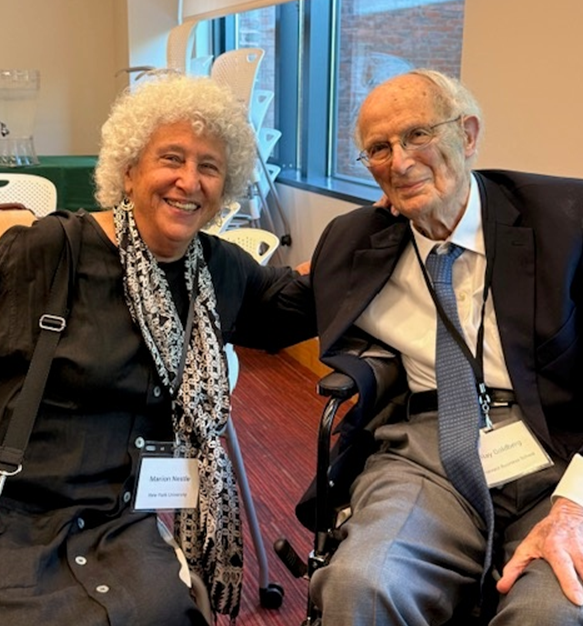
Ray Goldberg died last week at the age of 99.  He was still going pretty strong the last time I saw him last fall at the annual meeting of PAPSAC (Private and Public Scientific, Academic and Consumer Food Policy Group) at Harvard’s Kennedy School.

Edmund O’Keeffe, photo

We were an unlikely pair to know each other for so long and to care about each other so deeply.

When I first met him in the early 1990s, Ray was professor of agribusiness (a term he coined) at the Harvard Business School, as representative of Big Ag as anyone could be.  When he invited me to participate in the newly formed PAPSAC, I could not imagine why he would want me there or why I should go.

Contrary to Ray’s recollection, I did not attend the first meeting. I would have had to pay my own expenses, which seemed outrageous given that so many of the participants were CEOs of multi-billion dollar companies and flew to Boston via private jet.

The second year, Ray said they would pay for my travel and persuaded me that the meeting would be worth attending.  Its purpose, he explained, was to bring food business leaders and consumer activists together to share views and to reach mutual understanding.

My interpretation: Ray thought that if we saw how caring the CEOs of agribusiness firms were about feeding the world, we would not object so much to what they did.  That never worked, but he kept on trying.  And I kept on attending, for more than 25 years.

My rationale:

  • Ray was impossible to say no to.
  • I could learn how agribusiness leaders thought about what they were doing.
  • I could say what I thought in a presentation pretty much every year.

Two highlights:

  • I witnessed the CEOs of Pioneer Hi-Bred and other agbiotech companies scream at the CEO of Monsanto for alienating the public about genetically modified crops and ruining their businesses.
  • I attended the session when Ray had the bright idea of showing the film Food, Inc to the group (he thought they ought to see it).  This did not go over well, and I joined its director, Robby Kenner, in fielding audience attacks.

Despite what I consider to be a total contradiction between the profit goals of agribusiness and the goals of public healthl, Ray continued to insist that we all needed to listen to each other.

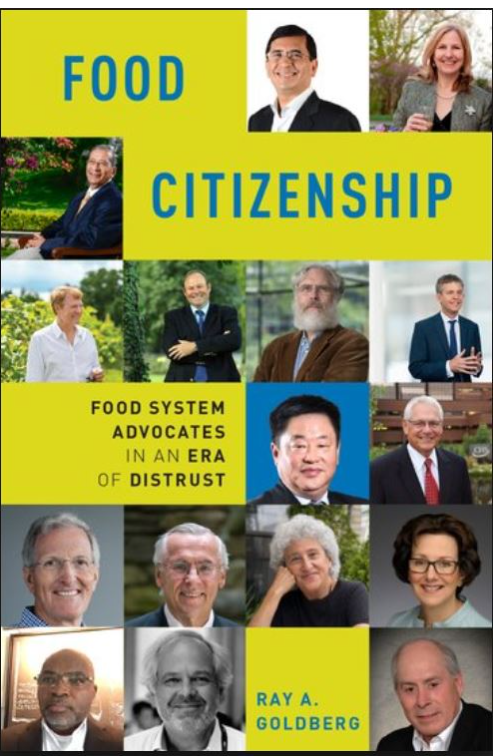
His sunny view of humanity is best illustrated by his book  Food Citizenship, which I wrote about in 2018 when it first came out.

The book consists of Ray’s interviews with dozens of PAPSAC participants, beginning with his interview with me.  [The interviews were videotaped and are  available at the Oxford University Press website.  The video of Ray’s interview with me is posted here.]

I always felt like a total outsider at this meeting, and was surprised to find myself at the core of Ray’s attempts to achieve mutual understanding among participants.

We could all use more of that.

As is clear from our interview and Ray’s response to my responses to his questions, we viewed the world of agribusiness very differently.

But I loved him, and will miss him.

Dec 19 2025

RIP Dr. Jerome Lowenstein: a remembrance

Last week I was heartbroken to receive a message from Danielle Ofri, the editor of the Bellevue Literary Review, announcing the death of Jerome Lowenstein, who had been my primary care doctor for more than 20 years.

To say that the editors of Bellevue Literary Review were saddened to learn of the passing of Jerome Lowenstein, MD, is an understatement. Jerry was our founding nonfiction editor, one of the original sparks that led to BLR’s creation.

How lucky I was to be his patient.  I would schedule my appointments late in the afternoon when we could talk for hours, mostly about his research on kidney function.  He was a practicing nephrologist, but had a small primary care practice to which I felt privileged to belong.

Here’s how that happened.

In California, I had been a Kaiser Permanente patient since childhood, and was used to non-profit medical care.  Dealing with for-profit New York health care was difficult, and in the mid-1990s I had an unsettling experience with an excessively interventionist (in my view)  primary care doctor, who I never wanted to see again.

Soon after this incident occurred, I was reading the New England Journal of Medicine when I came across a review of a book by an NYU doctor named Jerome Lowenstein, The Midnight Meal and Other Essays about Doctors, Patients, and Medicine.  The reviewer, Robert Schwartz, said:

He values words and explores how they reveal attitudes about patients. He hates dehumanizing and judgmental jargon and deplores the psychic numbing of overworked residents…He teaches by example, learns from patients, values the physical examination, and doubts — profoundly doubts — the utility of outcomes research.  Lowenstein finds evidence-based medicine disturbing, frightening, and anti-intellectual.

He worked at NYU?  I worked at NYU.  I looked up his email address, recounted my story, and asked if he could refer me to a primary care doctor who viewed medical care the way he did.

He said he had a small primary care practice, and that I sounded like his kind of patient.  Would I like to see him.

Would I ever!

When he gave up his practice some years ago, it felt like a crisis.  He arranged for all of us to be seen by Dr. David Kudlowitz, and that’s also worked out well.

I loved him.  I was not alone in that.

Farewell, dear doctor.  I will miss you and so will the world.

Obituaries

Sep 23 2025

RIP Marian Burros, cookbook author, food politics writer, colleague, and friend

It breaks my heart to learn of the death of the great cookbook author and food politics writer, Marian Burros.

She was immensely important to me and to my work.

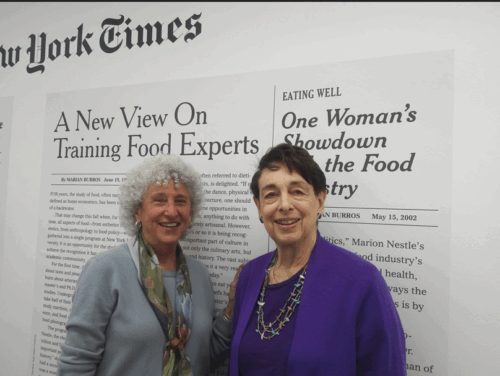
Marion Nestle and Marian Burros at NYU, 2018

Her obituary in the New York Times appeared on Saturday; I was interviewed for it some years ago and am quoted:

Marian was hugely ahead of her time in writing about the importance of food choices that not only improve health but also are sustainable and protect the environment…She was writing about the politics of food long before anyone dreamed that a food movement might exist.”

So true.  I first met her in the late 1980s when I was in DC working for Health and Human Services as managing editor of the Surgeon General’s Report on Nutrition and Health.  Marian was writing for the Washington Post and interviewed me about the report a couple of times.  Soon after, she moved to the New York Times and I moved to NYU.

In 1991, when the USDA withdrew the long-researched, about-to-be-published Eating Right Pyramid, ostensibly because it had not been tested on low-income women and children, I was contacted by a USDA staff person with documents proving that the real reason was pressure from meat producers who did not like the position of meat at the top of the pyramid.  As I tell in detail in my book, Food Politics, a USDA Deep Throat asked if I could get those documents to the press.

I called Marian Burros and asked if she’d be interested.  She was.

Her first of many articles on the pyramid scandal: Are cattlemen now guarding the henhouse? (it quotes me).

She worked on that story for a year, eventually digging out enough leaked information that she could piece together what the USDA was going to do—a bowl!

Her article so embarrassed the USDA that it had to admit the pyramid was a better option, and finally issued it.

In 1996, my NYU Department created undergraduate, master’s, and doctoral programs in Food Studies.  Clark Wolf, a food consultant who was advising us, told Marian Burros about the programs.

As soon as we had New York State approval for the programs, she wrote about them: A New View on Training Food Experts,

We had prospective students in our office that very afternoon, holding copies of the clipping, and saying they’d waited all their lives for this program.  Thanks to that publicity, even though this was mid-summer, we had a full class that fall.

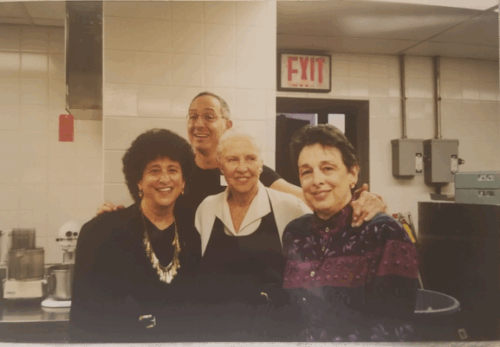
And here we all were, celebrating the Department’s new teaching kitchen.

Three Marions—Nestle, Cunningham, and Burros (with an a)—and Clark Wolf at NYU’s newly renovated teaching kitchen in 1996.

She was one tough reporter.  She asked hard questions and insisted on answers.  She knew the food politics scene better than anyone.

I was sorry when she retired from the Times.  It seemed like a great loss.

It is a great loss.

Sep 15 2025

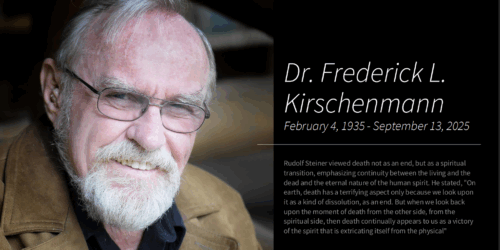
RIP Fred Kirschenmann

Fred Kirschenmann died over the weekend after a long illness, a great loss.

He described himself as a farmer-philosopher, and so he was.

I first met him in the early 2000s when I went to Iowa State to give a lecture.  The Dean of Agriculture, Cathy Wokeki, said I had to meet him.  He was then directing the Leopold Center for Sustainable Agriculture at Iowa State, which promoted organic, sustainable, regenerative farming methods right smack in the epicenter of U.S. industrial agriculture.  When the Center—an explicit critic of industrial methods—was unsurprisingly defunded, Fred became a Distinguished Fellow of the Center.

I got to know him better when we both served on the Pew Commission for Industrial Farm Animal Production from 2006-2009, where I got to witness his honesty, integrity, thoughtfulness, and humanity in action.

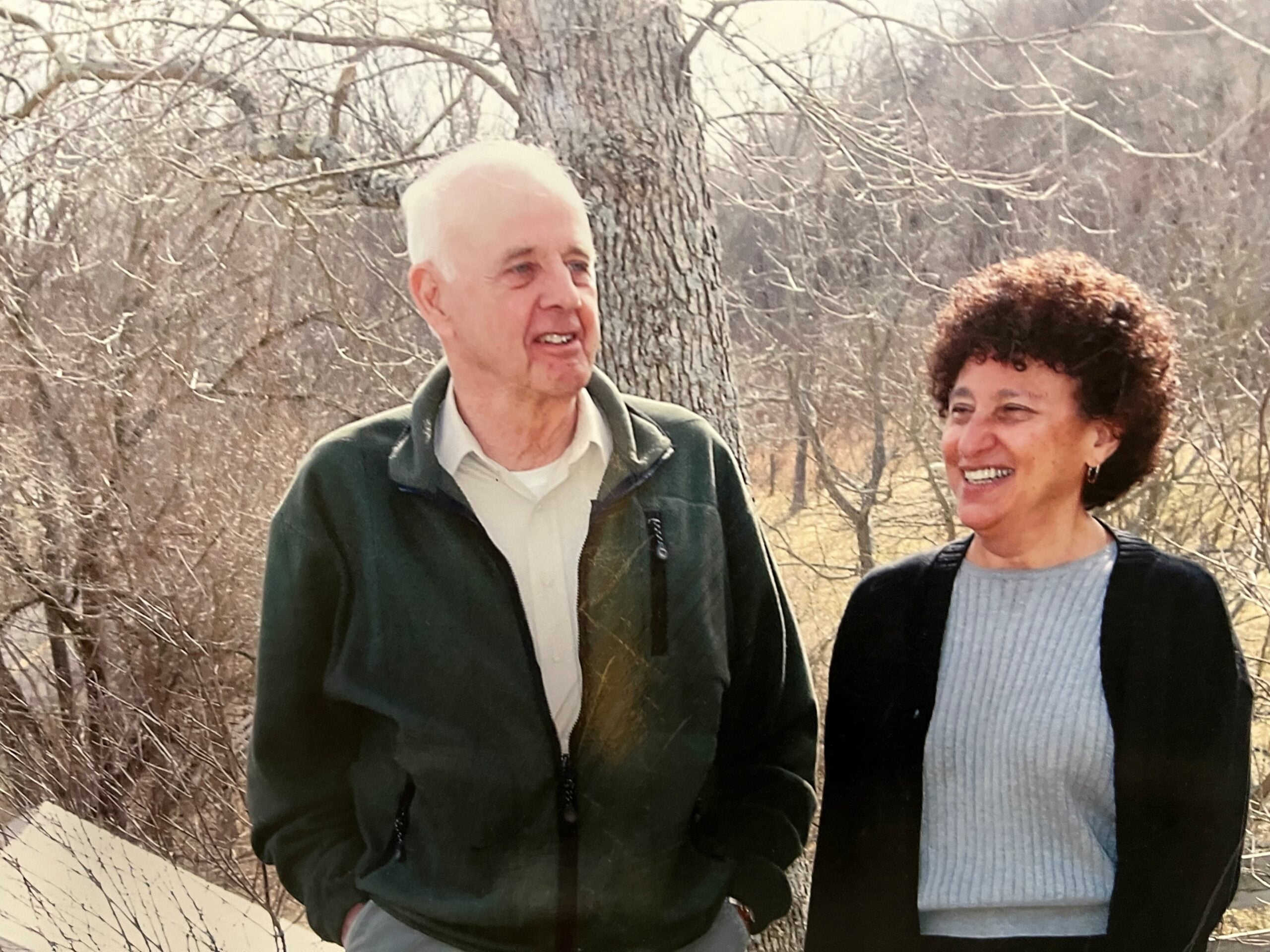
He wrote eloquently about his beliefs about the importance of sustainable faming in Cultivating an Ecological Conscience: Essays from a Farmer Philosopher, published in 2010.  My blurb for the book  pointed out that he’s “right up there with the other agronomic philosophers–-Wendell Berry and Wes Jackson…It should inspire everyone to start planting and to think deeply about the food we eat.”

Since then, I witnessed his leadership and got to see him occasionally at Stone Barns.  Over the last months, I followed his slow and painful decline through the postings of his daughter Annie, and wife Carolyn Raffensperger, on Caring Bridge.

I was touched last week when Carolyn played an interview I had given on PBS News for him to listen to [The interview was about the MAHA Strategy report].

He was an inspiration to all of us who care deeply about how we farm and what we eat.

Sometime during this year, Angie Tagtow and Carolyn collected tributes from Fred’s colleagues and friends.  I am honored to be included among so many esteemed colleagues in this Festschrift volume.

I will miss him.

His official obituary is here.  It explains his background and the source of his ethics and inspiration.

Mar 11 2025

Rest in Peace Joan Gussow*

This is a deep personal as well as professional loss.  Here’s the obituary from the New York Times. which quotes me.

Marion Nestle, a nutritionist and public health advocate, said that Ms. Gussow “was enormously ahead of her time,” adding, “Every time I thought I was on to something and breaking new ground and seeing something no one had seen before, I’d find out that Joan had written about it 10 years earlier.”

“She was a food systems thinker before anyone knew what a food system was,” Ms. Nestle said, referring to the process of producing and consuming food, including the economic, environmental and health effects. “What she caught on to was that you couldn’t understand why people eat the way they do and why nutrition works the way it does unless you understand how agriculture production works. She was a profound thinker.”

I first met Joan in the late 1970s when I heard her give a talk in the Bay Area when I was first teaching at the University of California San Francisco School of Medicine.  I had never heard anyone talk about the need to link agricultural production to nutrition and health—food systems, we now call that—and it felt revelatory.

Soon after, her publisher sent me the manuscript of what became The Feeding Web: Issues in Nutritional Ecologyasking whether he should take it.  My reader’s report praised it to the skies, but I worried that it was so critical of mainstream nutrition that students would find it nihilistic.  She added a brilliant and utterly inspiring conclusion.

I am not alone in being inspired by her work.  I have followed it with great admiration.

Ahead of her time?  Absolutely.

You have discovered that the food industry influences food choices?  Try Joan’s Who Pays the Piper from 1980.

You think food systems should be sustainable?  See Joan’s “Dietary Guidelines for Sustainability,” written with Kate Clancy in 1986.

Her students at Columbia were so lucky to be in her orbit.

I learned so much from her about how to think about food issues.

I am beyond sad at her loss.

If you want a better idea of her contribution, take a look at Brian Halweil’s 2010 profile of Joan for Edible Manhattan (I’m quoted).

Pam Koch at Columbia invites people to share memories, photos, or comments on what Joan meant to you at this link.

*For some reason, my original post did not get sent out so I am trying again

Mar 10 2025

Rest in Peace Joan Gussow*

This is a deep personal as well as professional loss.  Here’s the obituary from the New York Times. which quotes me.

Marion Nestle, a nutritionist and public health advocate, said that Ms. Gussow “was enormously ahead of her time,” adding, “Every time I thought I was on to something and breaking new ground and seeing something no one had seen before, I’d find out that Joan had written about it 10 years earlier.”

“She was a food systems thinker before anyone knew what a food system was,” Ms. Nestle said, referring to the process of producing and consuming food, including the economic, environmental and health effects. “What she caught on to was that you couldn’t understand why people eat the way they do and why nutrition works the way it does unless you understand how agriculture production works. She was a profound thinker.”

I first met Joan in the late 1970s when I heard her give a talk in the Bay Area when I was first teaching at the University of California San Francisco School of Medicine.  I had never heard anyone talk about the need to link agricultural production to nutrition and health—food systems, we now call that—and it felt revelatory.

Soon after, her publisher sent me the manuscript of what became The Feeding Web: Issues in Nutritional Ecologyasking whether he should take it.  My reader’s report praised it to the skies, but I worried that it was so critical of mainstream nutrition that students would find it nihilistic.  She added a brilliant and utterly inspiring conclusion.

I am not alone in being inspired by her work.  I have followed it with great admiration.

Ahead of her time?  Absolutely.

You have discovered that the food industry influences food choices?  Try Joan’s Who Pays the Piper from 1980.

You think food systems should be sustainable?  See Joan’s “Dietary Guidelines for Sustainability,” written with Kate Clancy in 1986.

Her students at Columbia were so lucky to be in her orbit.

I learned so much from her about how to think about food issues.

I am beyond sad at her loss.

If you want a better idea of her contribution, take a look at Brian Halweil’s 2010 profile of Joan for Edible Manhattan (I’m quoted).

Pam Koch at Columbia invites people to share memories, photos, or comments on what Joan meant to you at this link.

[*For some reason, this did not get sent out this morning so I am reposting it.]

Mar 10 2025

Rest in Peace Joan Gussow

This is a deep personal as well as professional loss.  Here’s the obituary from the New York Times. which quotes me.

Marion Nestle, a nutritionist and public health advocate, said that Ms. Gussow “was enormously ahead of her time,” adding, “Every time I thought I was on to something and breaking new ground and seeing something no one had seen before, I’d find out that Joan had written about it 10 years earlier.”

“She was a food systems thinker before anyone knew what a food system was,” Ms. Nestle said, referring to the process of producing and consuming food, including the economic, environmental and health effects. “What she caught on to was that you couldn’t understand why people eat the way they do and why nutrition works the way it does unless you understand how agriculture production works. She was a profound thinker.”

I first met Joan in the late 1970s when I heard her give a talk in the Bay Area when I was first teaching at the University of California San Francisco School of Medicine.  I had never heard anyone talk about the need to link agricultural production to nutrition and health—food systems, we now call that—and it felt revelatory.

Soon after, her publisher sent me the manuscript of what became The Feeding Web: Issues in Nutritional Ecologyasking whether he should take it.  My reader’s report praised it to the skies, but I worried that it was so critical of mainstream nutrition that students would find it nihilistic.  She added a brilliant and utterly inspiring conclusion.

I am not alone in being inspired by her work.  I have followed it with great admiration.

Ahead of her time?  Absolutely.

You have discovered that the food industry influences food choices?  Try Joan’s Who Pays the Piper from 1980.

You think food systems should be sustainable?  See Joan’s “Dietary Guidelines for Sustainability,” written with Kate Clancy in 1986.

Her students at Columbia were so lucky to be in her orbit.

I learned so much from her about how to think about food issues.

I am beyond sad at her loss.

If you want a better idea of her contribution, take a look at Brian Halweil’s 2010 profile of Joan for Edible Manhattan (I’m quoted).

Pam Koch at Columbia invites people to share memories, photos, or comments on what Joan meant to you at this link.

Jun 25 2024

Rest in Peace, Narsai David

This is a big personal loss.  I met Narsai David—chef, host, raconteur, radio personality, philanthropist, theater lover, friend—in 1955 when we lived at the student co-ops at Berkeley.  These required 5 hours of work a week, and I did mine peeling potatoes under Narsai’s supervision at the co-op central kitchen.

We stayed in touch over the years, sometimes memorably, as when we were both filmed with Craig Claiborne and Frank Blair for the KQED show, Over Easy in 1980 or so (that’s me on the right).

And then there was the 1997 Oldways trip to Crete where Narsai whipped off breads for the hundred or so guests lucky enough to be at that dinner.

He was the most extraordinarily generous person, quietly contributing to food, co-op, theater, and I’m sure other groups throughout the Bay Area.  He was on my list for people to see every time I was out there, sometime appearing on his radio show, and sometimes invited to his and Veni’s home for warm and gracious evenings.

We were friends for more than 60 years, it shocks me to realize.  I’m so saddened by his loss.