by Marion Nestle

Currently browsing posts about: Salmonella

Aug 11 2011

Q. What’s with the turkey recall? A. Same old, same old

I’ve been rounding up information about the Cargill recall of ground turkey contaminated with Salmonella Heidelberg.  William Neuman at the New York Times related the story on August 3. Same old same old.

Cargill is a huge company with, as Bill Marler counts them, a long history of food safety problems.  Did Cargill not bother to test for pathogens?   As I explain in my book Safe Food: The Politics of Food Safety, no meat company wants to test for pathogens.  If they found pathogens, they would have to recall the products.

And where was the USDA in all of this?  Best not to ask.

The USDA was testing.  The testing found Salmonella.  The USDA did nothing.

According to the Wall Street Journal,

Federal officials said they turned up a dangerous form of salmonella at a Cargill Inc. turkey plant last year, and then four times this year at stores selling the Cargill turkey, but didn’t move for a recall until an outbreak killed one person and sickened 77 others.

How come?

Food-safety specialists said the delay reflected a gap in federal rules that don’t treat salmonella as a poisonous contaminant, even if inspectors find antibiotic-resistant forms such as the Heidelberg strain implicated in the latest outbreak.

But CDC investigations show that turkey-related illnesses have been reported for months.  Despite the reports, the USDA took its own sweet time insisting on a recall.

The rationale for the delay is—get this—the USDA believes it does not have the authority to order recalls for any contaminant except E. coli O157:H7.  It has no authority to recall meat contaminated with Salmonella or other toxic forms of E. coli.

Or at least that’s how USDA interprets the legal situation (for the history of all this, see Bill Marler’s summary.

One reason for the USDA’s foot-dragging must surely be pressure from the meat industry which wants as little testing as possible and preferably none.  The meat industry would rather leave it up to you to cook your food safely.

According to a report by Elizabeth Weise in USA Today,

The reasons these bugs aren’t currently regulated are a mix of politics, money and plain biology — the bacteria are constantly evolving and turning up in new and nastier forms, making writing rules about them a bit of a nightmare. For example, the German E. coli variant that sickened more than 4,075 in Europe and killed 50…wasn’t known before this spring.

The meat industry takes advantage of this situation and argues:

“We don’t have a true baseline determining the prevalence of these organisms in the beef supply,” says Betsy Booren of the American Meat Institute (AMI) Foundation, the research arm of AMI. Without knowing how common they are, it’s impossible to say whether they should be considered adulterants, she says.

What they seem to be saying is that meat always has bacteria on it.  And just because these particular bacteria can kill people doesn’t mean the industry is responsible if anyone gets sick.  But shouldn’t the industry be doing a better job?

In Food Safety News, Michele Simon has a terrific analysis of the safety loopholes that allow this absurd situation to continue:

How did the meat industry get so powerful that it can keep USDA from doing its job? Now, instead of preventing illnesses from occurring by requiring testing with teeth, we have USDA regulations that are so lax they allow almost half the samples tested at ground turkey plants to be contaminated with Salmonella — a pretty easy standard to meet. And one that allowed this outbreak to occur.

I keep asking: how much worse does it have to get before Congress does something about ensuring safe food.  Cargill’s inability to protect the public from unsafe meat is reason alone to create a single food safety system that unites the functions of USDA and FDA.

If Congress isn’t ready to take that step, it could at least give USDA the power to act and the FDA the funding it needs to do its job.
Mar 11 2011

Is food getting safer? Not very

Michael Osterholm writes in the current New England Journal of Medicine that despite claims that foodborne illness is declining in the United States, that is only part of the story. His editorial refers to the now-published study of Salmonella Saintpaul that I talked about in a previous post.  He says:

All these findings, however, must be interpreted with caution, since most of the decreases occurred between 1996 and 2000, and there has been little additional change since then.

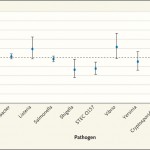
When the 2009 incidence of infections with the eight primary bacterial and parasitic pathogens is compared with their incidence in the period from 2006 through 2008, no significant change can be seen for six pathogens; only the infection rates with shigella and STEC O157 show significant decreases (see graph).

In addition, recent studies have demonstrated a significant increase in the incidence of foodborne disease caused by emerging non-O157 STEC, suggesting that surveillance for O157 is no longer sufficient to determine the effect of foodborne STEC infections.

On the basis of FoodNet data for the past 14 years,we must conclude that the improvements made in the late 1990s in the safety of our food supply are still having a positive effect. But we’ve made little additional progress in the past decade.

The graph he refers to comes from Pathogen. It represents the percent change in laboratory-confirmed foodborne infections from 2006–2007 to 2009.  The horizontal line represents no change.


Feb 24 2011

Closure (?) on Salmonella Saintpaul

The New England Journal of Medicine has just published a CDC report bringing the Salmonella Saintpaul outbreak of 2008 to an apologetic close (for a quick rundown on the history of this incident, see my previous posts).

The investigation of this outbreak first implicated tomatoes, with devastating effects on the tomato industry.  As the paper concludes:

Although an epidemiologic association with raw tomatoes was identified early in this investigation, subsequent epidemiologic and microbiologic evidence implicated jalapeño and serrano peppers. This outbreak highlights the importance of preventing raw-produce contamination.

Yes it does.   Jalapeño and serrano peppers turn up in salsas and guacamoles.  These are mixtures of many ingredients that are often eaten with chips or prepared foods.  People have a hard time remembering whether they ate peppers or not, particularly when the peppers are chopped fine.  As the investigators explained:

This outbreak investigation highlights the recurring challenges of epidemiologic identification of ingredients in foods that are commonly consumed, rapid identification and investigation of local clusters, the need to continue exploring hypotheses during an ongoing outbreak, and produce tracing in the supply chain.

Traceback issues such as commingling, repacking, varying degrees of product documentation throughout the supply chain, difficulty in linking incoming with outgoing shipments to the next level in the distribution chain, and the complexity of the distribution chain continue to hinder product-tracing efforts….

In addition, an understanding of the mechanisms and ecologies that can lead to contamination of produce on farms and the institution of additional control measures from the source throughout the supply chain are critical for preventing similar outbreaks in the future.

In other words, we badly need farm-to-table safety controls for all foods, no exceptions.

But, as the accompanying editorial by Michael Osterholm explains,

The new law has a major shortcoming: dollars. There was no appropriation approved by the Congress for the act or authorization in the bill for the FDA to assess fees on the companies that it inspects. The Congressional Budget Office estimated that implementing this legislation would require $1.4 billion between 2011 and 2015….

Recent reports in the media calling this act “historic legislation” must be tempered by the reality that without the necessary resources, requiring the FDA to carry out the law’s required activities will be like trying to get blood out of a rock.

Blood out of a rock?  The House just passed a bill that would CUT the FDA’s food safety budget by $241 million.

Of course the FDA doesn’t need the funds.  After all, only 21% of the 1,500 people known to have gotten sick with Salmonella Saintpaul had to be hospitalized, and only 2 died.  And Salmonella Saintpaul is in foods that real Americans don’t eat anyway, like peppers with funny foreign names and alfalfa sprouts.

I used to say that Congress would never move on food safety until a close relative of a senior Senator became seriously ill with food poisoning.   Now I have to include a senior House member.

Aug 21 2010

Why the U.S. needs a better food safety system

Yes, the Senate needs to pass S.510 but that is only the first step.  As the inimitable Carol Tucker Foreman puts it in today’s New York Times story on the latest egg recalls:

You have to treat eggs with the assumption that they’re contaminated with salmonella…We may all object to the fact that we have to treat food like toxic waste, but if we don’t want to get sick, and especially if you have someone in your house that’s immune-suppressed, you have to handle things carefully and demand that the standards be set higher.

If you are still unconvinced, take a look at the recalls announced by the FDA just since August 13 (I’ve deleted the ones that do not involve microbial contaminants):

The FDA has a lot to say about Salmonella risk, but it’s useful to note that all these recalls are voluntary. Hence the need for S.510.

S.510 won’t solve the problem but it is a necessary first step in getting to a food safety system that does a better job of protecting the public against this sort of thing.

Aug 20 2010

The Salmonella-in-eggs situation gets worse

Judging from the number of interview requests today, everyone has figured out that the egg recall is not only awful for the people who got sick but also has something to do with our hopelessly inadequate food safety system and dysfunctional Congress.

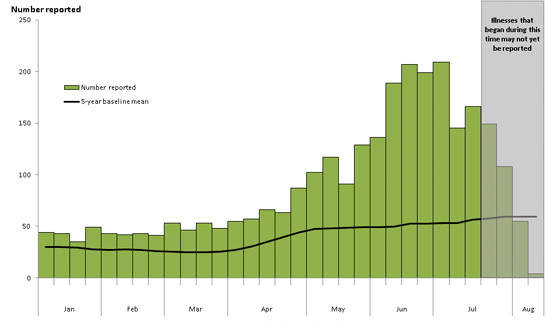
The CDC has updated its statistics on the number of illnesses.  Here’s what this epidemic looks like:

About 2,000 cases have been reported but the CDC does not yet know whether these are all related to this particular outbreak.

Here’s what’s special about this particular recall:

  • Salmonella in eggs never used to be a problem until we had industrial egg production that puts hundreds of thousands of hens in close (very close) proximity.
  • The company producing these particular eggs has a long history of rule violations.
  • The company was not required to follow standard food safety plans.  Whatever it had to do was voluntary.
  • The FDA started writing rules for safe egg production more than 10 years ago.  These were quashed. It finally got them done last July.
  • The new safety rules for eggs went into effect this July 9, too late to prevent this outbreak.
  • The FDA’s hands are tied by inadequate legislation and resources.
  • The House passed legislation last August—one year ago—to give the FDA more authority and more resources.  The Senate has been sitting on S.510 ever since.

The moral?  Voluntary doesn’t work.  We need mandatory food safety rules.

And sooner rather than later, no?


Aug 19 2010

Salmonella in eggs is old news. But 380 million?

Yesterday, the FDA announced yet another voluntary recall of eggs produced by Wright County Egg in Galt, Iowa.  The first announcement on August 13 covered 228 million eggs.  This one adds 152 million for a grand total of 380 million—so far.

In that first announcement, the Wright company said: “Our farm strives to provide our customers with safe, high-quality eggs – that is our responsibility and our commitment.”

That, however, is not how the New York Times sees it.  According to today’s account, Wright has a long history of “run-ins with regulators over poor or unsafe working conditions, environmental violations, the harassment of workers, and the hiring of illegal immigrants.”

OK, so where are we on safety regulation?  The FDA, after many, many years of trying, finally introduced safety regulations for shell eggs.  These supposedly went into effect on July 9.

I recount the history of FDA’s persistence in the chapter entitled “Eggs and the Salmonella problem” in What to Eat. Check out the table  listing the key events in this history from 1980 to 2005.  It’s not pretty.

Preventing Salmonella should not be difficult.  The rules require producers to take precautions to prevent transmission, control pests and rodents, test for Salmonella, clean and disinfect poultry houses that test positive, divert eggs from positive-testing flocks, refrigerate the eggs right away, and keep records.  These sound reasonable to me, but I care about not making people sick.

Problems with Wright County Eggs started in May before the FDA’s mandatory rules went into effect meaning that the procedures were still voluntary.  The recalls this month are after the fact.  Chances are that most of the recalled eggs have already been eaten.

The CDC is tracking this recall and has logged about 200 reports of illness associated with it so far.  It has plenty to say about Salmonella and its hazards.

According to FoodSafetyNews, the first lawsuits have been filed.

As for food safety legislation that would give the FDA the authority to handle these incidents more efficiently—and, let us hope, maybe even prevent them—it is still sitting in the Senate.  For S.510 watchers, Bill Marler has a helpful new analysis.

The recall, by the way, affects eggs sold under many different brands: Lucerne, Albertson, Mountain Dairy, Ralph’s, Boomsma’s, Sunshine, Hillandale, Trafficanda, Farm Fresh, Shoreland, Lund, Dutch Farms, and Kemps in the first round, and now also James Farms, Glenview, and Pacific Coast.

The good news is that cooking kills Salmonella.  I’m buying eggs at farmers’ markets these days.

Addition: Tom Philpott of Grist on Wright County’s unsavory history.