Why, you must be asking, am I even asking a question like this?
Because of this study, obviously, which I somehow missed when it came out in August (thanks to toxicologist Marc Stifelman for sending it to me).
The study: Cabbage and fermented vegetables: From death rate heterogeneity in countries to candidates for mitigation strategies of severe COVID‐19. Bousquet U, et al. Allergy. 2020 Aug 6;10.1111/all.14549. Online ahead of print.
The hypothesis:
- The basic observation behind this study is that countries differ in death rates from Covid-19, and death rates differ between regions in the same country.
- Differences in diet could account for differing death rates.
- People in countries with low death rates typically eat cabbage and fermented vegetables.
- Cabbage and fermented vegetables contain precursors of sulforaphane, the most active natural activator of an antioxidant in the metabolic pathway most affected by Covid-19. They also promote a healthy microbiome.
The nutritional epidemiology:
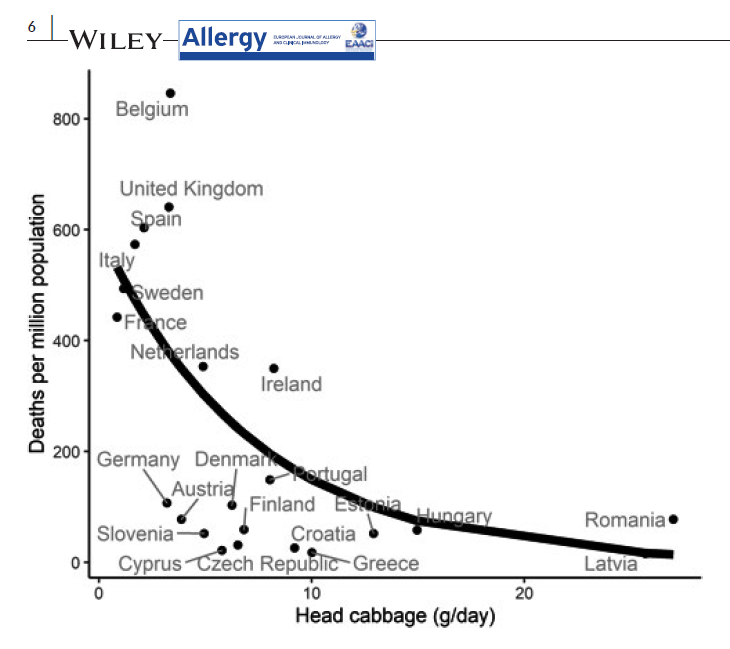
CAUTION: Correlation does not necessarily mean causation. The diets—and other lifestyle characteristics—of people in Romania and Latvia differ from those in the UK and Italy in other ways besides diet; other differences might well account for these variations.
Personally, I love cabbage in any form.
But for prevention of bad outcomes from Covid-19, I’m counting on vaccination, not kimchi or sauerkraut.