by Marion Nestle

Currently browsing posts about: Microbiome

Feb 16 2026

Industry-funded study of the week: Whole Milk and weight loss

To many people, full-fat milk tastes better and is more satisfying, which is reason enough to prefer it.  But the “drink full-fat milk” advice in the new dietary guidelines doesn’t make much sense to me.  Most of the nutrients in milk are in the whey portion and vitamins A and D are added to low fat milk.  This makes low- and full-fat milk pretty much equally nutritious.   Also, full-fat milk is just as processed as skim milk; the dairy industry removes the fat and adds it back to the desired percentage.

But the dairy industry wants to sell more full-fat milk and sponsors research demonstrating its superiority.  This recent example replaced their typical dairy consumption with whole milk.  If they had the right kind of intestinal bacteria, they lost weight.

The study: Qin P, Berzina L, Geiker NRW, Sandby K, Krarup T, Kristiansen K, Magkos F. Associations Between Gut Microbiome Enterotypes and Body Weight Change During Whole Milk Consumption. Nutrients. 2026; 18(4):563. https://doi.org/10.3390/nu18040563

Background: Evidence is accumulating that gut bacterial communities modulate the outcome of dietary interventions.

Objective: To assess how gut microbial enterotypes correlate with obesity-related outcomes during one month of whole milk consumption.

Methods: This post hoc analysis used data from a previously published trial, which included a lead-in phase during which men with abdominal adiposity replaced habitual dairy product consumption with 400 g/day of whole milk for one month. We compared body weight, urinary metabolites, fecal metabolites, and gut microbiome composition and function based on shotgun metagenomic sequencing at the beginning and at the end of the lead-in phase between individuals with the two most prevalent enterotypes, the Bacteroides1 (B1) enterotype (n = 24) and the Ruminococcaceae (R) enterotype (n = 38).

Results: Individuals with the B1 enterotype, but not those with the R enterotype, exhibited decreases in body weight and the relative abundance of Streptococcus thermophilus. Multiple linear regression analysis identified enterotype as a strong predictor of body weight change (p = 0.0034). In addition, urinary taurine level change was positively associated with body weight change in B1 individuals, not in R individuals.

Conclusions: Our findings reveal an enterotype-specific response to an identical dietary modification, underscoring the value of integrating enterotype information into nutrition-intervention design and personalized nutrition strategies.

Funding: The FerMetS study and analyses were funded by research grants from Arla Food for Health and the Danish Milk Levy Fund. Dairy products were provided by Arla Foods amba.

Conflicts of Interest: NRWG has received grants from the Danish Agricultural and Food Council. FM has received grants from Arla Foods A/S. The funder had no role in the study design, data collection, data analysis, data interpretation, or the decision to publish the results. The remaining authors declare that they have no conflicts of interest.

Comment

I checked the Arla Foods website.  It says: “Arla Foods is the 4th largest dairy company in the world and a cooperative owned by more than 12,700 dairy farmers.”  The relationship between the microbiome and body weight is truly fascinating and this study suggests that some kinds of bacteria are better than others for maintaining a healthy weight.  The authors make the point of this study clear in their conclusion: “In summary, our findings suggest that individuals with the B1 enterotype may be more prone to weight loss in response to whole milk consumption…..”  They view whole milk as a diet aid.
Jul 5 2021

Industry-sponsored study of the week: Prebiotics

I read about this one in NutraIngredients.com.

While previous animal studies have suggested a significant impact of the gut microbiota on the development and maturation of brain networks that underlie emotional behaviour, fewer studies have been conducted on humans. Intake of a galacto-oligosaccharides (GOS) prebiotic over 3 weeks has been shown to lower the secretion of the stress hormone cortisol and emotional processing in healthy adults, suggesting that GOS intake may be useful in modifying anxiety-related psychological mechanisms. However, reviews and meta-analyses on the efficacy of prebiotics for reducing anxiety symptomology are mixed, calling for further well controlled trials in human participants.

I am always curious to know who pays for this kind of research, so I looked up the study.

Anxiolytic effects of a galacto-oligosaccharides prebiotic in healthy females (18-25 years) with corresponding changes in gut bacterial composition.  Nicola Johnstone Chiara Milesi Olivia BurnBartholomeus van den BogertArjen Nauta Kathryn Hart Paul SowdenPhilip W J BurnetKathrin Cohen Kadosh.   Sci Rep 2021 Apr 15;11(1):8302.

The study: “We examined multiple indices of mood and well-being in 64 healthy females in a 4-week double blind, placebo controlled galacto-oligosaccharides (GOS) prebiotic supplement intervention and obtained stool samples at baseline and follow-up for gut microbiota sequencing and analyses. We report effects of the GOS intervention on self-reported high trait anxiety, attentional bias, and bacterial abundance, suggesting that dietary supplementation with a GOS prebiotic may improve indices of pre-clinical anxiety.”

Conflict of interest statement: AN is an employee of FrieslandCampina, Amersfoort, The Netherlands. BvdB reports co-ownership of MyMicroZoo, Leiden, The Netherlands with no financial benefit from contributions to this manuscript. NJ, CM, OB, KH, PS, PWJB and KCK declared no financial or potential conflicts of interest.

Comment:  Probiotics are microorganisms that maintain a healthy microbiome.   They are typically found in fermented foods like yogurt.  Prebiotics are substances in food—or, in this case, supplements—that feed probiotic microbes.  This prebiotic supplement is GOS, a complicated chain of sugar molecules that is found in milk.

Why would an employee of FrieslandCampina want to do this study?  “Milk is the foundation of everything we do at FrieslandCampina.”

Why would a co-owner of MyMicroZoo be interested?  “The MyMicroZoo analysis shows the composition of your microbiota, and gives insight into how to improve your vitality.”

I’m all for eating yogurt (but watch out for the added sugars).  But GOS supplements?  Pardon my industry-induced skepticism.

Jan 18 2021

Annals of nutritional epidemiology: Can cabbage mitigate the severity of Covid-19?

Why, you must be asking, am I even asking a question like this?

Because of this study, obviously, which I somehow missed when it came out in August (thanks to toxicologist Marc Stifelman for sending it to me).

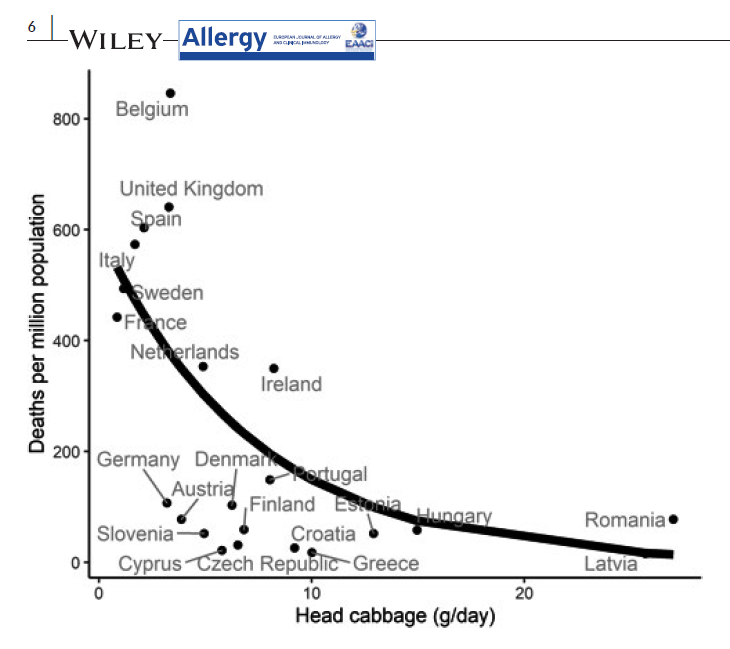
The study: Cabbage and fermented vegetables: From death rate heterogeneity in countries to candidates for mitigation strategies of severe COVID‐19.  Bousquet U, et al.  Allergy.  2020 Aug 6;10.1111/all.14549. Online ahead of print.

The hypothesis:

CAUTION:  Correlation does not necessarily mean causation.  The diets—and other lifestyle characteristics—of people in Romania and Latvia differ from those in the UK and Italy in other ways besides diet; other differences might well account for these variations.

Personally, I love cabbage in any form.

But for prevention of bad outcomes from Covid-19, I’m counting on vaccination, not kimchi or sauerkraut.

Jan 23 2020

What’s Up with the Microbiome?

NutraIngredients.com, one of those industry newsletters I follow closely, publishes numerous articles on probiotics, gut health, and the microbiome.  I have a few examples here, but let’s start with this one:

Postbiotics?  For this, a glossary may help:

  • Probiotics:  Beneficial microbes in the intestinal tract
  • Prebiotics:  Food substances that promote the growth of probiotics
  • Synbiotics:  Probiotics and Prebiotics together
  • Postbiotics:  Bioactive substances produced by probiotics (e.g., microbial cells, cell constituents, metabolites).
  • Parabiotics:  Heat-killed microorganisms

More articles on these topics:

And Natural Products Insider has a report on prebiotic supplements available for downloading.

Aug 5 2019

Industry-funded study of the week: “probiotic” weight-loss supplement

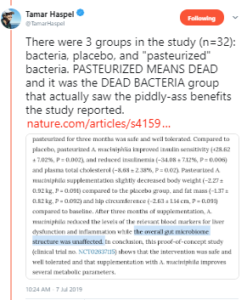
I spotted some tweets about this study from Washington Post writer Tamar Haspel, who has a sharp eye for this sort of thing.  Her first tweet said:

Her second tweet explained the problem:

So of course I had to look up the study.  It’s not one I would ordinarily have noticed because its title does not use the word “probiotic,” which typically refers to the live bacteria (in yogurt, for example).  The evidence for benefits of probiotics is iffy, so this study raises lots of questions.

Let’s take a look at it:

The Study:  Supplementation with Akkermansia muciniphila in overweight and obese human volunteers: a proof-of-concept exploratory study. Depommier C, et al.  Nature Medicine (2019

Conclusion: I’ve left out the statistics to make this easier to read:  “Compared to placebo, pasteurized A. muciniphila improved insulin sensitivity…, and reduced insulinemia…and plasma total cholesterol…. Pasteurized A. muciniphila supplementation slightly decreased body weight…compared to the placebo group, and fat mass…and hip circumference…compared to baseline….In conclusion, this proof-of-concept study…shows that the intervention was safe and well tolerated and that supplementation with A. muciniphila improves several metabolic parameters.”

Competing interests:  Five of the authors “are inventors of patent applications…filed with [patent offices in at least 12 countries]…dealing with the use of A. muciniphila and its components in the context of obesity and related disorders.” Two of the authors are cofounders of A-Mansia Biotech S.A., a Belgian company that sells A. muciniphila supplements, presumably as weight-loss supplements.

Comment: As Haspel points out, the subjects in this study were given either (a) live bacteria, (b) Pasteurized (and, therefore, mostly dead) bacteria, or (c) a placebo.  The Pasteurized ones were associated with metabolic benefits and weight loss.  Pasteurization is what gets done to milk to kill most—not all—of the living bacteria it contains.  In this study, Pasteurized bacteria had the same effect on the microbiome as the unpasteurized.  The point of the study was to show that the Pasteurized supplement would induce weight loss; the observed loss, however, was not statistically significant.   Nature Medicine‘s editors should know better.  So should the New York Times’ editors.  Haspel points out that the New York Times account of the study accepted its conclusion uncritically, headlining it “A Probiotic for Obesity?”  At least the headline included a question mark.  The article did not mention the authors’ patents or conflicts of interest; it should have.

Bottom line: If you want to keep your microbiome healthy, eat a healthy diet.

Nov 29 2018

NutraIngredients-USA on “Personalized Nutrition”

The food industry is intensely interested in personalized nutrition because it can create and sell products appeared to be aimed directly at individual lifestyles and preferences.

This approach is aimed much more at marketing than it is about public health.

With that said, take a look at how the food industry is using this idea.

Special Edition: Personalized Nutrition

The future is personal, but the revolution is already taking place around us. Innovative science is combining with entrepreneurial endeavor to bring personalized nutrition to our fingertips.

Personalized nutrition is breaking down the silos and bringing together experts in genetics and genomic profiling, microbiology, nutrition and diet, mobile technology, big data, healthcare and more.

In this special edition we talk to the pioneers and experts in this sector, the scientists and the emerging brands, and the tech developers bringing the personalized nutrition future to the present day.

Jun 5 2017

Food-Navigator USA: Special edition on digestive health

Here is another one of Food-Navigator USA’s collections of articles on specific topics from the food industry’s perspective.  This one is about the endlessly fascinating microbiome, and the probiotics (beneficial bacteria) and prebiotics (substances that feed beneficial bacteria) that keep it healthy.

Special Edition: Digestive health

As pre- and probiotics continue to gain traction in the food and supplement arena, and interest in all things fermented – from sauerkraut to kombucha – gathers pace, we explore how food and beverage manufacturers can tap into growing interest in digestive health, how to market and position products on a digestive health platform without getting into legal hot water, plus new research into the relationship between gut bacteria and health.