by Marion Nestle

Currently browsing posts about: Meat substitutes

Apr 10 2026

Weekend reading: more on alternative meats

I know I just posted a bunch of these, but here are even more.

To understand what’s happening with alternative meats—both plant- and cell-based—it helps to remember that companies making these products are businesses funded by venture capitalists.

The European Union’s recent ban on using the term “meaty” to apply to these products could have major implications for sales.

In the U.S.

In the European Union

Jan 29 2026

What’s happening with plant-based meat: a roundup

Here’s my most recent collection of items about plant- and cell-based meats, in an effort to try to figure out what is happening with the market for these products.  Prospects are not as bright as they were at the height of this trend, but these product have considerable staying power.  Time will tell.

Trends

Successes

Difficulties

Regulation

Nov 25 2024

Industry-funded study of the week: plant-based meat alternatives

Plant-Based Meat Analogs and Their Effects on Cardiometabolic Health: An 8-Week Randomized Controlled Trial Comparing Plant-Based Meat Analogs With Their Corresponding Animal-Based Foods. Toh DWK, Fu AS, Mehta KA, Lam NYL, Haldar S, Henry CJ. Am J Clin Nutr. 2024 Jun;119(6):1405-1416. doi: 10.1016/j.ajcnut.2024.04.006. Epub 2024 Apr 8.

Erratum in: Am J Clin Nutr. 2024 Aug;120(2):459. doi: 10.1016/j.ajcnut.2024.06.012.

This study compared effects on cardiometabolic health among people eating meat or plan-based alternatives for 8 weeks.

Conclusion: An 8-wk PBMA (plant-based) diet did not show widespread cardiometabolic health benefits compared with a corresponding meat based diet.

Funding: This study was supported by Pinduoduo Incorporated (HongKong Walnut Street Limited). Pinduoduo Incorporated had no role in study design, study conduct, laboratory analyses, data collection, management and interpretation or the writing, reviewing and approval of the manuscript.

Comment

This study was sent to me by a reader, who viewed it as a rare example of an industry-funded study with results unfavorable to the sponsor’s interests.  He thought the “Walnut” in the company’s name indicated a plant-based bias.

I wasn’t so sure and wondered what Pinduoduo did, exactly.

According to Wikipedia, “Pinduoduo Inc. (Chinese拼多多Pinyin: Pīn duōduō) is a Chinese online retailer with a focus on the traditional agriculture industry. The business is the largest product of PDD Holdings, which also owns the online marketplace Temu.”

But it gets even better.  The American Journal of Clinical Nutrition published a correction to the paper:

The original funding statement was insufficiently elaborated and has been revised for greater clarity: Christiani Jeyakumar Henry [the senior investigator on this study] reports partial financial support provided by Pinduoduo Incorporated (HongKong Walnut Street Limited) which is an agricultural research firm.

This, then, is a standard example of an industry-funded—and conducted—study producing just the results wanted.  Another example of marketing research, alas.

Feb 1 2024

Cultured meat: of great interest, still not on market

Cell-Based or Cultured Meat continues to generate predictions, positive (new products, new approvals, growth) and negative (doom, bans).

Current status: The FDA and USDA have approved sales of cell-cultured chicken but the only place selling it is Bar Crenn in San Francisco (where I have not been).

While waiting for it to get scaled up (if this ever will be possible), here are a few items I’ve collected recently.

THE POSITIVES

THE NEGATIVES

THE QUESTIONS

Nov 9 2023

The latest developments on the cultivated meat front

I’m trying to keep up with what’s happening with cultivated meat.  So far, the FDA has approved a couple of cultivated chicken cell companies, and these are selling “chicken” in a couple of restaurants, one in San Francisco and the other in Washington DC.

The big issue: scaling cell production up enough to have product to sell.  It takes lots of cells–billions? trillions?—to make a portion big enough to eat.

Here’s what’s going on in this area in the U.S. and U.K.

Apr 6 2023

Annals of cell-cultured meat: woolly mammoth meatballs?

My son Charles, who lives in Los Angeles, sent me this gem from the L.A. Times: “The woolly mammoth is back — in the form of a meatball.”

A woolly mammoth meatball has been created from the animal’s DNA — 4,000 years after the beast went extinct.

The dish is made of cultured meat, grown in labs from animal cells. It used the DNA of the woolly mammoth, together with fragments of DNA from an African elephant, which is the animal’s closest relative still alive today.  Vow, the Australian company that created the food...said it hopes that the project will challenge people to reassess the climate damage caused by cows and other livestock.

I knew you would want to know about this.

*******

For 30% off, go to www.ucpress.edu/9780520384156.  Use code 21W2240 at checkout.


Mar 2 2023

Keeping up with cell-based cultured meat

I don’t know about you but I’m riveted by what’s in the pipeline for cell cultured meat alternatives.   Here are some recent items I’ve been collecting.

Products under development

State of the industry

State of the techno-food scene

Comment

Cell-based meat, meat-plus-algae, and pet food are not yet on the US market so it’s too early to see what they taste like and how well they will do.  I see these products as mostly about mergers, acquisitions, and generating lots of money for investors, which is why I included the Soylent event (Soylent is a nutrient supplement drink, but I put it in the same category of “techno-food”).

Jan 31 2023

Impossible Foods picks a public fight with a reporter

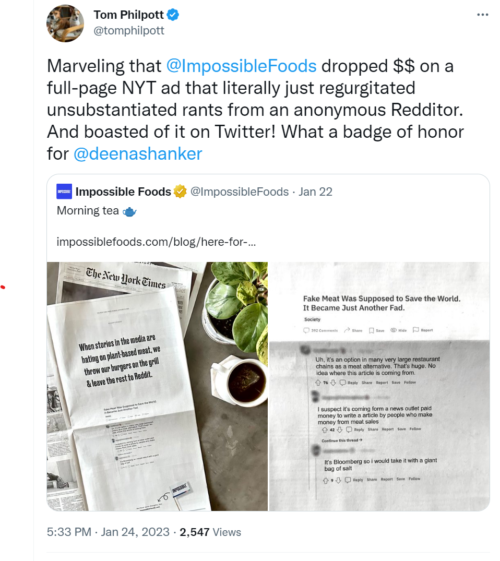
When I saw this tweet from Tom Philpott, I knew immediately what it was about.

I had seen Deena Shanker’s investigative report in Bloomberg News, not least because I’m quoted in it: Fake Meat Was Supposed to Save the World. It Became Just  Another Fad.

The article’s subtitle: “Beyond Meat and Impossible Foods wanted to upend the world’s $1 trillion meat industry. But plant-based meat is turning out to be a flop.”

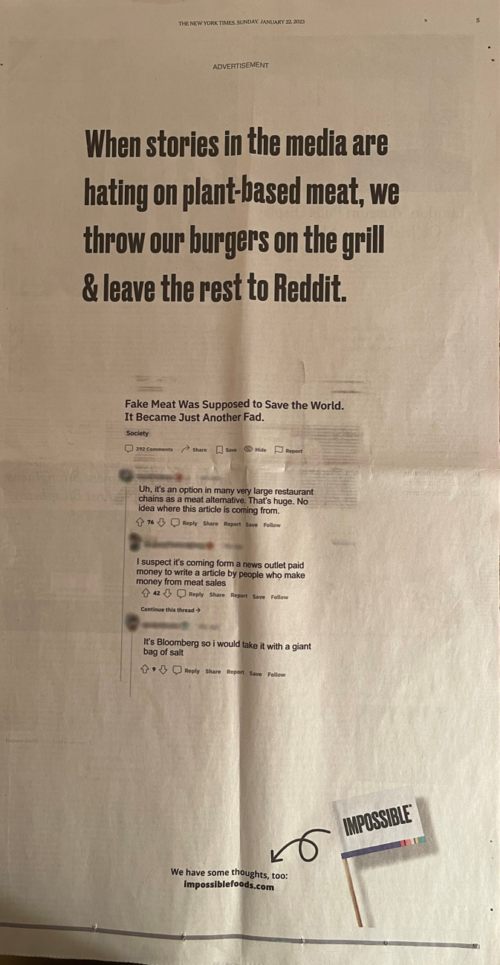
And then I saw this ad in the January 22 New York Times.

Anonymous Reddit writers saying things like “I suspect it’s coming form [sic] a news outlet paid money to write an article by people who make money from meat sales.”

A badge of honor for Deena Shanker indeed.  Clearly, she hit a nerve.

Meat alternatives still have their fans and I’m not ready to write off fake meat just yet.   But this ad makes me much less sympathetic to this particular Cause.

Ironic addition, January 30: Impossible Foods to lay off 20% of its staff.

********

For 30% off, go to www.ucpress.edu/9780520384156.  Use code 21W2240 at checkout.