Currently browsing posts about: EFSA(European Food Safety Authority)

Nov 30 2011

Report from the EU: functional foods, supplements, health claims


Sebastián Romero Melchor writing in Food Chemical News (subscription required, alas) a few days ago points out that the market for functional foods in the European Union is growing.  He advises U.S. firms who want to take advantage of  its €40 billion (equal to roughly $54 billion USD) market to pay attention to some important facts:

  • Novel ingredients: Ingredients that were not consumed to a significant extent in the EU before May 15, 1997 must undergo a costly and lengthy authorization procedure so dreadful that most companies give up and choose not to include them.
  • Supplements: The European Commission has no problem with vitamins and minerals, but marketing of food supplements and fortified foods remains subject to each European country’s separate national laws.  Products legally marketed and/or manufactured in a member-state can be legally marketed throughout the EU, provided that they are (a) safe, (b) not novel, and (3) not medicinal.
  • Health claims: The European Food Safety Authority (EFSA) has issued opinions on health claims for most substances.  It has evaluted about 2,750 petitions for health claims but only approved about 600.

If only the FDA would take as rigorous a stance.

May 15 2011

Foods with benefits? Oh, please.

Sunday’s New York Times has not one but two articles about “functional foods,” those with something added over and above what’s in the food in the first place.

A front-page story, “Dessert, laid-back and legal,” describes brownies.  No, not brownies laced with marijuana.  This time they contain the sleep-inducing drug melatonin.

The brownies, according to the Times, contain just as much melatonin as are found in drug pills but are cheaper and can be purchased with food stamps (another reason for taking a look at the whole question of SNAP benefits?).

Since melatonin is a drug and not an approved food additive, the makers of these products are trying to get around the annoying FDA restrictions by marketing the brownies as “dietary supplements.”  Supplements, by order of Congress when it passed the Dietary Supplement Health and Education Act (DSHEA) of 1994, do not have to meet FDA’s rigorous scientific criteria for safety or efficacy.

DSHEA applied to supplements, not foods, but the FDA has chosen to regulate foods containing such additives by the weaker rules applying to supplements and to deal with them as a regulatory gray area.   Is melatonin a drug, a supplement, or in brownie from a food?  The FDA is going to have to decide this, and fast.

A much longer story in the business section, “Foods with benefits, or so they say” (in which I am quoted) focuses on the entire point of functional foods: the ability to put something in a product that allows you to market it using health and wellness claims.  Health claims sell food products.  People like buying products with a “health aura,” no matter how poorly the health claim is supported by science.  Science is irrelevant here.  Marketing is what’s relevant.

As I discuss in my book, Food Politics, until the early 1990s, the FDA did not allow health claims on food products.  Claiming a specific health benefit for a food, said the FDA, meant that the food was being marketed as a drug.  If a food was being marketed as a drug, it needed to prove safety and efficacy, something no food maker wanted to do.

When Congress passed the Nutrition Labeling and Education Act in 1990, it struck a deal with the food industry.  The industry was objecting that because Nutrition Facts labels required them to say what was bad about their products, they ought to be allowed to say what was good about them.  Congress agreed, and forced the FDA to review the science linking certain food ingredients to health benefits as a basis for permitting health claims.

The FDA approved some claims but rejected others.  The rejected companies took the FDA to court, and the courts mostly ruled in favor of the companies on the grounds of the First Amendment.  The FDA stopped trying to control unsupported health claims and only recently has taken then on again.

But as sales soar, federal regulators worry that some packaged foods that scream healthy on their labels are in fact no healthier than many ordinary brands. Federal Trade Commission officials have been cracking down on products that, in their view, make dubious or exaggerated claims. Overwhelmed regulators concede that they are struggling to police this booming market, despite recent settlements with makers of brands like Kellogg’s Rice Krispies and Dannon’s Activia, which the authorities say oversold their health benefits.

To the distress of international food marketers, the U.S. currently has much looser regulations about health claims than are available in Europe.  The European Food Safety Authority has been reviewing thousands of petitions for health claims on food products and turning most of them down as scientifically unsubstantiated.  That doesn’t stop American food makers from loading on the claims.

From the ivory tower in which I sit, the remedy is easy: don’t allow health claims on processed foods at all.  The claims are all inherently misleading, as would be obvious if you gave it a minute’s thought.

But if they aren’t worth much to you, they are worth plenty to the marketers of processed foods.  And that’s what this is really about.

Nov 1 2010

Europe food chair resigns industry post

This is a conflict-of-interest story.

Last week, FoodNavigator.com reported that the board of the European Food Safety Authority (EFSA) had reelected its chair, Diána Bánáti, despite evidence that she also sits on the board of the International Life Sciences Institute (ILSI), an industry-funded group that pretends to be a public health non-profit organization.

EFSA, you may recall,is the agency that is under enormous pressure to rule favorably on industry petitions to allow health claims on European package labels.

The EFSA board said:

The Board deplores the unfounded attacks on the independence of EFSA and its Chair recently reported, and concluded that by no means the integrity of the persons involved could be questioned.  However, the Board added that in order to avoid misperception, Bánáti should step down from management positions in any organisations that represent food industry interests, apart from public interests.  Professor Diána Bánáti has resigned from positions which may create a potential conflict of interests with EFSA activities.

ILSI was not one of the organizations from which she resigned.  Evidently, the EFSA Board considers ILSI to be a public health organization.

Within days, however,  Ms Bánáti thought better of it and resigned from the ILSI Board. To my great surprise, I get credit for this action.

Bánáti’s action was that recommended by Marion Nestle, an expert on nutrition and the food industry at New York University, in a Nature news article on the matter—Food agency denies conflict-of-interest claim—who said that were she Bánáti, “she would resign from the ILSI board”….In a statement issued yesterday, ILSI says that it “accepts Professor Diána Bánáti’s decision to resign from the ILSI Europe Board of Directors with regret” and reiterated its insistence that ILSI is not a lobbying group.

Nature is the most prestigious science magazine in Great Britain and, arguably, anywhere, but I thought I was simply stating the obvious.

Jul 19 2010

Does science support food health claims?

I think not nearly well enough, but you would never know it from listening to food manufacturers. 

Let’s start with Europe.  Health claims are a big deal there these days, as the agency dealing with them, EFSA (European Food Safety Authority), copes with thousands of petitions.

In June,  EFSA representatives complained that the “scientific” evidence submitted by food companies to support their petitions included—get this—”excerpts from the Old Testament, Wikipedia, a Tea Association press release, a Royal Air Force report and the American Heritage Dictionary.”

The NDA panel, which is responsible for assessing the mountain of health claims applications submitted under the Regulation, said that along with the expected references to clinical studies published in peer-reviewed academic journals, it had also been presented with references from Wikipedia, press releases, dictionaries, the Bible and even an RAF report.

Trying to make sense of translations of references from other languages into English had presented additional difficulties, while ‘clarifications’ provided by some applicants in response to requests for further information had been confusing or inadequate, further delaying the process.

The quality of this evidence, says EFSA, is ‘far from optimal.”  Indeed.

From the food industry point of view, however, scientific substantiation of health claims presents pesky barriers.  Moving on to the United States, a food industry commentator asks:

We’re talking about the biggest food companies in the world being told the claims that help sell some of their foods are deceptive and misleading….And them agreeing to change or withdraw the claims…Er sorry… but why go along with it if you stand by the science?…Is the science there or not? Do these products (a probiotic drink and an antioxidant-boosted cereal) work or not?…Does the problem lie with the nutrition science itself (not enough clinically backed, human intervention trial-demonstrated, positive associations), or the way the science is being interpreted by regulators and companies that wish to express some of that science in their marketing materials?

Good questions.  As I read the literature, the more carefully done studies of functional ingredients tend to show the least benefit. 

As I keep saying, functional foods are about marketing, not health.

Jul 8 2010

The news in food nanotechnology

Nanotechnology involves the ability to control matter at the scale of a nanometer—one billionth of a meter. The world market for products that contain nanomaterials is expected to reach $2.6 trillion by 2015.

So says a report from the Government Accountability Office (GAO): Nanotechnology: Nanomaterials Are Widely Used in Commerce, but EPA Faces Challenges in Regulating Risk. GAO-10-549, May 25, 2010.

GAO identified a variety of products that currently incorporate nanomaterials already available in commerce…[in] food and agriculture….The extent to which nanomaterials present a risk to human health and the environment depends on a combination of the toxicity of specific nanomaterials and the route and level of exposure to these materials. Although the body of research related to nanomaterials is growing, the current understanding of the risks posed by these materials is limited.

The effects of nanotechnology on the environment are regulated by the EPA (Environmental Protection Agency), which is why this report targets recommendations to EPA.

Shouldn’t some of those recommendations be directed toward FDA, the agency that regulates food safety?  Maybe GAO needs to do another report?

In the meantime, the European Food Safety Authority is preoccupied with issues related to the safety of food nanotechnology.

The risk assessment framework for nanotechnology in Europe – like so much else connected to the technology – appears to be in its infancy but developing at a rapid pace…. Nano knowledge gaps have led some to call for a ban on the use of nanomaterials in food products until their safety has been fully established. One area of concern is whether nanoparticles can migrate from packaging materials into foods.

In seeking to assess nanomaterials, the food safety body repeatedly used phrases such as “specific uncertainties”, “limited knowledge” and…“difficult to characterise, detect and measure” in relation to toxicokinetics and toxicology in food. Likely usage and exposure levels are also largely a mystery.

The European Food Safety Authority says that lack of knowledge means that risk assessment of risk assessments must be done on a “cautious case-by-case approach.”

Last April, the European Parliament’s environment committee said nanotech products should be withdrawn from the market until more is known about their safety.  In June, that committee added that nanotech foods should be assessed for safety before they are approved for use and labeled.

Doesn’t that sound reasonable?  Let’s hope it’s not too late to put such constraints in place, and in the U.S. too.

Mar 2 2010

Kellogg seeks weight-loss health claim for cereals

While we are on the subject of European decisions on health claims, Kellogg has just petitioned the European Food Safety Authority to be allowed to put claims for weight loss on its breakfast cereals: “Ready-to-eat breakfast cereal can help to reduce body weight, can help to reduce body fat, can help to reduce waist circumference.”

Do you think they mean Froot Loops?

Kellogg is always way ahead of the curve on health claims.  What is especially creative about this one is that the company is filing the claim through “article 13.5,” which means that the “science still remains proprietary and does not require disclosure through this process.  A Kellogg official explained:

As we understand article 13.5, five years after approval of the health claim, the wording can then can be used by other cereal manufacturers but our scientific data does not have to be made public.

EFSA, I hope, will turn this one down flat.  I want to see the science before believing that breakfast cereals are diet products.  Sure they are, if you eat just one serving for breakfast, use one more to substitute for a meal, and then eat a small meal.  That would work.  But so would chocolate bars.

Feb 28 2010

European decisions on health claims: Vitamins, yes. Antioxidants, no.

Thanks to Anita Laser Reutersward in Sweden for forwarding the most recent decisions of the European Food Safety Authority (EFSA) on  petitions for health claims.

Health claims are vitally important to food marketers.  Evidence: they have filed 44,000 petitions with EFSA to date.  EFSA consolidated these into 4,185 claims.  It is dealing with them in batches.

EFSA did not approve many of the 416 petitions in this latest batch :

Experts issued unfavourable opinions on most of the claims in the second series due to the poor quality of the information provided to EFSA including:

  • Lack of information to identify the substance on which the claim is based, e.g. “probiotics”
  • Lack of evidence that the claimed effect is indeed beneficial to the maintenance or improvement of the functions of the body (e.g. food with “antioxidant properties”)
  • Lack of human studies with reliable measures of the claimed health benefit

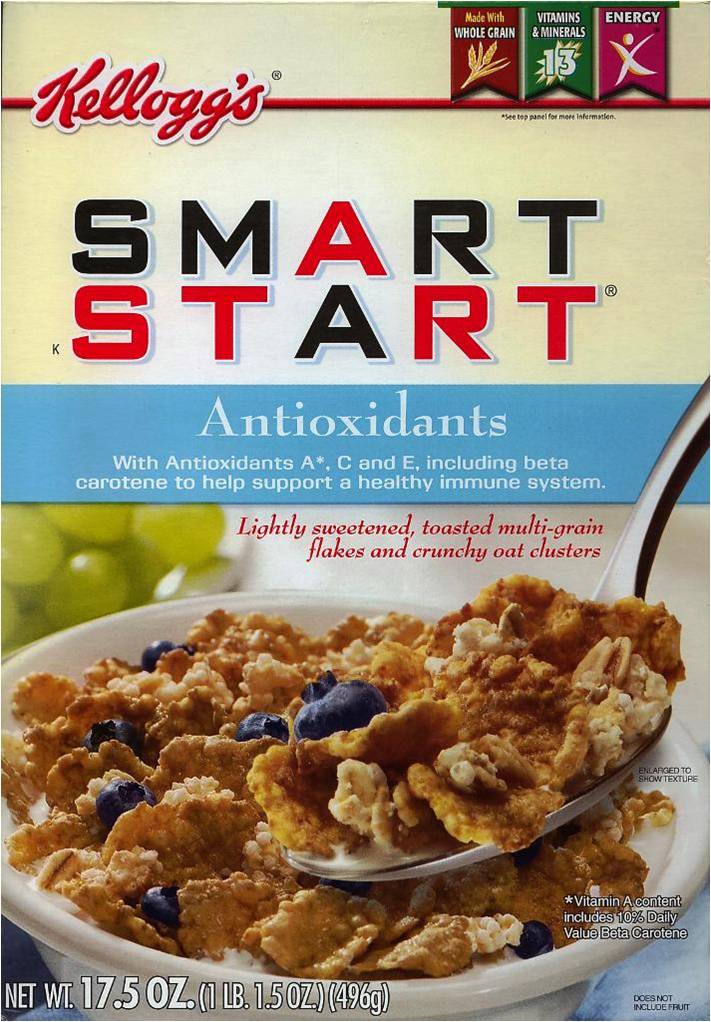
Its decisions about antioxidants are especially interesting in light of claims on products in American supermarkets.  Under EFSA rules, this Kellogg package would not be allowed.

In its decision, EFSA said:

“On the basis of the data presented, the Panel concludes that a cause and effect relationship has not been established between the consumption of the food(s)/food constituent(s) evaluated in this opinion and (1) a beneficial physiological effect related to antioxidant activity, antioxidant content, or antioxidant properties, and (2) the protection of body cells and molecules such as DNA, proteins and lipids from oxidative damage.”

My translation: EFSA panels took a good hard look at the science and could not find evidence for benefits at the physiological or molecular levels from taking antioxidant supplements or eating foods with antioxidants.

I can’t wait to see how food manufacturers respond.

March 1 update: here come the comments.  According to FoodNavigator.com, EFSA rejected health claims for:

vitamin D, probiotics, green tea, black tea, lutein, beta glucans, meso-zeaxanthin, alpha-lipoic acid, melatonin, peptides, xanthan gum, sugar-free gum, guar gum, gamma-linolenic acid (GLA), fermented whey and linoleic acid.

These decisions “came as a massive blow to the European and international functional foods and nutraceuticals industries, especially the herbal antioxidant and probiotic sectors, which have yet to see a positive NDA opinion.”

Feb 16 2010

European companies’ ongoing struggle for food and supplement health claims

As readers of this blog know, I am not a fan of health claims on food packages or supplements.  I think they are inherently misleading.   It’s hard for me to believe that eating any one food product or supplement will have a significant effect on disease risk.

It is one thing to say that a nutrient is required for good health.  It is quite another to say that products containing that nutrient are going to have the same effect.  We would all be better off eating foods rather than food products.

That’s why health claims are really about marketing, not health.

Food marketers work hard to get approval for health claims.  America is well ahead of Europe in allowing them.  European regulatory agencies are still trying to hold health claims to reasonable scientific standards.

The European Food Safety Authority (EFSA) has been turning down requests for health claims right and left, but recently broke down and  approved one for iron, requested by the Association de la Transformation Laitière Française, a trade association of French dairy cooperatives.  Iron, of course, is an essential nutrient.

EFSA said the association could say: “Iron contributes to normal cognitive development of children.” But EFSA said the association could not say: “Iron is necessary for the cognitive development of children.”

I don’t think dairy products should say either, but that’s just me.

As for supplements:  In December, Food Chemical News reported that supplement firms in the European Union are considering filing a case with the World Trade Organization over EFSA’s refusal of so many of their proposed claims.   They consider the rejections a barrier to trade.  The firms are looking for a non-European Union country to make their case.

Never underestimate the self-interest of makers of food products and supplements in the struggles over health claims.

Dec 21 2009

Food labeling: yet another update

The FTC Forum last week got everyone going about food labels.  Here are the latest items to hit my inbox:

Traffic light front-of-package labels may do some good after all: As I explained in a previous post, British investigators did a study showing that the green-yellow-red traffic light dots on food packages do not necessarily help people make healthier choices.  Now, another British scientist argues that the study showed no such thing; at best, it showed that more research is needed to see how consumers interpret and act on those signals.

European Food Safety Authority (EFSA) approves some (weak) omega-3 claims: Under great pressure from food companies desperate to make claims for omega-3 fatty acids, EFSA is allowing three, if somewhat grudgingly:

  • DHA intake can contribute to normal brain development of the foetus, infant and young children
  • DHA intake can contribute to normal development of the eye of the foetus, infant and young children
  • DHA intake can contribute to the visual development of the infant

“Can,” I suppose, is a bit less conditional than “may,” but these are not strong claims.  And they say nothing at all about making kids smarter.  Under these rules, that  “brain development” claim on Nestlé’s omega-3-fortified Juicy Juice drink (the one I find so absurd), would be OK.  But anything more specific, the EFSA committee said, would have to be backed by further science.

FDA food labeling rules: if after all the fuss about serving sizes at the FTC Forum, you want to know what FDA really says about them,  you can find the details on the FDA food labeling website.  On that site, click on Label Formats/Graphics to find the current rules on serving sizes.  Good luck making sense of them.

That’s more than enough about food labels for the moment.  It’s the holidays and time to talk about something cheerier.  Stay tuned.


Nov 20 2009

Europe “clarifies” basis for health claims

European food manufacturers continue to file thousands of petitions for approval of health claims for their products.  The European Food Safety Authority (EFSA) takes a dim view of most of them, arguing that the claims are poorly substantiated by scientific evidence, if at all.

Now EFSA is attempting to clarify what manufacturers have to do to gain approval for their claims.  I say “attempting” because EFSA’s statements often are models of bureaucrat-speak.

EFSA, for example, says it is willing to consider evidence for claims based on studies performed in people with a particular disease:

For studies in groups (e.g. subjects with a disease) other than the target group (e.g. general population) for a claim EFSA considers whether scientific conclusions can be drawn for the substantiation of the claim on a case by case basis…For example, for claims on reducing gastro-intestinal discomfort (in the general population) evidence in patients with irritable bowel syndrome may be accepted.

OK.  I get that.  Then it offers further clarification:

For claims on maintenance of normal joints (in the general population, evidence in osteoarthritis patients is not accepted as osteoarthritis patients are not considered to be representative of the general population with regard to the status of the joint tissues.  In its evaluation, EFSA considers that where a health claim relates to a function that may be associated with a disease, subjects with the disease are not the target for the claim.

EFSA explains its overall philosophy for deciding which claims to approve.  It does not use a pre-established formula for the type or number of studies.  Instead, it weighs:

All the evidence from the pertinent studies (i.e, studies from which scientific conclusions can be drawn for substantiation of the claim)…with respect to its overall strength, consistency and biological plausibility, taking into account the quality of individual studies and with particular regard to the population group for which the claim is intended and the conditions of use proposed for the claimed effect.

As with all scientific evaluations, EFSA’s judgments are subjective.  It considers animal studies, but grants more weight to studies in humans.  These, it says, are “central for the substantiation of the claim.”

Food manufacturers also view the evidence subjectively, but tend to be less scientifically rigorous in their interpretation of benefit, especially when their own products are involved.   Hence: conflict.

At the moment, EFSA is holding a hard line on health claims.  FDA: take notice!


Page 1 of 212