Currently browsing posts about: Local food

May 29 2010

USDA’s latest collection of relevant reports

The USDA does terrific research on many useful topics.  Here is a sample of some just in.

STATE FACT SHEETS:  data on population, per-capita income, earnings per job, poverty rates, employment, unemployment, farm characteristics, farm financial characteristics, top agricultural and export commodities.

WIC PROGRAM: research, publications, and data related to WIC (Special Supplemental Nutrition Program for Women, Infants, and Children). WIC served 9.1 million participants per month at a cost of $6.5 billion in 2009.

FEED GRAINS DATABASE: statistics on domestic corn, grain sorghum, barley, and oats; foreign grains plus rye, millet, and mixed grains. You can also get historical information through custom queries.

LIVESTOCK, DAIRY, AND POULTRY OUTLOOK:  current and forecast production, price, and trade statistics.

AGRICULTURAL OUTLOOK STATISTICAL INDICATORS: commodity and food prices, general economic indicators, government program expenditures, farm income estimates, and trade and export statistics.

ASPARAGUS STATISTICS: acreage, yield, production, price, crop value, and per capita use; also world area, production, and trade.

FOODBORNE ILLNESS COST CALCULATOR:   the cost of illness from specific foodborne pathogens, depending on the  annual number of cases, distribution of cases by severity,  use or costs of medical care, amount or value of time lost from work,  costs of premature death, and disutility costs for nonfatal cases.

ORGANIC FARMERS: explains why use of organic practices in U.S. lags behind other countries, differences and similarities between organic and conventional farmers, reduced consumer demand resulting from the weaker U.S. economy,  and potential competition from the “locally grown” label.

LOCAL FOOD SYSTEMS: defines local food,  market size and reach,  characteristics of local consumers and producers, and  economic and health impacts.  Addresses whether localization reduces energy use or greenhouse gas emissions (inconclusive).

BIOFUELS: Reaches 88 million gallons in 2010 as a result of one plant becoming commercially operational in 2010, using fat to produce diesel. Challenges include reducing high costs and overcoming the constraints of ethanol’s current 10-percent blending limit with gasoline.

Thanks to USDA for producing data that policy wonks like me just love to cite.

Sep 18 2009

USDA says: Eat Local! HHS says: Prevent!

Really, we have to rethink USDA.  It has just awarded $4.8 million grants to community groups to promote local agriculture as part of a $65 millioncampaign to Know Your Farmer, Know Your Food.  Local food!

And HHS, not to be outdone, is awarding $650 million in grants for community initiatives to improve diets and get people more active.  Prevention!

OK, these are tiny fractions of the Departments’ budgets but I read them as symbolic steps in a new and terrific direction.  More of the same, please.

Jul 26 2009

Food in Fairbanks

I’m just back from a long trip to Alaska where I gave a talk at the University of Fairbanks.  Fairbanks, in central Alaska, is 200 miles from the Arctic Circle and has a short growing season from the end of May to the beginning of September, but those few weeks are brightly lit.  The sun set at midnight in mid-July and it never really got dark.

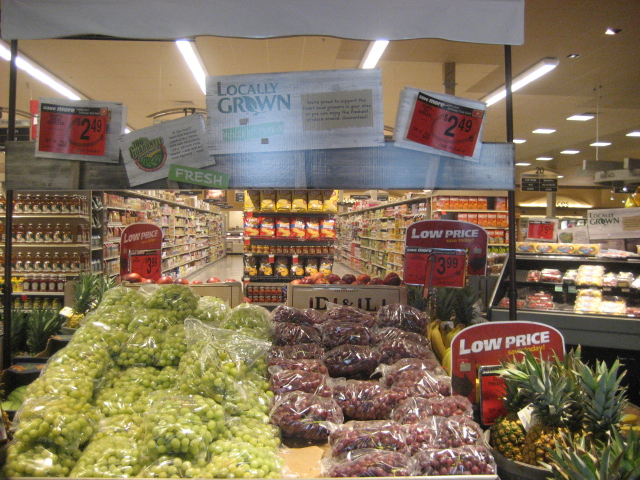
As for the food revolution, it is booming.  Even the local Safeway has gotten into locally grown foods, although not always accurately.Not exactly local food When I saw the pineapples, I asked what “locally grown” meant.  Somewhere in Alaska.   Oh.   But Safeway really does have locally grown food, mostly cabbages and root vegetables.  Where were they grown?   Someplace around here.

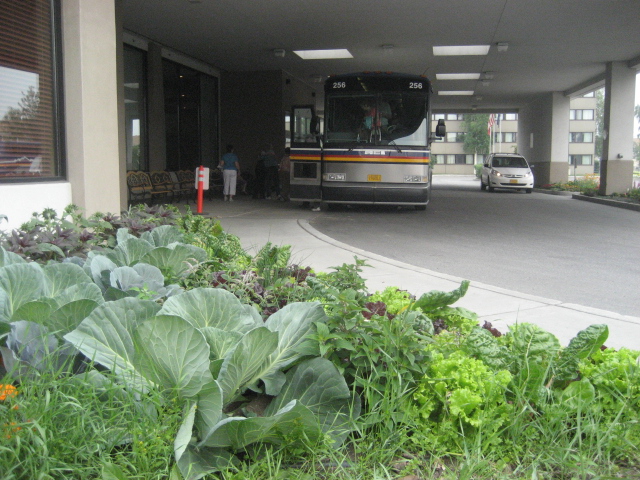
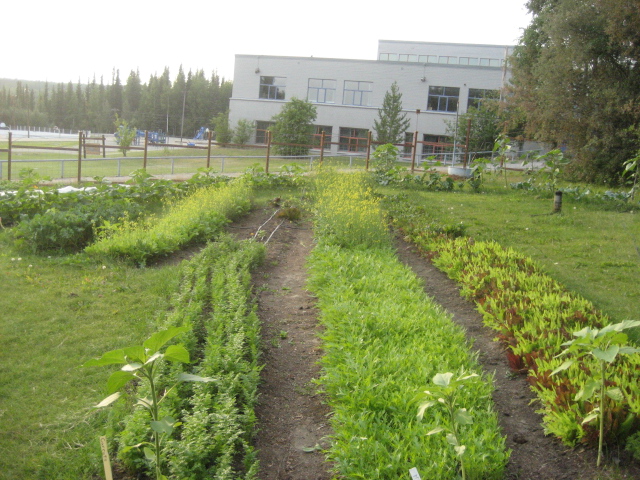
I saw vegetables growing everywhere, even in small urban spaces such as the entryway to the hotel where I was staying.  The long daylight makes for big vegetables and this plot sported a two-foot long zucchini.  Alas, it had disappeared by the time I got back to photograph it.

Hotel garden

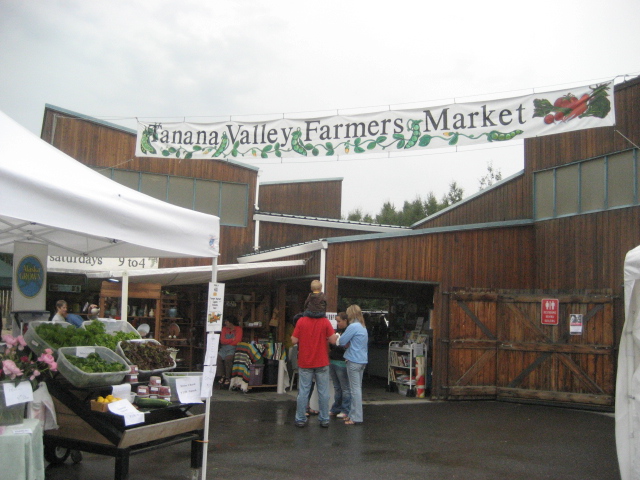
And yes, Fairbanks has a farmers’ market, and it was in full swing.

Farmers' Market, Fairbanks

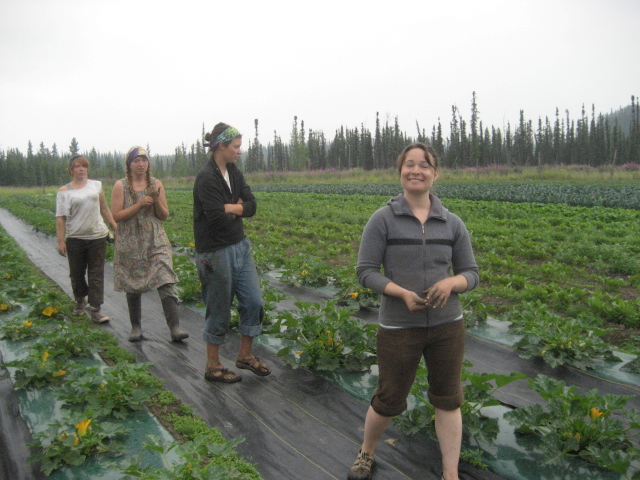
And then to the organic farm at Rosie Creek.  It was full of summer interns visiting from the nearby Calypso Farms.Rosie Creek

Calypso Farms has a terrific garden program in five schools in the area.

Calypso

And here a few first-time tourist remarks:

Where is the most entertaining food? That had to be at Bigun’s Crab Shack in Skagway.  Bigun is the chef, spelled that way, not Big-’un (He’s the one that didn’t get away, according to his mom).  What Cajun cooking is doing in Skagway is beyond me but it was wonderful to have it on a hot summer day.

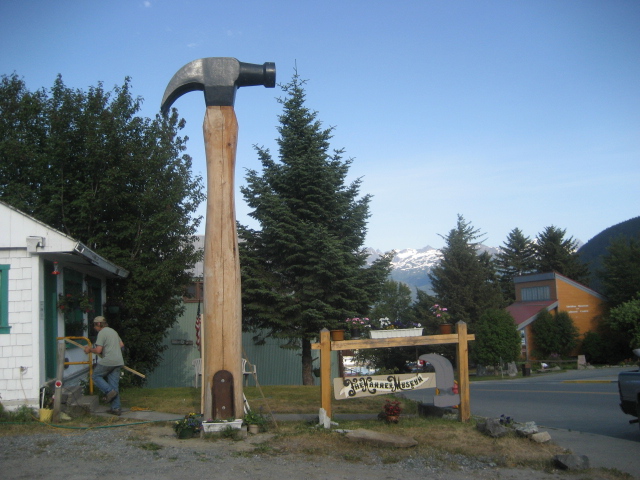
And what was the best off-beat museum?  It has nothing to do with food, alas, but I still vote for the Hammer Museum in Haines.  Not to be missed.

The Hammer Museum

May 6 2009

American agriculture at a glance

The New York Times has an informative series of maps of the locations of the more than 10,000 organic farms in the U.S.  And notice the increase in sales!

That number of organic farms may seem like a lot but it pales in comparison to the total 2.2 million farms.  Most farms are East of the Mississippi and in the far West.  The maps also show where most of the orchards, vegetable farms, and dairies tend to be.  A big chunk of the country must have a hard time getting locally grown fruit and vegetables, let alone organics.  Doesn’t this look like a growth opportunity?

May 5 2009

Food miles: do they matter?

Thanks to Dick Jackson, chair of environmental sciences at the UCLA School of Public Health, for sending me the latest paper arguing that food miles – the distances foods travel before they get to you – make no difference to climate change.  Eating less meat, say the authors, is what counts.

Never mind the assumptions on which such estimates are based.  I have no idea whether they make sense.  But before jumping to interpret this paper as an argument against the value of local food, Jackson suggests that we think about the other, perhaps less tangible, benefits of local food production.  He is a transportation expert so he particularly emphasizes reductions in air pollution, noise, congestion, paving, heat, and the removal of trees.  On the personal side, the benefits include more physical activity, “social capital” (the conversations and other transactions between consumers and farmers), income that stays in the community, and – not least – food that is fresher and tastes better.

I’ve always thought that the real benefits of local food production were in building and preserving communities.  I like having farms within easy access of where I live and I like knowing the people who produce my food.  If local food doesn’t make climate change worse and maybe even helps a bit, that’s just icing on the cake.  Or am I missing something here?

Feb 8 2009

Some good news at last: small farms!

To what no doubt was great shock to the Department of Agriculture, the number of small farms in America went up from 2002 to 2007.  This is great news for local, sustainable agriculture and let’s hope for lots more of the same.  But most of these farms are not yet self-supporting, and their owners have day (or night) jobs to stay afloat.  According to Andrew Martin in today’s New York Times, 40% of U.S. farms  (900,000 of 2.2 million) earn less than $2,500 a year in sales.  Agribusiness predominates: 5% of  farms (125,000) account for 75% of production.  But what a great sign this is of good things to come.  Let’s hope the USDA wises up and puts some support behind this welcome trend.

All this comes from the USDA’s 2007 Census on Agriculture. Check out the nifty slide show link on that page for a quick overview of the facts and figures.

Update February 10: Here’s Verlyn Klinkenborg’s New York Times editorial on the topic.  He points out that as new small farms (9 acres or less) come into existence, medium-size farms are the ones to get engulfed and devoured by agribusiness. The new diversity in crops and farmers “is a genuine source of hope for American agriculture.”

Dec 10 2007

Local v. Industrial foods: More sponsored science?

The business section of Sunday’s New York Times reports counterintuitive research suggesting that locally grown foods may have a higher carbon footprint than foods transported from long distances. CSPI’s Integrity in Science project says the source of the research, University of California Davis’ program on sustainable agriculture gets industry funding, including a $250,000 grant from Campbell Soup. It’s not that food companies buy the research results they want. It’s just that groups that take industry money are more likely to come up with research favorable to the sponsor’s interests. Just a coincidence, I guess.