by Marion Nestle

Currently browsing posts about: Coca-Cola

Oct 29 2009

Family doctors resign from AAFP over Coke partnership

Yesterday, 20 family physicians in Contra Costa County, California, ripped up their membership cards in the American Academy of Family Physicians in protest over the AAFP’s partnership with Coca-Cola.

coke_1

The director of the Contra Costa Department of Health Services, Dr. William Walker, announced that he was resigning his 25-year membership in AAFP.  In his statement, Dr. Walker said:

…I am appalled and ashamed of this partnership between Coca-Cola and the American Academy of Family Physicians. How can any organization that claims to promote public health join forces with a company that promotes products that put our children at risk for obesity, heart disease and early death.

…The AAFP is supposed to be an organization that works to protect the health of children not put them at risk. Their decision to take soda money is all the more unconscionable because, unlike doctors in the 40s, they well know the negative health impact of soda. There is no shortage of documentation that soda is a major contributor to our nation’s obesity epidemic.

…Let me be clear about something: as disappointed as I am with the American Academy of Family Physicians for being duped into thinking that Coca Cola wants to help promote health, the real problem here is our children are being put at risk.

Companies like Coca Cola are polluting our communities with deceptive advertising promoting products that put our children’s health at risk.

…as a family practice doctor and the Health Officer for Contra Costa, I do have a prescription for every parent, teacher, community leader and student:

Look beyond the glitzy advertising that makes you think pouring liquid containing sugar into your body is healthy. Read the label. Look at the ingredients. I’m not suggesting that you boycott sugared drinks, but please make an informed decision about what you are consuming.

I’m calling on every city and neighborhood in our County to fight back against the industry that pushes these harmful products. I ask the American Academy of Family Physicians to end this unhealthy partnership and to join us in leading this important campaign to take back the health of our residents and end the obesity epidemic.

Strong words, indeed.  I hope that the AAFP – and other health and nutrition organizations that might consider food industry partnerships – pay close attention to these words.

* The event was covered in the Contra Costa Times. The Health Department’s website includes the press release and also a video and podcast.

Addendum:

Dr. Wendel Brunner, PhD, MD, Director of Public Health in the Contra Costa Department of Health Services has given me permission to post excerpts from his letter to a representative of the California Association of Family Physicians who had asked for more information about the protest:

“The epidemic of obesity is the greatest public health and clinical medicine issue of our time, and will lead to untold disease, shortened life spans, and medical cost. That epidemic took off rapidly in the 80’s. While genes and personal choices do have an impact on obesity, only profound environmental changes could lead to such a rapid development of the epidemic, and it will only be stopped by policy development and environmental and norm change. We need to create an environment that supports people in making good choices for themselves and their families.

One of the best choices families can make is to pretty much eliminate sweetened beverages. And the soda industry doesn’t want that to happen, so they are looking for credible groups who will say that drinking soda is OK for your health. But you know all that already, which makes this even more frustrating.

I am an old county doctor, but I still believe that physicians have a responsibility to advocate for their patients and fight to protect their health, and to first of all, do no harm. I am truly gratified to see that our younger physicians in Contra Costa have those same values too. The responsibility of a physician to their patient is a sacred trust; physicians should never sell out their patients’ health and well-being for a price, not even one “in the mid six figures”.

The AAFP needs to change their policy and thereby begin to redeem themselves. In the process, they would educate the country and do something valuable for the nations health, as well as for their own integrity. If they do not, they will continue an unfortunately long and sordid tradition of professionals and their organizations forgetting their purpose and their ethics and putting their narrow organizational financial interest above the interest of the public that they serve. Resigning membership seems to be the most effective way for physicians to provide a wake-up call to the AAFP, and at this point is the best thing a physician could do to benefit the organization.We anticipate that there will be more resignations as this story develops.

Everything cannot be blamed on the environment or peer pressures or economic factors; patients do have a personal responsibility to make good choices for their health and the health of their families. But physicians have the personal responsibility to make good choices too, and so do the professionals who work for them.

The AAFP and the individuals in it made a bad choice. They now have the responsibility to fix it.”
Oct 9 2009

Another sad partnership story: AAFP and Coca-Cola

On October 6, the American Academy of Family Physicians (AAFP) announced its new partnership with Coca-Cola.  What does AAFP get from this?  A grant “to develop consumer education content on beverages and sweeteners for FamilyDoctor.org.”

The AAFP, says its president, looks forward to

working with The Coca-Cola Company, and other companies in the future, on the development of educational materials to teach consumers how to make the right choices and incorporate the products they love into a balanced diet and a healthy lifestyle.

Coca-Cola must be thrilled with this.  As its CEO explains in an op-ed in yesterday’s Wall Street Journal, soft drinks are entirely benign and have nothing to do with obesity.  Obesity is due to lack of physical activity and eating too much of other foods, not Coke.  His view of the situation is entirely predictable.

But what about the AAFP?  Family practice doctors have been telling me for years that it is not unusual for them to see overweight kids and adults in their practices who consume 1,000 to 2,000 calories a day from soft drinks alone.  The first piece of advice to give any overweight person is to stop drinking soft drinks (or other sugary drinks).

This partnership places the AAFP in embarrassing conflict of interest.  I gather that members were not consulted.  They need to make their voices heard.  I hope AAFP members decide that no matter what Coke paid for this partnership, their loss of credibility is not worth the price.

Addendum: Here’s what a Chicago Tribune blogger has to say about this.

Further addendum, October 10: As noted in the comments, AAFP members were consulted, more or less.  Apparently, they decided Big Food was less of a problem than Big Pharm.  Really?  How about selling out to neither?

Oct 2 2009

Coca-Cola reveals calories?

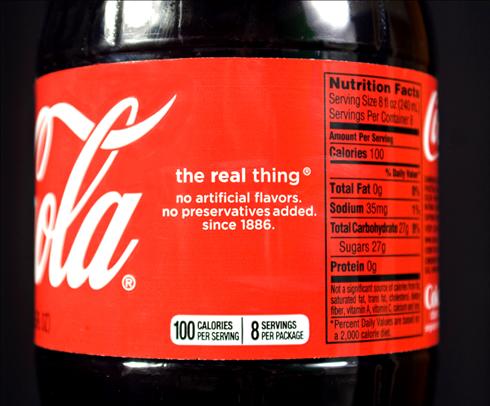
Well, sort of reveals.  Coca-Cola announces that it will put calories on the front of its packages (so you don’t have to search for and put on glasses to read the Nutrition Facts).  You can see what the label will look like in the story in USA Today.

calories01x-large

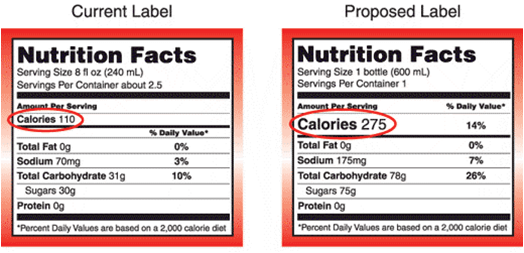
This sounds good but I view this action as another end run around FDA’s proposed regulations.  In March 2004, the FDA proposed to require the full number of calories to be placed on the front of food packages likely to be consumed by one person, like a 20-ounce soda for example (see figure).  A 20-ounce soda is 275 calories, not 100.

FDA

If Coca-Cola followed that FDA proposal, a label of a 2-liter bottle would have to say 800 Calories right on the front of the package.

This idea got stuck in Bush administration but there’s a good chance the new folks at FDA might take it up again.

Is Coca-Cola serious about helping people avoid obesity?  If so, maybe it could send out a press release distancing itself from those consumer-unfriendly ads run by the Center for Consumer Freedom (see previous post).

Here’s another question: Does Coca-Cola fund the CCF directly or indirectly through the American Beverage Assocation or some other industry trade group?  I will believe that they might really have an interest in consumer health when I know they have no connection whatsoever to CCF and its current ad campaigns.

Dec 23 2008

FDA warns Coke: Coke Plus violates Jelly Bean rule!

Thanks to Jack Everitt for forwarding an article from Reuters U.K. about the FDA’s recent warning to Coca-Cola.  Coke Plus, says the FDA, violates the Food and Drug Act.  Food companies are not allowed to add vitamins and minerals to sugary carbonated water (or jelly beans)  just so they can be marketed as healthy.

OK, but Coke Plus is not exactly a secret.  How come the FDA waited to do this until this “midnight” period just before a new administration takes over?  And how come, asks Jack, do we have to “hear about this from a UK newspaper, rather than a US one. Just like with the last election, we now have to rely on out-of-the-country news sources.”

Let’s hope the FDA is a high priority for Obama.  It should be!

Mar 17 2008

Soft drinks in decline?

The Wall Street Journal reports that sales of Coke and Pepsi and other top brands slipped last year by a percentage point or two. They can’t keep up in the face of rising commodity costs, prices, and the popularity of vitamin waters and sports drinks. The drop might seem like a blip but these companies have stockholders to please and are supposed to be growing and increasing their sales every quarter. So it’s no surprise that the WSJ is taking such a hard look at the declining bottom lines. Expect to see even more production of functional drinks, sweetened and not, and at higher prices, of course.

Jan 27 2008

Coke and Pepsi promote health!

I’m getting lots of e-mails about Coca-Cola’s co-sponsorship of the National Heart, Lung and Blood Instutite’s HeartTruth Red Dress campaign to increase women’s awareness of their risk for heart disease. You can find out more about Diet Coke’s sponsorship on the Coca-Cola website. Here’s my favorite line in the news release: “Participation by Coca-Cola does not imply endorsement by DHHS/NIH/NHLBI.” Really? I’ll bet Coke hopes people will think it does.

But that’s not all. The American Dietetic Association (ADA) is partnering with Pepsi. Pepsi, it says, “will work with ADA to develop consumer and professional education programs, and tackle nutrition research questions.” How’s that for unbiased?

Dec 29 2007

Coca-Cola is promoting exercise!

Coca-Cola is announcing its new partnership with ExerciseTV. The press statement explains: “Coca-Cola continues to make great strides in educating the public about the importance of exercise, and how its broad range of products can benefit health-conscious consumers.” This must be part of Coke’s new strategy as a wellness company (see previous comments on the “Pomegranate-Blueberry” drink and Minute Maid Orange Juice). What do we think of this?

Tags:
Dec 26 2007

Coca-Cola’s new health drink?

Coca-Cola’s Christmas gift was a full-page, full-color ad in the December 25 New York Times announcing Minute Maid’s new “enhanced juice.” The label says “Omega-3/DHA HELP NOURISH YOUR BRAIN.” “POMEGRANATE, BLUEBERRY: FLAVORED BLEND OF 5 JUICES.” Curious to see what was in it, I checked the online label information. Surprise! The first two ingredients are Apple and Grape juices from concentrate. Pomegranate comes in at #3. #4 is mixed fruit and vegetable juices, #5 is blueberry juice, #6 is raspberry juice–all from concentrate. Then come #7 gum acacia and #8 DHA algal oil. Others ingredients follow, but never mind. Of course this drink will nourish your brain. It contains an ounce of sugars per 8-ounce serving (and the bottle contains 7 servings)!