Oct
21
2021
Food supply chains: the hot issue of the day
This tweet makes me think it’s time to talk about supply chains.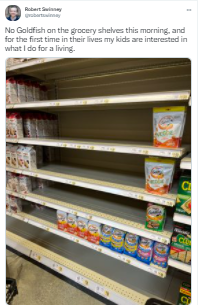
Supply chains are a big problem right now, particularly for anything that has to be transported.
How come? Pandemic-induced buying sprees, coupled with shortages of:
- Truck drivers.
- Shipping crates.
- Longshoremen.
Your local grocery store is out of items? Join the crowd.
Around 18% of beverages, 15% of frozen foods, 16% of snacks, 15% of candy and 18% of bakery items were out of stock at stores during the week ending on October 3, according to the latest data from IRI, which tracks in-stock levels at leading US grocery chains, big box stores, pharmacies and wholesale clubs.Before the pandemic, 7% to 10% of products were typically out of stock on shelves, according to IRI.
Nobody expects this situation to get better soon.
The UK newsletter, FoodManufacture, has done a special edition on supply chains (subscribe free at this link).
- Perfect storm hits the food and drink supply chain: The food and drink supply chain has taken a beating over the past 18 months, with each new crisis piling on a new concern for business to worry about. But above all else, the main concern is how to get the supply chain moving again in spite of the recent heavy goods vehicle (HGV) driver shortage… Read
- Food supply chain fragility: what can be done? Events over the past 18 months have shown how fragile our global food system is. Fotis Fotiadis, chief executive officer and co-founder of Better Origin, discusses what can be done in this opinion piece… Read
- UK beef ban by China risks damaging future trade: China’s latest ban of British beef imports over a case of bovine spongiform encephalopathy (BSE) could damage future trade with the country, according to the Agriculture and Horticulture Development Board (AHDB)… Read
- Fuel shortages create challenges for food and drink: As queues over the weekend left forecourts empty, members of the food and drink industry weighed in on how the fuel crisis has affected them… Read
- EVCL Chill enters administration placing jobs at risk: Chilled food logistics business EVCL Chill Ltd – including EVCL One, EVCL Two and EVCL Three – has entered into administration after struggling with challenges created by the heavy goods vehicle (HGV) driver shortage, placing more than 400 jobs at risk… Read
- PepsiCo completes £14m distribution centre investment: PepsiCo has completed a £14m upgrade of its Southern Region Distribution Centre (SRDC) based in Leicester… Read
Addition