Currently browsing posts about: Label-scoring-systems

Oct 7 2011

European Union sets rules for food labels

According to Food Chemical News (October 7), the European Union has finally agreed on rules for food labels.  These are disappointing.  They allow much of the current confusion to continue. 

Here’s what they are said to do:

  • Packaged foods will have to be labeled with amounts of calories, fat, saturated fats, carbohydrate, protein, sugars and salt.  This is the ”mandatory nutrition declaration.”
  • Amounts are to be expressed per 100 grams or 100 milliliters.  Per-portion will be voluntary as will percentage of reference intakes, meaning that the confusing Guideline Daily Amounts can continue.
  • Packages may display traffic lights or other graphics and symbols, as long as they don’t mislead consumers, are supported by evidence of consumer understanding, and don’t create trade barriers in the EU’s internal market [my interpretation: goodbye traffic lights].
  • All elements of the nutrition declaration must appear together, but some can be repeated on the ”front of pack.” 
  • The mandatory nutrition declaration can be supplemented voluntarily with “better for you” nutrients such as mono-unsaturated fats, polyunsaturated fats, polyols, starch, fiber, vitamins, and minerals [alas, this is a sellout].  
  • Calories must be expressed per 100 g/ml, but also per portion.

Too bad.  I was hoping for something better, more along the lines of what the Institute of Medicine(IOM)  has proposed and less along the lines of what the Grocery Manufacturers and Food Marketers are doing.

The second  IOM report on front-of-pack (FOP) labeling is due out in a few weeks.  I am eager to see what the IOM committee thinks the FDA should do about FOP labels.  Stay tuned. 


Dec 7 2010

How about reassessing First Amendment “right” to market junk foods?

Food companies insist that they can make health claims for their products, whether backed by science or not, because commercial speech is protected by the First Amendment.

The First Amendment, in case you have forgotten, says:

Congress shall make no law respecting an establishment of religion, or prohibiting the free exercise thereof; or abridging the freedom of speech, or of the press; or the right of the people peaceably to assemble, and to petition the Government for a redress of grievances.

In a commentary in JAMA earlier this year about front-of-package labeling, David Ludwig and I argued that it was time to take another look at current interpretations of the First Amendment suggesting that free commercial speech is equivalent to free political or religious speech.  Surely, we said, consumers would be better off without front-of-package labels and health claims on food products.

Last month, the British journal Public Health Nutrition published an article by  Timothy Lytton, the Albert and Angela Farone Distinguished Professor of Law at Albany Law School.

His article, “Banning front-of-package food labels: First Amendment constraints on public health policy,” takes issue with our JAMA argument:

In recent months, the FDA has begun a crackdown on misleading nutrition and health claims on the front of food packages by issuing warning letters to manufacturers and promising to develop stricter regulatory standards. Leading nutrition policy experts Marion Nestle and David Ludwig have called for an even tougher approach: a ban on all nutrition and health claims on the front of food packages.

Nestle and Ludwig argue that most of these claims are scientifically unsound and misleading to consumers and that eliminating them would ‘aid educational efforts to encourage the public to eat whole or minimally processed foods and to read the ingredients list on processed foods’.

Nestle and Ludwig are right to raise concerns about consumer protection and public health when it comes to front-of-package food labels, but an outright ban on front-of-package nutrition and health claims would violate the First Amendment. As nutrition policy experts develop efforts to regulate front-of-package nutrition and health claims, they should be mindful of First Amendment constraints on government regulation of commercial speech.

And now, Public Health Nutrition has just published our letter in response to Lytton’s paper.  We say:

In his thoughtful paper about front-of-package food labels, Timothy Lytton states that a ban on such labels would violate First Amendment provisions of the US Constitution. Lytton cites case law to argue that lower courts have consistently interpreted the First Amendment as providing guarantees of free commercial speech.

Indeed they have, and in 2003, the Bush Administration Food and Drug Administration (FDA) stopped defending against misleading health claims cases on First Amendment grounds. We are not lawyers and make no pretense of arguing case law. However, it seems obvious to us that this interpretation of the First Amendment neither follows its original intent, nor promotes the public interest.

The founding fathers clearly intended the First Amendment to guarantee the right of individuals to speak freely about religious and political matters, not the right of food companies to market junk foods to children and adults. Laws are subject to reinterpretation and change, as the history of civil rights legislation makes clear.

That politics influences interpretation of the law at the highest level is evident from the US Supreme Court’s decisions in Bush v. Gore (2000) and Citizens United v. Federal Election Commission (2010).

We think the time has come for major legal challenges to the right of corporations to mislead the public on the grounds of free speech. The front-of-package health claims controversy demands immediate attention. We hope that legal scholars will examine current food marketing practices in the light of the First Amendment and establish a firm legal basis for bringing this issue back to court. Lytton’s arguments make the need for such reconsideration perfectly evident.

Public interest lawyers: get to work!

Oct 13 2010

IOM Front-of-Package Label Committee releases Phase 1 report

The Institute of Medicine (IOM) released its first Front-of-Package (FOP) labeling report this morning. Phase I is a tough, detailed examination of about 20 of the existing FOP schemes along with some recommendations about what such schemes ought to do.

FOP labels are those little spots, check marks, and tokens that are all over food packages these days and that are supposed to indicate that the product is especially healthy for you.  They may seem utterly trivial, but they are of desperate importance to food companies.  FOP labels sell food products.  Food marketers love them and need them.  The FDA worries that having so many of them confuses the public, and that the schemes are based on criteria that serve industry purposes more than to promote public health.

As the IOM press release explains:

A multitude of nutrition rating, or guidance, systems have been developed by food manufacturers, government agencies, nutrition groups, and others in recent years with the intent of helping consumers quickly compare products’ nutritional attributes and make healthier choices. Ratings are typically communicated to shoppers through symbols placed prominently on food packaging, usually on the front, or on retail shelf tags. Unlike the Nutrition Facts panel, these rating systems and symbols are unregulated, and different systems focus on different nutrients. The variation may confuse consumers, and questions have been raised about the systems’ underlying nutritional criteria.

The committee did a terrific analysis of current FOP schemes.  My favorite parts are its

  • Clear, concise histories of nutrition and FOP labeling (students: take note!)
  • Detailed evaluation of the strengths (few) and weaknesses (many) of the existing schemes
  • Demonstration of the inconsistent results of applying the schemes to specific foods

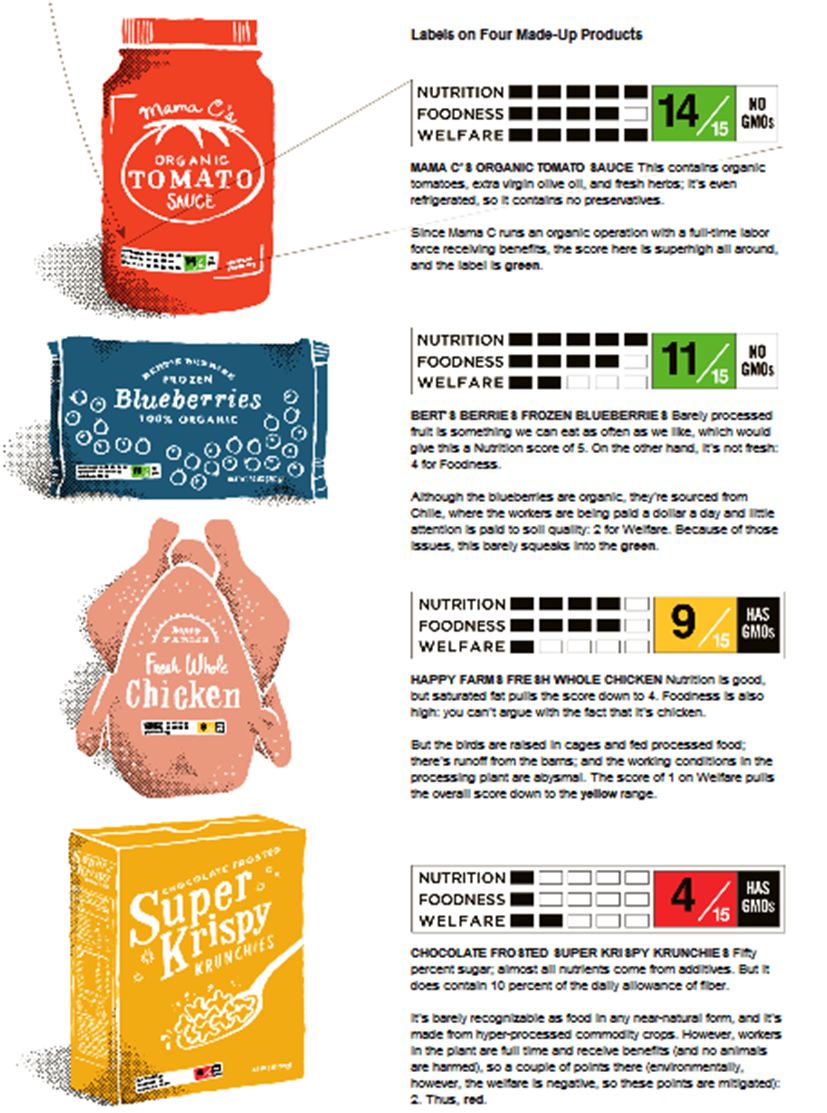
The report gives examples of the inconsistent results of three scoring schemes: Guiding Stars, NRFI [Nutrient-Rich Foods Index], and Nu-Val

  • Instant oatmeal received 3 Guiding Stars, and scores of 87 by NRFI and 39 by NuVal.
  • Non-instant oatmeal received 2 Guiding Stars, and scores of 22 by NRFI and 57 by NuVal
  • Toasted oat cereal received 2 Guiding Stars, and scores of 84 by NRFI and 37 by NuVal
  • Fat free milk, 1% fat milk, and fat free plain yogurt received 3 Guiding Stars, but fat free milk was scored 56 by NRFI and 91 by NuVal; 1% fat milk was scored 30 by NRFI and 81 by NuVal, and fat free plain yogurt was scored 43 by NRFI and 96 by NuVal.

The committee’ key recommendation: FOP labels should deal with just four nutrients: calories, saturated fat, trans fat, and sodium.

These nutrients, says the committee, “are routinely overconsumed and associated most strongly with diet-related health problems affecting many Americans, including obesity, heart disease, high blood pressure, Type 2 diabetes, and certain types of cancer.”

Comment: Trans fat seems unnecessary here.  It is already out of most packaged foods.   Or maybe the committee thinks that leaving it off will give food companies permission to put hydrogenated oils back in?

The committee chose not to add sugars to this list:

The committee concurred that both added and naturally occurring sugars contribute to the caloric content of foods and beverages and overconsumption of high-calorie products can lead to obesity.  Highlighting calories per serving in nutrition rating systems would address this concern.

Comment: I think consumers want to know about added sugars in food products.  I certainly do.

Phase II comes next

It will examine designs and look at consumer understanding of the labels, and will discuss “the pros and cons of having a single, standardized front-label food guidance system that is regulated by the Food and Drug Administration.”

Presumably, Phase II will deal with questions that are not addressed in the Phase I report:

  • Will this scheme supersede all of the other labeling systems currently on food packages?
  • Will it be voluntary or mandatory?  For all food products, or just selected ones?
  • If the scheme is voluntary, why would food companies choose to use it since it mostly highlights the negatives—the nutrients to be avoided?
  • How will it affect the nutrient-content claims currently on food packages?  (Examples: “Contains 8 vitamins!”  “100% vitamin C!” “High fiber!”)
  • How will it affect shelf-labeling schemes such as the Nu-Val system used at Price Chopper supermarkets and the ANDI system used by Whole Foods?

FOP labels are about marketing, not health

This scheme, like the many others developed by food companies singly or together, is designed to help the public decide whether one highly processed, packaged food product is nutritionally better than another.

As I have discussed many times on this site, this approach raises a philosophical question: Is a slightly “better for you” food product necessarily a good choice?

I hope the committee will ponder this and some of my other questions as it enters Phase II.

Addendum: I gather from what I’ve heard about the press conference this morning that some of my questions were answered.  The FOP proposal will not affect nutrient content claims on the front of packages.  Companies will still be able to proclaim the nutritional benefits of their products in words and banners.  They just won’t be able to use them in whatever symbol gets chosen.  So what difference will this report make?  Not much, alas, except to get rid of the silly symbols in use right now.

Update, October 14:  William Neuman’s account of this event in the New York Times starts with this: “Tell us how your products are bad for us.”

Jul 12 2010

UK government to eliminate pesky Food Standards Agency

As City University Professor Tim Lang explained (see yesterday’s post), which government is in power makes a big difference.

The new UK government is not wasting a minute before caving in to food industry demands.

First the government promised the food industry no new regulations.  Now it is eliminating the Food Standards Agency (FSA), which is more or less the equivalent of our FDA.  How come?

Would you believe front-of-package food labels?

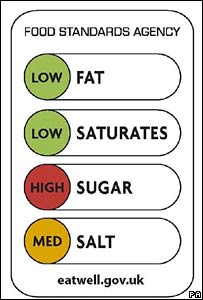
According to the account in The Guardian (UK), this is happening because the FSA “fought a running battle with industry over the introduction of colour-coded ‘traffic light’ warnings for groceries, TV dinners and snacks.”

Rest in Peace

The FSA has led calls for the Europe-wide introduction of a traffic light system that required food companies to label the front of their products with red, amber or green symbols to denote the amounts of fat, saturated fat, salt and sugar contained per serving.   The agency…said this was the best way to allow Europe’s increasingly obese shoppers to make informed decisions about the food they bought.

The British Medical Association, British Dietetic Association and British Heart Foundation are among health groups that supported the scheme…But traffic light labelling was buried by the European parliament last month, when MEPs backed a rival system favoured by multinationals such as Nestlé, Kraft and Danone.

The industry advocated “guideline daily amounts”, a system that listed percentages of recommended daily allowances included in each serving.

The food industry spent an estimated £830m on lobbying to stop the traffic lights scheme, which enjoyed a level of popularity with consumers because it was relatively easy to understand.

Note: That’s $1.247 billion to defeat traffic lights.  Why?  Because consumers know they aren’t supposed to buy products labeled with red dots.  The food industry much prefers the incomprehensible Guideline Daily Amounts like the ones that Kellogg and General Mills were quick to put on their cereal boxes.

Getting rid of traffic lights was not enough.  The food industry is so angry with FSA over the traffic light proposal that it lobbied the new government to axe the agency.

Mission accomplished (or maybe not).

Addition: Even responsible food industry commentators think this is a bad idea:

As regards the proposed splitting up of the FSA – we only have to look to the number of food safety scares in the US to see the consequences of its fragmented food safety approach.

So instead of putting the food watchdog to sleep, shouldn’t the UK government instead give it more teeth?

Update, July 14: Tim Lang and Geof Rayner did an editorial on this for the BMJ:

Mr Lansley’s thoughts imply that a combination of corporate and individual responsibility will do the trick. This is risky thinking. The Healthy Weight, Healthy Lives programme he inherits did not underplay the personal responsibility that individuals have for their weight, and it recognised that without system-wide action there would be little hope in turning around what already seemed to be the worst public health crisis since HIV….Ironically, by showing his hand early, Mr Lansley has done public health proponents a service. Tackling obesity requires bold efforts to shift how we live, but fiscal constraint should not be an excuse for ideological reassertion.

Dec 21 2009

Food labeling: yet another update

The FTC Forum last week got everyone going about food labels.  Here are the latest items to hit my inbox:

Traffic light front-of-package labels may do some good after all: As I explained in a previous post, British investigators did a study showing that the green-yellow-red traffic light dots on food packages do not necessarily help people make healthier choices.  Now, another British scientist argues that the study showed no such thing; at best, it showed that more research is needed to see how consumers interpret and act on those signals.

European Food Safety Authority (EFSA) approves some (weak) omega-3 claims: Under great pressure from food companies desperate to make claims for omega-3 fatty acids, EFSA is allowing three, if somewhat grudgingly:

  • DHA intake can contribute to normal brain development of the foetus, infant and young children
  • DHA intake can contribute to normal development of the eye of the foetus, infant and young children
  • DHA intake can contribute to the visual development of the infant

“Can,” I suppose, is a bit less conditional than “may,” but these are not strong claims.  And they say nothing at all about making kids smarter.  Under these rules, that  “brain development” claim on Nestlé’s omega-3-fortified Juicy Juice drink (the one I find so absurd), would be OK.  But anything more specific, the EFSA committee said, would have to be backed by further science.

FDA food labeling rules: if after all the fuss about serving sizes at the FTC Forum, you want to know what FDA really says about them,  you can find the details on the FDA food labeling website.  On that site, click on Label Formats/Graphics to find the current rules on serving sizes.  Good luck making sense of them.

That’s more than enough about food labels for the moment.  It’s the holidays and time to talk about something cheerier.  Stay tuned.


Dec 17 2009

Do traffic-light labels work? Maybe not.

A new study from the U.K. suggests that traffic-light labels on food products are not inducing people to choose healthier options.  The study contradicts the results of a previous study by the British Food Standards Agency, which found the traffic-light labels to be preferred by consumers, of use to them, and a stimulant to manufacturers to reformulate products to qualify for more of those little green dots.

While the arguments go on, and the FDA and the Institute of Medicine conduct their own studies of front-of-package labeling, and the FTC establishes its own standards for advertising, I have a suggestion: How about removing ALL health and nutrition claims from junk foods.

How about trying to think about foods as foods, not drugs.  Let food packages carry Nutrition Facts labels and lists of ingredients, but that’s all.  It would save everyone a lot of trouble.  Federal agencies could get back to worrying about more important things.  City and state attorneys could too.  And consumers would no longer be misled by absurd claims that cereals or snacks will make people healthy.

Just a thought.

Dec 4 2009

Food agencies at work (or not): FDA

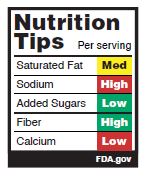
Front-of-Package Labels: The FDA is hard at work trying to do something about public understanding of food labels.  What with the fuss about the Smart Choices program (now withdrawn), FDA wants to get the front-of-package labeling under control.  It is considering various formats for giving a quick overview of the nutritional quality of food products.  FDA is asking for public comment on the various formats (see Federal Register notice).

The FDA chose five versions (plus variations) for comment:

  1. A mini Nutrition Facts version called Nutrition Tips
  2. A UK traffic lights version
  3. A version like Hannaford’s Guiding Stars
  4. A version like the discontinued Smart Choices
  5. One that just highlights calories/servings

I rather like this one, a variation of #1 (colorful, easy to understand, not too cluttered, and makes calories clear).

Scan10266

The Nutrition Facts Panel: The FDA also is taking another look at the Nutrition Facts panel on the back of food packages.  It is seeking public comment on  a plan for consumer research to test understanding of elements on the Nutrition Facts panel.  Here’s the Federal Register notice with all the information about what’s going on and where to file comments.

What’s interesting about this is that the FDA has great social science researchers on staff.  They’ve been kept under wraps the last eight years and apparently are being let loose again.  Even so, they don’t get to just go out and do studies like we academics do (with human subjects approval, of course).  Oh no.  First, they have to announce that they plan to do the studies (which they did some time ago) and get comments on the idea.  Then they do the research plan and have to ask for further comments on the research design.  That’s what this notice is about.  Once they deal with these comments, they can finally get to work.    It’s a miracle if they do anything at all.  Keep them busy: send comments!

Agency Transparency: The Association of Health Care Journalists (ACHJ) and ten other journalism organizations have filed a complaint.  The FDA, they say, is still requiring journalists to obtain permission from an agency official in order to conduct interviews with staff members.  This is a leftover from the Bush administration.  Time to get rid of it.

Blogging: It is especially time to open up to reporters because Michael Taylor, who is now senior advisor to the FDA commissioner, is now blogging on the Atlantic Food Channel (which also reprints my posts).  If he can blog, FDA staff can talk to reporters.

Addendum: Beverages pretending to be dietary supplements: The FDA has just issued guidance to the beverage industry to stop putting herbal supplements into beverages and calling them dietary supplements so they can get around food rules on health claims.  If a beverage is consumed as a food, it should be labeled as a food.  Guidance, of course, is non-binding but I see this as a warning that the FDA is going to be enforcing its own rules.  Good show!

Sep 26 2009

The Not-So-Smart Choices story continues…

We now have a piece mentioning the Smart Choices program in The Economist as well as a letter from Dr. Eileen Kennedy, the member of the Smart Choices program committee to whom the quotation about Froot Loops, “Better than a doughnut,” is attributed.

The Economist discusses the booming business of functional foods: “Consumers are swallowing such products, and the marketing claims that come with them.” It mentions the fuss over Smart Choices, but the best part is the caption to the illustration that comes with it.

It's practically spinach

It's practically spinach

And, I’ve been sent a copy of an e-mail letter to alumni from Dr. Eileen Kennedy, dean of the Friedman School of Nutrition Science and Policy at Tufts University, explaining her participation in the Smart Choices program:

Dear Friedman School Alumni,

There is an issue that has emerged as a result of a NY Times article that appeared in the business section on Sept 5, 2009. Since I believe I was grossly misquoted in the article and that the article does not accurately depict the Smart Choices program, I want to share with you some background on this program and my involvement.

In 2007, I was invited to join the Keystone Roundtable on Food and Nutrition. Keystone is a non-profit organization that brings individuals together around potentially controversial issues. The roundtable included health organizations, food companies, retailers, and academic researchers from a variety of U.S. universities. I was one of the academics who served pro bono on the roundtable. Initially, we met to discuss revisions to the FDA nutrition label. Ultimately, we decided to address the issue of Front of Pack Labels on food products. The final recommendations of the group were based on consensus science including the Dietary Guidelines for Americans, the FDA definition of healthy, WHO recommendations and the Institute of Medicine Scientific reports. The program that emerged from this meticulous process is called “The Smart Choices Program (SCP).” Food products that qualify as “better for you” get a check mark as well as disclosure of calories per serving and number of servings in a product.

I believe there are three major advantages to this program in addition to the rigorous scientific underpinnings.

First, the SCP is intended to improve food patterns at point of purchase – the super markets. To do this, food products are divided into 19 categories – based on research – that reflect how people buy food. All fruits and vegetables without additives automatically qualify.

Second – and a major plus – the program was tested prior to launch with consumers.

Finally, food companies who participate in the program have agreed to abandon their proprietary systems and adopt one system – the Smart Choices Program.

Thus, thousands of products using the SCP check mark will reach millions of consumers. It is a credit to the social responsibility of participating companies that because of the strict nutrition criteria, fewer of the individual food products will qualify for the Smart Choices Program.

As a non-industry board member, I have been targeted by negative emails, letters and even some phone calls. I regret that some of this hostility has been focused on the Friedman School and Tufts University and must note that I serve as an individual on the Smart Choices Program. Tufts University is not involved with it….

As nutritionists, we know that, in many ways, the science of nutrition is straight-forward. It is the translation of science into action that is often complex and can be contentious. Within our field, there are many opinions on how to improve the nutritional well-being of people worldwide. It is precisely at an academic institution like Tufts that we should have a respectful and open dialogue about these issues….For additional information, you may also want to go to www.smartchoicesprogram.com….

The letter gives me a chance to repeat a few points that I have made in previous posts (see Smart Choices, Scoring Systems) and on the general matter of corporate sponsorship of nutrition activities (tagged as Sponsorship).

First, this enterprise was paid for by participating companies to the tune of $50,000 each for a total of $1.67 million.  Social responsibility?  I don’t think so.  Companies usually get what they pay for.  Hence: Froot Loops.

Second, a comment on the research basis.  I have written extensively in Food Politics and in What to Eat about the influence of food companies on federal dietary guidelines and the compromises that result.  Even at its best, the process has to be impressionistic and cannot be either meticulous or rigorous.  The guidelines are meant to be generic advice for healthful eating.  They were never meant to be used – and cannot be used – as criteria for ranking processed foods as healthful.

The FDA standards for comparison to Daily Values on food labels are also worth a comment.  They were the basis of Hannaford supermarkets’ Guiding Stars program, which awards one, two, or three stars to foods that meet FDA-based criteria.  By those criteria, Froot Loops does not qualify for even one star.  If Smart Choices had relied on FDA criteria, such products would not be check marked.

Dr. Kennedy makes some excellent points in her letter and I particularly agree with one of them: nutritionists differ in opinion about how best to advise the public about diet and health.  Mine is that the Smart Choices program is a travesty and the sooner it disappears, the better.

September 29 update: The L.A. Times weighs in with a story (which quotes me).  It’s got another great comparison from a member of the Smart Choices committee:  “Cereal provides an array of nutrients and is a good breakfast…especially if the alternative is a sweet roll.”  My son, who saw the story, has this comment: “Hey! I think Froot Loops are a “Smart Choice.” After all, they have “froot,” don’t they? And maybe no nutritionist you know would recommend Froot Loops for breakfast, but what about for lunch or dinner?”

Sep 7 2009

FDA to research food labels

The FDA just announced in the Federal Register that it plans to take a good hard look at public understanding of what’s currently on food labels.  It says it will do an Internet survey of 43,000 people to:

  • Identify attitudes and beliefs to do with health, diet and label usage
  • Determine relationships between these attitudes and beliefs, demographics, and actual label use
  • Look at the relevance of these attitudes
  • Identify barriers to label use

I hope they ask me!

What is this about?  Let me take a wild guess: Health claims?  Smart Choices labels?  Anything that makes people think highly processed foods are good for them?  Or distracts from the Nutrition Facts panel?

The FDA is required to allow 60 days for comment.   Tell the FDA you think the more research it does on food labels, the better!

Sep 5 2009

Kellogg’s asks for a Froot Loops correction. More on Smart (?) Choices

Froot Loops

Earlier this week, I received a phone call from Dr. Celeste Clark, Kellogg’s senior vice president for global nutrition, corporate affairs and chief sustainability officer.

She had seen my previous blog post on the Smart Choices program, and wanted me to know that Froot Loops has been reformulated to contain 3 grams of fiber, not less than 1 gram, as I had posted, and that  in all fairness, I ought to post the new version.  Sure.  Happy to.  Here it is.Froot Loops_Nutrition Facts

This higher fiber product, of course, gets us into the philosophical question:  Is a somewhat-better-for-you, highly processed food really a good choice?  Does the additional 2.5 grams of fiber convert this product to a health food?  Whether Froot Loops really is a better choice than a doughnut as the Smart Choices program contends, seems debatable.

If I read the Nutrition Facts and ingredient list correctly, Froot Loops cereal contains:

  • No fruit
  • Sugar as the first ingredient (meaning the highest in weight–41%)
  • Sugar as 44% of the calories
  • Partially hydrogenated vegetable oil and, therefore, trans fat (although less than half a gram per serving so the label can read zero)

But with an implied endorsement from the American Society of Nutrition, which is managing the Smart Choices program, I guess none of that matters.  Or maybe the added fiber cancels all that out?

I pointed out to Dr. Clark that I had just bought the fiberless Froot Loops at a grocery store in midtown Manhattan, which means the old packages must still be on the market.

I discussed this and other such products with William Neuman of the New York Times whose reporting on the Smart Choices program appears on the front page of today’s business section under the title, “For your health, Froot Loops.  Industry-backed label calls sugary cereal a ‘Smart Choice.’”

According to his well reported account, Kellogg’s and other participating companies pay up to $100,000 for that seal.  No wonder the American Society of Nutrition and everyone else involved in the program want to set nutrition standards so loosely that they can encompass as many products as possible.   The more products that qualify for the Smart Choices logo, the more money the program gets.  I’d call that a clear conflict of interest.

Neuman managed to find nutritionists who defend the program.  I am not one of them.

Update September 6: CBS did a story on Smart Choices (I’m interviewed in it)

Update September 9: The American Society of Nutrition must be getting a bit defensive about the negative publicity, as well it should be.  It has issued an explanation to members.

Page 1 of 41234