Currently browsing posts about: Michael Pollan

Oct 19 2009

Today’s scandal: industrial agriculture vs. Michael Pollan

In my previous post, I mentioned that a Cal Poly donor had written the university arguing that Michael Pollan should not be permitted to speak to students unopposed.  The donor, Mr. David Wood of Harris Ranch Beef Company, wrote Dr. Warren Baker, President of Cal Poly, threatening to withdraw his promised $500,000 contribution if the invitation to Mr. Pollan was not withdrawn.

I now have copies of the actual letters.  They are well worth reading by anyone concerned about the relationship of industrial agriculture to its impact on soil and water, climate change, rural sustainability, air quality, animal welfare, worker safety, antibiotic resistance, and human health, as well as by the influence of Big Agriculture on public policy.

Here is the letter from Mr. Wood to Dr. Baker. And here are Dr. Baker’s response to that letter and Mr. Wood’s response to Dr. Baker’s response.

My favorite quotation from Mr. Wood’s response is this:

For too long now, those intimately involved in production of agriculture have silently allowed others (academics and activists) to shape their future. Not any longer! The views of elitists’ [sic] like Michael Pollan can no longer go unchallenged. Agriculture cannot allow the Pollans of the world to shape societal expectations (and ultimately policy makers’ decisions) regarding the production practices that can or cannot be employed by those whose livelihood depends on the continued development and adoption of modern agriculture practices.

I will let this comment speak for itself.

Note: thanks to all the people, especially Matt, who offered help with downsizing the letter file.

Oct 17 2009

Pushback on alternative agriculture

After my George McGovern lecture at FAO (see the most recent previous post), the U.S. ambassador to the U.N. in Rome, Ertharin Cousin, thanked me for speaking and then told the audience that the opinions expressed in my talk were mine alone and did not represent those of the U.S. government.

The main point of my talk was that hunger, obesity, and food safety are social rather than personal problems and require social rather than personal solutions.  If such problems are individual, they can be solved with technical interventions such as functional foods, commercial weaning foods, irradiation, and genetically modified foods.  But if we view them as social problems, we need to find solutions that involve sustainability, social justice, and democracy.

For example, we know how to end hunger:

  • Breastfeeding
  • Clean water and safe food
  • Empowerment of women
  • Education
  • Community food security
  • Sustainable agriculture
  • Political stability

These are social interventions.  Technical solutions do not enter into them except in emergencies.

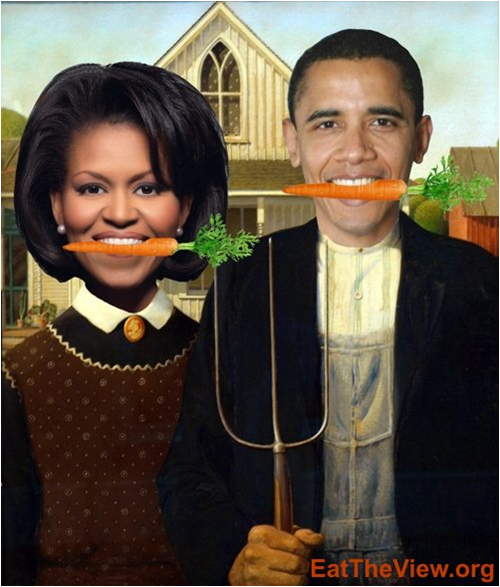
I praised the Obamas for leadership in promoting sustainable food production, and ended my talk with this image.  I left it up while I was answering questions but the ambassador asked to have it turned off.

ObamasUnder ordinary circumstances, I would pass her actions off as standard practice and not take them personally.  But I am hearing more and more tales of pushback against such ideas.

According to an account in the Los Angeles Times, another university – this time Cal Poly in San Luis Obispo – has reneged on a Michael Pollan invitation under pressure from agricultural interests.

The L.A. Times quotes David Wood, chairman of Harris Ranch Beef Co., who has promised $150,000 toward a new meat processing plant on campus:

While I understand the need to expose students to alternative views, I find it unacceptable that the university would provide Michael Pollan an unchallenged forum to promote his stand against conventional agricultural practices.

Apparently, this university caved under pressure just as Washington State did in a similar incident earlier this year (see my post on that incident).   And I hear rumors about invitations that never got offered.  Freedom of speech must hold at agricultural universities unless the opinions offend donors.

Expect to see more of this as the food movement gets stronger and more effective.

May 29 2009

Washington State U. vs. Michael Pollan (and Bill Marler)

For days now, my e-mail inbox has been flooded with messages about the flap at Washington State University over Michael Pollan’s Ominivore’s Dilemma. The messages come from Bill Marler, the Seattle-based “food poisoning attorney” and blogger whose firm specializes in class action lawsuits on behalf of victims of foodborne illness.

This is a good story.  The university bought copies of Omnivore’s Dilemma to distribute to the freshman class (a common community-building exercise at universities these days).  Then, it decided not to give them out.  Could corporate pressure from Washington State agribusiness have had anything to with this decision? No, said the university; they just couldn’t afford to bring Pollan to the campus.

Marler called their bluff.  If it’s really about money, he said, he’d pony up.   The result: the event is back on.

But I’m curious.  Does it really cost $40,000 to get Pollan to travel from Berkeley to WSU?  Pollan says no.  I just hope Marler gets to keep the change and use it to help sick kids.

Mar 4 2009

Food, Inc.: The Movie

I talked my way into a press screening of Food, Inc. last night.  Good thing.  This film is the riveting documentary directed by Robert Kenner due for release soon but already generating lots of buzz, and for good reason.  It’s a terrific introduction to the way our food system works and to the effects of this system on the health of anyone who eats as well as of farm workers, farm animals, and the planet.  It stars Eric Schlosser and Michael Pollan, among others, but I was especially moved by Barbara Kowalcyk, the eloquent and forceful food safety advocate who lost a young son to E. coli O17:H7 some years ago.  I can’t wait for the film to come out so everyone can see it.  I will use it in classes, not least because it’s such an inspiring call to action.  Here’s the trailer.

Dec 12 2008

Want a better USDA? Sign here!

Food Democracy is circulating a petition to the Obama transition team to appoint a USDA Secretary who cares about sustainability (what a concept!).  Click on the link to join the movement!  If you want to read more about this, see Nicholas Kristof’s column linked to my post on December 10 and Michael Pollan’s magazine piece linked to the one on October 12.

Dec 10 2008

Michael Pollan talks to Bill Moyers

Here is Bill Moyer’s recent interview with Michael Pollan, talking about what the new president can and cannot do for American agriculture.  Worth a look.

http://www.pbs.org/moyers/journal/11282008/profile.html

12/11 update: Take a look at today’s New York Times where Nicholas Kristof enthusiastically supports the idea that Obama should appoint a “Secretary of Food.”

Nov 11 2008

Corn is in everything!

Investigators at the University of Hawaii have just analyzed nearly 500 samples of fast food for their content of stable isotopes of carbon and nitrogen.  These are not radioactive but do indicate whether a plant conducts its photosynthesis through what is called a C3 or C4 metabolic pathway.  Corn is a C4 crop.  The analysis shows that virtually all of the meat came from animals raised on corn.  The potatoes were typically fried in corn oil.  Corn, say the investigators, is the basis of fast food.  And virtually all fast food is raised or prepared the same way. 

Didn’t we know that?  Yes, but the technology used in these experiments is clever.  Michael Pollan discussed this kind of chemical evidence in Omnivore’s Dilemma. Although I do not think it was his intention, many readers came away with the idea that corn is poison.  It isn’t.   Corn is a perfectly reasonable food, especially when mixed with soybeans, and the mix works fine for fattening up cattle.  From the standpoint of nutrition and the environment, feeding cattle on grass would be ideal, but it may not always be practical. That’s why some forward thinking cattle producers are raising their animals on grass for as long as they can, and then doing a quick finish with corn and soybeans.

A more important issue may be corn subsidies. Cheap feed promotes industrial meat production, with all of its environmental and health implications.  CAFOs (confined animal feeding operations), as the Pew Commission said earlier this year, have truly dreadful effects on the environments of the communities in which they operate, are not healthy for animals, and overuse antibiotics, which affects human health.   Corn subsidies make CAFOs possible. 

We can argue about how much corn is OK, but I can’t think of any reason to exclude it from the diets of animals or humans.   Corn is a good source of calories and is about 10% protein.  Its oil is relatively unsaturated.  And high fructose corn sweeteners are an almost one-for-one substitute for sucrose. For humans in particular, fresh sweet corn in mid-summer is surely one of the great wonders of the universe.   As with so much else in nutrition, some corn is OK, but a lot may not be.


Oct 12 2008

The New York Times Magazine food issue

It’s a good one, with terrific articles by Michael Pollan on farm policy for the next administration, David Rieff on what to do about agriculture in Africa, and Mark Bittman on why food should be taken seriously.  Read, think, and enjoy!

P.S. And for fun, check out Safire on the meaning of “locavore” and “functional food.”

May 12 2008

Food prices again: risks vs. benefits

Alexandra Lewin, a doctoral student at Cornell, is working with Corporations and Health Watch in Washington, DC, which “tracks the effects of corporate practices on public health.” Her latest contribution is an analysis of the effects of higher food prices on school lunch programs. Given the impossibly small amount of money schools have to work with, they will surely, she says, “find it ever more difficult to say no to an easy source of revenue: soda, cookies, and other junk food. Here we go again.”

On the other hand, Dan Barber, the fabulous chef of Blue Hill in Manhattan and Stone Barns, writes in the New York Times that higher food prices now “could lead to better food for the entire world.” Market forces, he says may well force more attention to the benefits of small farms “bringing harvests that are more healthful, sustainable and, yes, even more flavorful.” This, of course, is what Michael Pollan and Alice Waters were quoted as saying a month or so ago. I hope they are right.

Jan 23 2008

Do dietary guidelines do more harm than good?

I wouldn’t even ask such a silly question if the American Journal of Preventive Medicine wasn’t going to publish a paper arguing just this point. Along with one of the editors of that journal, I wrote an editorial commenting on the paper, to which its authors added a rebuttal to our editorial. The authors argue that the government has no business issuing advice based on weak evidence. I would agree except that evidence will never be as good as we wish it would be because research on human nutrition is really, really hard to do. And when it comes to diet, dietary guidelines are not exactly radical; the basic advice hasn’t changed in 50 years. I summarize it like this: “eat less, move more, eat plenty of fruits and vegetables, and don’t eat too much junk food.” Michael Pollan gets it down to 7 words: “Eat food. Not too much. Mostly plants.” The Dietary Guidelines published in 2005 may take 70 pages, but in general, they say pretty much the same thing.

Page 1 of 212