This will be a moderated discussion with Debbie Stabenow, who will receive the Carver-Carson award that evening, for members of the Carver-Carson Society.

by Marion Nestle
May
25
2022
The US is soon to become a net food importer, says USDA
I was interested to see this graph in a recent report, USDA Agricultural Projections to 2031.
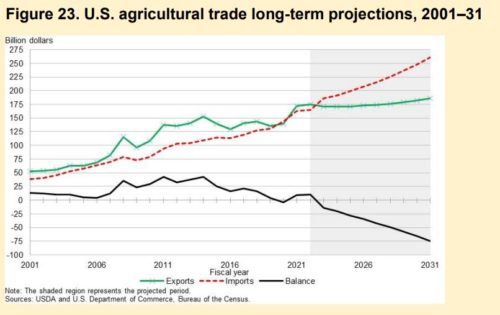
What this says is that agricultural imports are soon expected to be greater than agricultural exports.
Within the next year or so, the United States will be a net importer of agricultural products.
As the report puts it:
Agricultural exports are expected to grow at an annual rate averaging 0.8 percent per year from 2021 through 2031. The value of U.S. agricultural imports is projected to increase by an average annual rate of 6 percent over that same period as domestic consumer spending is expected to remain strong over the next decade combined with domestic preferences for an array of agricultural goods that continue
to exceed domestic production.
I think we need to ask what this means for long-term food security in this country.
The next Farm Bill is under discussion. It ought to deal with the question of how US agriculture can produce more food for people rather than feed for animals and fuel to cars.
I keep remembering a meeting I went to in Washington DC years ago, where a USDA official said that he did not think Americans should waste land for growing food when it could be done so much more cheaply elsewhere. I hope USDA thinks differently now.