Food Politics

by Marion Nestle
Jan 6 2026

The What to Eat Now spinoffs: miracles of AI?

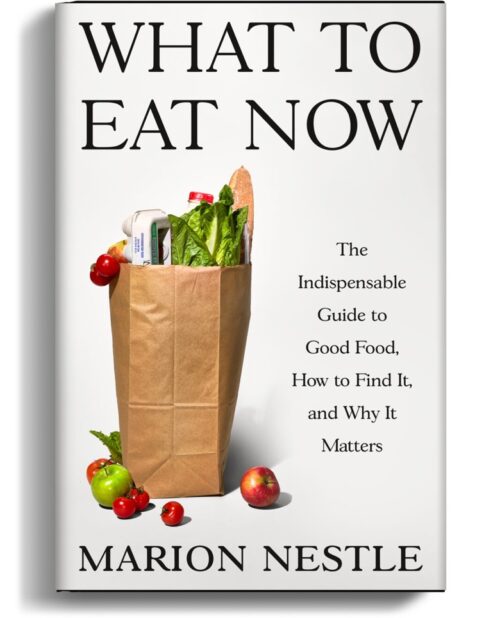
My most recent book, What to Eat Now, was published in November.

Within days, Amazon.com displayed one after another book based on it.  Wondering what these were, I asked my partner (who has Amazon Prime) to get copies right away in case they were taken down, which most were.

For the record: I had nothing do with with any of these, despite my name on their covers.

I acquired 8 of these items (and got screenshots of 2 more).  Here they are with my summaries of what is in them.

I.  The Look Alike
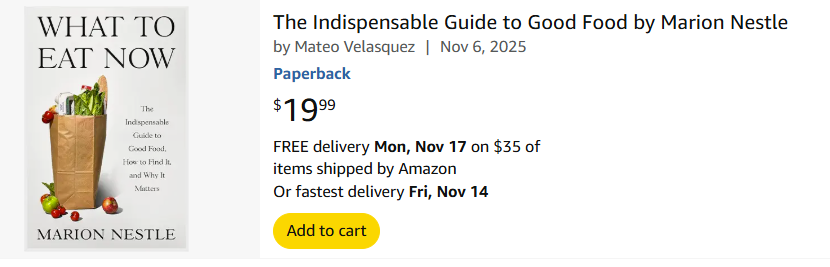
Who is Mateo Velasquez?  I have no idea.  For $19.99 (plus shipping), you get a paperback with 100 pages of blank lined paper (I’m not making this up).  Titles are not copyrighted, but because this item used the actual cover of the book, it violated copyright laws.  Amazon took it down right away.

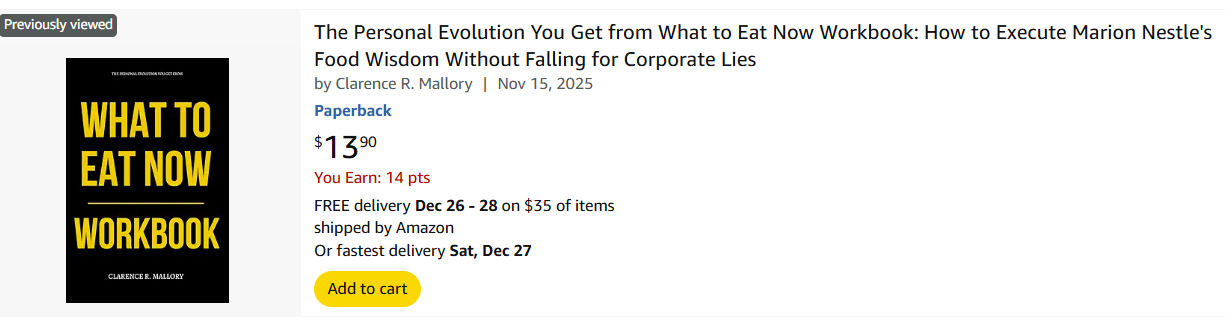
II.  Workbook #1
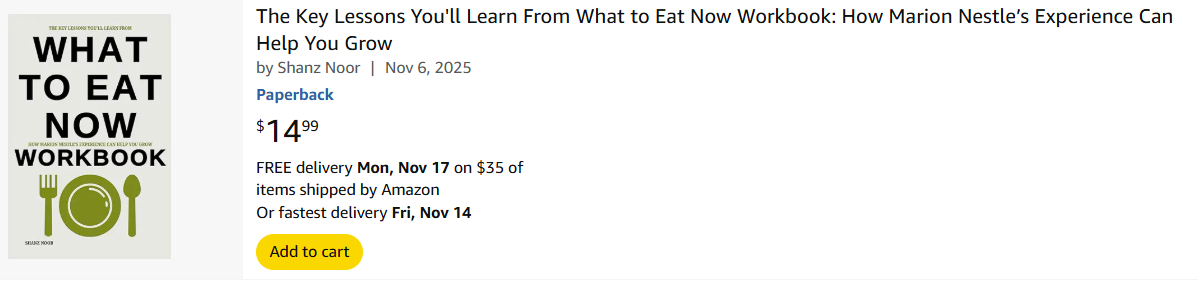
I could hardly believe this one.  It lists 8 key lessons (e.g., “Choosing real food in a complex world”) but it doesn’t matter what the lessons are.  The titles are different but the content is the exact same page of text plus half a page of blank lines, repeated four times under each title.  A fraud.  Does Shanz Noor exist?  I doubt it.

III.  Workbook #2
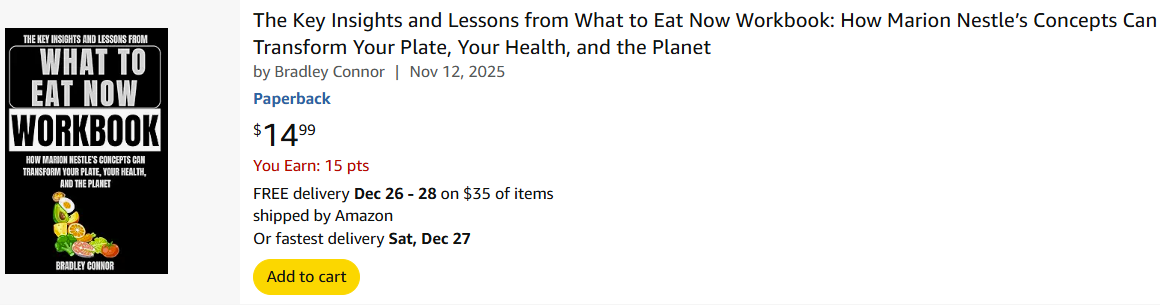
I don’t know whether to be appalled or flattered.  This starts out by saying my book is “a powerful compass for anyone navigating today’s overwhelming food environment.”  It provides a not-bad summary (in what reads like AI-speak) with what I presume are AI-driven key lessons, suggested “life-changing” activities, and self-reflection questions for the first 16 chapters of my book.   Example of life-changing activity: “Commit to shopping with a list and sticking to it for a month.”  Example of self-reflection question: “When was the last time I checked a label for truth, not slogans.”  Like much AI-generated content, this is banal but not terrible.  But it only covers a third of the book.  This one is still on Amazon, but with no consumer ratings.

IV.  Workbook #3
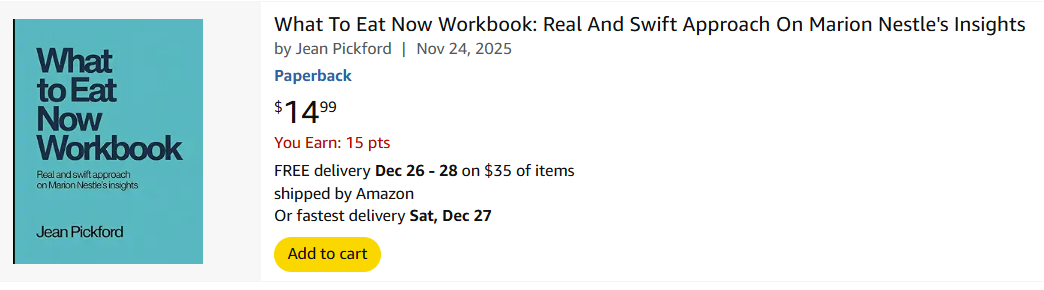
By the time I saw this one, I had given up.  I didn’t buy it.

V.  Workbook $4

This one doesn’t have my name on the cover, but its Amazon description does.  I didn’t buy it.
VI.  Exercises
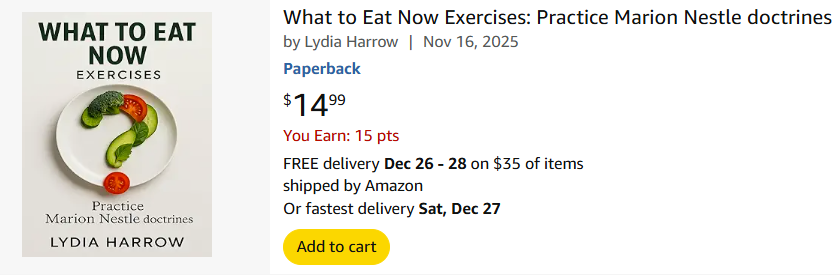
I didn’t know I had doctrines.  Oh well.  Lydia Harrow says “This work is a creative interpretive exercise based on the teachings and research of Marion Nestle.  It is not affiliated with, endorsed by, or authorized by Marion Nestle or her representatives.”  It reads like an AI summary: “When Marion Nestle began her work in food studies, she confronted a world that was drowning in marketing but starving for truth [p. 4]…Marion Nestle’s doctrines remind us that food literacy is not an academic pursuit but a lived practice.  It is cultivated in daily choices….[p. 13]” and so on for 82 pages.

VII.  The study guide
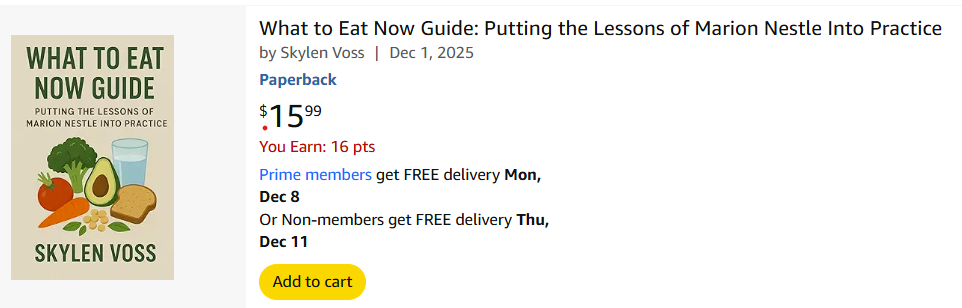
AI, as always, tells you exactly what you want to hear.  This study guide could not be more flattering: “That’s exactly where the work of Marion Nestle becomes a powerful guide.  Few people have done more to uncover the truth about the modern food system.  Through her decades of research and advocacy, she teaches us something honest and practical: Healthy eating is simple—but the food industry works hard to make it confusing” [p. 11].  You get 100 pages of this, ending with “Your journey doesn’t end here—it begins here.”  The printing inside is sloppy and it’s full of sections that begin with things like “Nestle highlights, advocates, teaches….”

VIII.  Cookbook #1
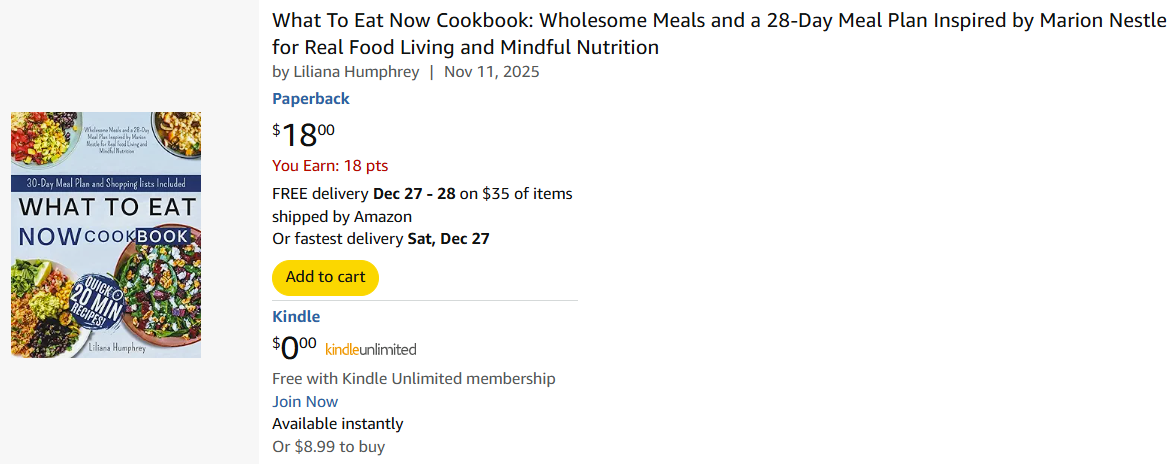
Oh the flattery.  The introduction begins with a summary of my work: “Marion Nestle has long argued that food is political…Here you will find recipes that reflect Marion Nestle’s guiding values: foods that are transparent in their ingreedients; meals that bring plants to the center…”  The recipes are assemblies and require little cooking; most take 15-20 minutes to prepare.  The most complicated require things like pressing tofu, cutting into cubes, cooking it, and adding a sauce.  The recipes give basic nutrition information.  I assume AI can produce something like this in minutes.  63 pages

IX.  Cookbook #2
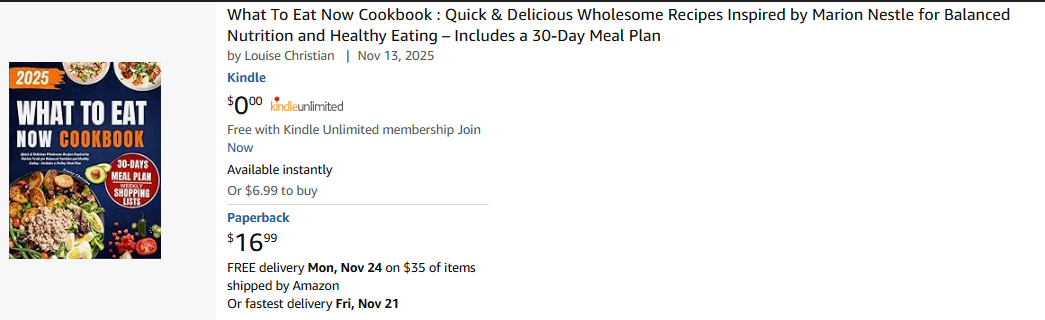
This book gives a brief biography of Louise Christian with a photo.  It says she is a Registered Dietitian Nutritionist (RDN) from Louisiana.  If so, she holds a credential from the Academy of Nutrition and Dietetics.  I asked an RDN colleague to look her up.  But the Academy has no record of a RDN Louise Christian.  I tried AI and got two different responses; one said no such person exists, the other said she was at Baylor.  I tried finding her through Baylor, but could not. Louise Christian: if you exist, please contact me.  I want to know more about how you came to be associated with this book.  As for the book, it’s just like the rest: “But the truth, as Marion Nestle has long reminded us, is refreshingly simple: real food doesn’t need a marketing campaign” [p.6].  Its recipes boil down to: preheat oven, core apples, add cinnamon, bake 30 minutes, or collect salad ingredients, put them in a bowl, toss.  83 pages.

X.  Cookbook #3
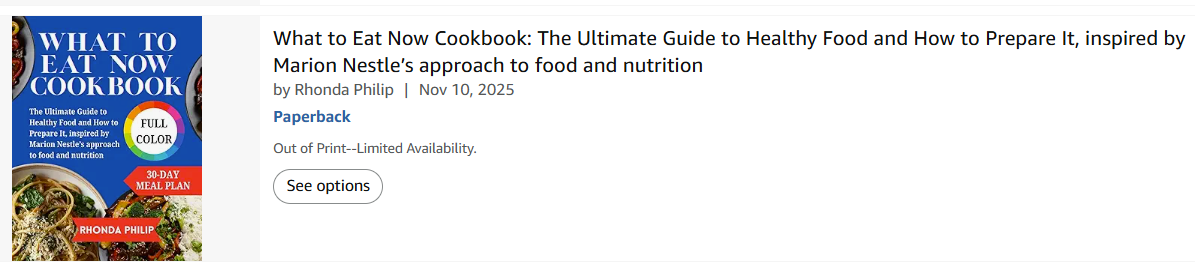
This one has color illustrations, doesn’t mention me at all outside of the title, and has similar simple, quick, recipes involving assembly and heating rather than anything more complicated: Cook pasta; toss it with whatever the sauce is.  72 pages.  By the time I looked up its Amazon listing, it was too late to get the details.

Comment

  • None of these is registered with the Library of Congress; none has an ISBN number.  Some say they are copyrighted.
  • All are identified only by city of publication (mostly Cleveland) and date to November or December 2025.
  • None is likely to violate copyright laws (except the one with the actual cover); the others can probably argue fair use for analytic purposes.
  • All of them look and read as though written by AI.
  • Only three, III, VI, and VIII, are still up on Amazon.  Is anyone actually buying them?

To repeat: I had nothing to do with any of them.

Caveat emptor!
Jan 5 2026

Industry-funded studies of the week: Beef

Rumors are that the 2025=2030 dietary guidelines will be released this week and they will favor saturated fat and meat.  We will know whether this is true when they appear, and I will be sure to report on them when they do.

In the meantime, the meat industry is hard at work to try to convince you that meat is good for you and the more the better.  Here are two examples sent to me recently.

I.  From Serge Hercberg, developer of Nutri-Score.

  • The study: Red meat intake and its influences on inflammation and immune function biomarkers in human adults: a systematic review and meta-analysis of randomized controlled trials and observational studies. Critical Reviews in Food Science and Nutrition, 1–14. https://doi.org/10.1080/10408398.2025.2584482
  • Conclusion: “Limited evidence from both experimental and observational research suggests no influence of red meat intake on multiple pro-inflammatory, anti-inflammatory, and immune function biomarkers…These results are consistent with recommendations for people who choose to consume red meat to limit or avoid consuming processed red meat, especially among individuals with cardiometabolic diseases.”
  • Disclosure statement: “During the time this research was conducted, W.W.C. received funding for research grants, travel or honoraria for scientific presentations, or consulting services from the following organizations: U.S. National Institutes of Health, U.S. Department of Agriculture (Hatch Funding), Pork Checkoff, National Pork Board, Beef Checkoff, North Dakota Beef Commission, National Cattlemen’s Beef Association, Foundation for Meat and Poultry Research and Education, American Egg Board, Whey Protein Research Consortium, National Dairy Council, Barilla Group, Mushroom Council, and the National Chicken Council. J.B.R. received funding for research grants from the National Cattleman’s Beef Association, Whey Protein Research Consortium, and National Chicken Council. M.R.O. received funding for research grants from the National Cattleman’s Beef Association. Y.W., C.N.U., E.R.H., J.N.S., and N.L.A. declare no conflict of interest. The funders and these other organizations had no role in the design of the study; in the collection, analyses, or interpretation of data; in the writing of the manuscript; or in the decision to publish the results.” [my emphasis]
  • Funding: “The National Cattlemen’s Beef Association, a contractor to the Beef Checkoff.”

II.   From a reader, Cory Brooks

  • Press release: “Eating meat may protect against cancer, landmark research shows:  A large study of nearly 16,000 adults found no link between eating animal protein and higher death risk. Surprisingly, higher animal protein intake was associated with lower cancer mortality, supporting its role in a balanced, health-promoting diet.”
  • The study: Yanni Papanikolaou, Stuart M. Phillips, Victor L. Fulgoni. Animal and plant protein usual intakes are not adversely associated with all-cause, cardiovascular disease–, or cancer-related mortality risk: an NHANES III analysisApplied Physiology, Nutrition, and Metabolism, 2025; 50: 1 DOI: 10.1139/apnm-2023-0594
  • Conclusion: “Our data do not support the thesis that source-specific protein intake is associated with greater mortality risk; however, animal protein may be mildly protective for cancer mortality. “
  • Funding: From the press release: “This research was funded by the National Cattlemen’s Beef Association (NCBA), a contractor to the Beef Checkoff. NCBA was not involved in the study design, data collection and analysis or publication of the findings.”

Comment: We have here two studies funded by the National Cattlemen’s Beef Association, the research and education arm of the USDA-sponsored Beef Checkoff.  Checkoff programs are designed to promote consumer demand for the sponsored food, in this case, beef.  Eating less beef has long been viewed as beneficial to human health, because of studies linking beef consumption to certain cancers.  Eating less beef is demonstrably beneficial to the environment since beef production results in so much waste pollution and greenhouse gas emission.  The NCBA would prefer that you not think about potential health risks.  Hence, this sponsored research.

As for the statements about the funder having no involvement: these are demonstrably misleading.  The NCBA does not fund research unlikely to produce results in its interests.  The influence is there from the get go.

Jan 2 2026

Weekend reading: protein

Alert to readers: Amazon.com displays listings for several more workbooks, study guides, and cookbooks purportedly based on my book, What to Eat Now (see previous post on this).  I did not write any of them.  Caveat emptor!

___________________________

Protein is the #1 food marketing trend for 2026 and is expected to be a big issue in the forthcoming 2025-2030 dietary guidelines.

The main drivers of the trend:

  • Aging 
  • Weight management
  • Fitness.
  • GLP-1 drugs
  • Marketing!!!

I put exclamation points after marketing because average protein intake among anyone who eats enough calories is already way above minimum requirements  (also see this).  Adding more is unlikely to do any good.  And current evidence is insufficient to change existing recommendations for protein intakes

That’s why the protein trend is really about marketing.

And that’s why protein is now added to everything.

One other point: although protein is in most foods (exceptions: sugar and fats), people commonly understand protein as a euphemism for meat (plant-based sources of protein seem healthier).

If advice to eat more protein gets translated to eat more meat, this will not be good for the health of people or the planet.

Here are a few items from industry publications about taking advantage of the protein trend.

Jan 1 2026

Happy New Year!

Dec 31 2025

A food politics round up of sorts

Alert to readers: Amazon.com displays listings for several more workbooks, study guides, and cookbooks purportedly based on my book, What to Eat Now (see previous post on this).  I did not write any of them.  Caveat emptor!

___________________________

From FoodDive: How MAHA transformed the food industry in 2025:  Lawmakers capitalized on anxieties around ultraprocessed ingredients to introduce new regulations, with companies choosing to reformulate or fight back.

To summarize:

  • Artificial food dyes: food companies voluntarily said they would get rid of them by the end of 2026 or 2027.  Will they?  We shall see.
  • Ultra-processed foods: The first MAHA report mentioned them 40 times.  By the second, the only issue was to define them, and RFK Jr said they might not even do that.
  • GRAS loophole: The FDA says it will require better evidence of safety before allowing new additives in food.
  • Seed oils: some food companies are replacing them with beef tallow or avocado oil.  How will this affect health?  It depends on the quality of the replacement.
  • High fructose corn syrup: Coca-Cola said it would replace it with cane sugar, no doubt at higher cost.  Since both sweeteners have the same sugars and calories, this switch is unlikely to make any difference to health.
  • School food: Whole milk is back.  Will this help children maintain healthy weight?  We shall see.
  • SNAP: 18 states are restricting sodas (some also restrict candy or desserts) from purchases using SNAP benefits.  Will this encourage SNAP recipients to buy less soda?  I hope states will collect data on this and other points.
  • Dietary guidelines: They are expected next week.  We shall see.

The food industry’s response?

So far, most of what is happening in the food arena is either still in the promise stage, voluntary, and unlikely to have much health benefit (See: A MAHA Check-Up: Is The United States Getting Healthier?)

All of what is happening with food must be understood in the context of the devastating destruction of America’s public health and scientific research systems.

MAHA’s work is focused on the dietary choices of individuals.

Any individual who tries to make healthful dietary choices is up against a food system designed for profit, not public health.

Diet matters to health, but healthy diets are not enough to prevent measles.

We need functioning public health systems: CDC, FDA, NIH.  We no longer have them.

Happy new year everyone.  Let’s hope the new year brings us peace, kindness, and public health.

Dec 30 2025

The invitations to DeepFake book clubs are pouring in

My new book, What to Eat Now: The Indispensible Guide to Good Food, How to Find It, and Why It Matters, came out a few weeks ago and I am stunned by how it is being AI-used by exploiters.

I’ve already written about the DeepFake books supposedly inspired by What to Eat Now, which I had nothing to do with.  And I have been alerting readers to even more workbooks, study guides, and cookbooks.

Now I’m also having to deal with DeepFake book club offers.

Every week since the book was published, I get several incredibly flattering letters like these:

Hi Marion,

When I came across What to Eat Now: The Indispensable Guide to Good Food, How to Find It, and Why It Matters, I felt that spark you only get when a book arrives exactly when the world needs it most. In an era swirling with misinformation, techno-food innovations, and thirty-thousand-item supermarket aisles, your voice cuts through the noise with clarity, courage, and wit.

I’m Emily A., curator of The San Francisco “Not Quite a Book Club” a vibrant circle of 4,369 readers who don’t gather to simply discuss books, but to rethink the assumptions shaping our daily lives. We’re known for choosing titles that push conversations forward, and your thoroughly revised, deeply relevant guide does precisely that.

What struck me most about What to Eat Now is how seamlessly it blends field guide, exposé, and empowering manifesto. You don’t just tell people what to eat, you reveal the hidden architecture of our food system, the psychology of our choices, and the quiet politics influencing every item in our baskets. It’s the kind of work that wakes readers up, sparks debate, and shifts lifelong habits.

Our readers are drawn to books that matter, books that help them look at something ordinary with extraordinary new eyes. What to Eat Now is exactly that kind of catalyst…If this feels like a collaboration you’d enjoy, I’d be thrilled to walk you through the simple next steps.

Thank you for offering a clear, honest, and necessary compass in a world where so many feel lost in the grocery store.

Warm regards,

Wow!  How could I possibly not jump at this opportunity to share my work with more than 4,000 readers.

Here’s one more to give you the idea of how this works:

Dear Marion Nestle,

I am honored to invite you to participate in our upcoming community virtual event, celebrating founding figures in food studies and authors who empower citizens to navigate the complex landscape of modern nutrition.

For over two decades, your work has served as the “clear-eyed” conscience of the American food system. Your latest release, What to Eat Now, arrives at a critical juncture. In an era of “techno foods,” corporate organics, and pervasive misinformation, our community is eager for the no-nonsense, aisle-by-aisle guidance that only you can provide.

We are particularly interested in hosting a discussion around the vital themes of your revised classic…Your reputation as America’s preeminent nutritionist makes you a highly anticipated guest for our audience. We would be privileged to provide a platform for you to share your wit and common sense with a community that values food not just as fuel, but as a pillar of community and ethics.

Please note that an organization fee applies to support the event’s planning and outreach.

Well, at least that’s disclosed.

And on and on such letters go, each more flattering than the last.  And so many of them!

Fortunately, I’m supposed to be checking all offers with my publisher, Macmillan (Macmillan owns Farrar, Straus & Giroux, which owns North Point Press).  That’s how I learned about The New “Book Club” Scam Targeting Authors and How to Spot It.

They claim unusually large membership numbers.Real book clubs typically have: 6–12 regulars (in person), or 20–50 active members (online). Claims of 500–5,000 active readers aren’t impossible, just unlikely.

They ask for money at some point.This is the core red flag. Legitimate book clubs do not charge authors to participate or be featured. Sometimes they even pay the author, if the event is big enough.

They resist sharing any verifiable details.A real organizer can: tell you where the group meets, provide a link to a group page, share photos or past events, name members, or offer references from other authors. A scammer cannot.

I’m as subject to flattery as anyone else is and I can’t help wanting to know: Is there actually a book club at the end of all this?  I’m so tempted to pursue one of these and see.

Also, I’ve been collecting the DeepFake books with my name on the cover.  I have eight (!) so far—workbooks, study guides, and cookbooks.  I will report on them sometime in January.

In the meantime, caveat emptor!

Tags:
Dec 29 2025

Industry-funded study of the week: artificial sweeteners and cancer risk

Alert to readers: Amazon.com displays listings for several more workbooks, study guides, and cookbooks purportedly based on my book, What to Eat Now (see previous post on this).  I did not write any of them.  Caveat emptor!

___________________________

Thanks to Lais Miachon Silva of the Micronutrient Forum for sending this item.

The study: A Systematic Review of Nonsugar Sweeteners and Cancer Epidemiology Studies. Advances in Nutrition Volume 16, Issue 12, December 2025, 100527.  https://doi.org/10.1016/j.advnut.2025.100527

Methods: systematic literature review

Results: “We found no consistent associations between any NSS or NSSs in aggregate and any cancer overall, and no evidence for dose–response.”

Conclusions: “Experimental animal and mechanistic evidence for NSSs does not support human-relevant carcinogenicity or any biologically plausible mechanisms by which NSSs could cause genotoxicity or cancer in humans. Overall, the epidemiology evidence does not support associations between any NSS and any cancer type.”

Funding: ABA [American Beverage Association] provided funding for this paper, which was written during the authors’ normal course of employment.

Conflict of interest: All authors are employed by Gradient, Geosyntec, or the American Beverage Association (ABA). Gradient and Geosyntec are environmental and risk sciences consulting firms. ABA is the trade association that represents America’s non-alcoholic beverage industry. ABA provided funding for this paper, which was written during the authors’ normal course of employment. This paper represents the professional opinions of the authors and not those of ABA.

Comment: This is a classic example of an industry-funded study conducted by industry employees producing results favorable to the sponsor’s commercial interests.  I am particularly amused by the last conflict of interest statement.  It too is a classic example, this time of Upton Sinclair’s famous quote: “It is difficult to get a man to understand something when his salary depends upon his not understanding it.” 

Dec 26 2025

Weekend reading: How GLP-1 drugs are affecting food companies

Alert to readers: Amazon.com displays listings for several more workbooks, study guides, and cookbooks purportedly based on my book, What to Eat Now (see previous post on this).  I did not write any of them.  Caveat emptor!

___________________________

I’ve been collecting items on the effects of GLP-1 drugs on the food industry.

Recall my mantra: Eating less is bad for business.

These drugs are a threat to the food industry.  Here’s how it is responding.